Best Lightweight Lithium Trolling Motor Batteries for Boats
Finding the right lightweight lithium battery for a trolling motor hinges on portability, reliability, and long life in marine settings. This guide highlights five top options that balance weight, cycle life, and protection features. Each product is suited for different boat sizes and power needs, from compact fishing craft to larger vessels. Read on to compare best-for scenarios, supported by practical buying considerations and a concise product table.
| Product | Best For | Key Benefit |
|---|---|---|
| SUPER EMPOWER 12V 100Ah LiFePO4 | Compact trolling setups and RV/marine auxiliary power | Drop-in replacement with robust BMS |
| Litime 12V 100Ah (Group 31) | Lightweight, high-durability marine use | Low-temp protection and 15k cycles at 60% DOD |
| GOKWH 12V 100Ah (Bluetooth) | On-the-water monitoring and expandable systems | Bluetooth app for real-time status |
| DC HOUSE 12V 100Ah (Group 24) | Bluetooth monitoring and cold-weather protection | Low-temp cut-off and 15k cycles |
| GRENERPOWER 12V 100Ah (Group 24) | Home energy storage and RV/marine use | Long cycle life with 100A BMS |
Note: All listed batteries are designed for energy storage and trolling-motor use, not engine starting. They emphasize deep-cycle operation, high cycle counts, and BMS protection to handle marine conditions and varying temperatures.
SUPER EMPOWER 12V 100Ah LiFePO4 Battery

- Best for: Small-to-medium trolling setups and mobile power in RVs or boats. It serves well as a primary auxiliary battery or house power source.
- Why selected: Drop-in Group 24 form factor with 100Ah capacity and integrated BMS protecting against overcharge, over-discharge, short circuits, and temperature extremes.
- Limitations: Not intended for engine starting or cranking applications.
Litime 12V 100Ah Trolling Motor LiFePO4 (Group 31)
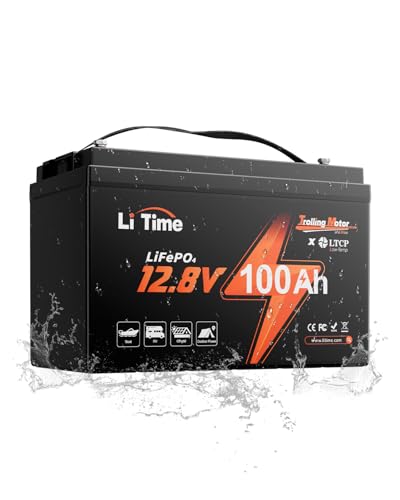
- Best for: Light, fast boats needing a lighter, robust 12V power source with strong cold-weather protection.
- Why selected: 22.16 lbs, Group 31 size, and triple ABYC-style protection with a built-in 100A BMS; smart low-temp protection prevents cold-damage.
- Limitations: Ensure compatibility with your trolling motor’s charging profile and BMS settings.
GOKWH 12V 100Ah LiFePO4 Marine Battery with Bluetooth

- Best for: On-the-water monitoring and scalable systems for longer trips.
- Why selected: 1280Wh capacity with Bluetooth 5.0 for live monitoring of SOC, voltage, current, and temperature; supports expansion for larger setups.
- Limitations: Bluetooth range depends on environment; ensure your phone has compatible app access.
Litime 12V 100Ah Trolling Motor (Bluetooth, Group 31)

- Best for: Boat owners who want Bluetooth monitoring and strong cold-weather protection in a compact package.
- Why selected: 100A BMS, low-temp protection, and 15k cycles at 60% DOD; IP-rated protection helps in damp marine environments.
- Limitations: Bluetooth setup requires a compatible device and app.
BUKNUWO 12.8V 100Ah LiFePO4 Battery

- Best for: Marine and RV users seeking high energy density in a compact footprint.
- Why selected: 12.8V design with 1.28kWh capacity, lightweight (about 22 lbs), and high cycle life with 100A BMS; expandable in series/parallel up to 51.2V 400Ah.
- Limitations: Verify compatibility with your charging system’s LiFePO4 mode and expansion plans.
Litime 2-Pack 12V 100Ah Trolling Motor LiFePO4

- Best for: Dual-battery setups needing synchronized monitoring and protection.
- Why selected: Bluetooth monitoring, low-temp protection, and 20+ safety protections; designed for reliability in marine environments.
- Limitations: Ensure both batteries are balanced in parallel configurations for optimal performance.
Buying Guide: Key Considerations for Lightweight LiFePO4 Trolling Motor Batteries
How do you choose between a 100Ah LiFePO4 pack and a higher- or lower-capacity option? The main factors include weight, cycle life, BMS protections, and compatibility with your trolling motor and charging setup. If you need the lightest option for a small craft, prefer Group 31 or Group 24 models with robust BMS. For longer days on the water, prioritize higher cycle life and expansion capabilities.
What matters in a marine LiFePO4 battery? Look for low-temperature protection, automatic cutoffs, IP rating for moisture exposure, and a BMS that guards against overcharge, over-discharge, and short circuits. Bluetooth monitoring can add convenience on the water, but ensure you can access the app reliably from your deck.
Is a drop-in replacement important? A true drop-in drop-in for Group 24 or 31 sizes simplifies installation, often requiring no wiring changes. Check dimensions, weight, and terminal types (M8 or similar) to ensure compatibility with your current battery box and connections.
Expandable systems offer future-proofing. Some models support series/parallel expansion up to higher voltages, enabling larger setups for solar or home energy storage beyond trolling motors. Plan for future needs to avoid re-wiring later.
FAQ
- Q: Do these batteries work with standard trolling motors? A: They are designed for trolling motors and marine electronics, with appropriate BMS protection and voltage compatibility.
- Q: How long will they last on the water? A: Deep-cycle LiFePO4 batteries can deliver thousands of cycles, often around 5,000+ cycles at 100% DOD and more at higher DoD levels, depending on the model.
- Q: Can I use Bluetooth monitoring on the water? A: Yes, several models offer Bluetooth or app-based monitoring for real-time status updates.
- Q: Are these suitable for cold climates? A: Many include low-temperature cutoffs to protect the battery during charging and discharging in cold weather.
- Q: Do they replace lead-acid batteries directly? A: Many are designed as drop-in replacements for Group 24 or Group 31 lead-acid batteries, with higher energy density and longer life.
- Q: What maintenance is required? A: LiFePO4 batteries require minimal routine maintenance beyond ensuring proper charging and storage conditions per manufacturer guidance.