Best LED Street Light Lamps for Outdoor Lighting
Answering the search for reliable outdoor illumination, these LED street light lamps deliver bright, energy-efficient options for driveways, gardens, sidewalks, and parking areas. The top picks cover commercial-grade shoebox fixtures, solar-powered security lights, and high-wefficiency corn bulbs. This guide helps buyers choose based on installation type, power source, and environmental conditions. Ideal buyers include facility managers, homeowners upgrading outdoor lighting, and those seeking off-grid solar options.
| Product | Type | Best For |
|---|---|---|
| MIHEAL Ultra-Thin 30W Flood Light | LED Flood Light | Small-to-mid outdoor spaces; garages and gardens |
| ledmo 200W Parking Lot Lights (3-Pack) | LED Shoebox Light | Parking lots and large areas |
| JWT 2 Pack Solar Street Lights | Solar Street Light | Off-grid areas; eco-friendly projects |
| JWT 4 Pack Solar Street Lights | Solar Street Light | Large outdoor spaces; multi-lot setups |
| XYCN 2 Pack 36W Corn Light Bulb | LED Corn Light | Houses and small spaces; retrofit projects |
Before you buy, consider: installation type (hardwired vs. solar), brightness needs (lumens), daylight color (Kelvin), weather durability (IP rating), and energy savings. The following sections profile five relevant options and clarify who each is best for.
MIHEAL Ultra-Thin 30W Flood Light Review

Best for compact outdoor spaces requiring bright, pointed illumination. This 30W model delivers high luminous efficiency and an IP68 rating for indoor or outdoor use, including gardens, yards, warehouses, and gates. The design supports long life with minimal maintenance.
- Best for: small to medium outdoor areas where water resistance is essential
- Why selected: compact, durable, and energy-efficient flood light
- Caution: outdoor mounting should ensure proper sealing to maintain IP68 integrity
ledmo 200W Parking Lot Lights

Best for large outdoor areas like parking lots or stadium perimeters. These 200W shoebox-style fixtures deliver 26,000 lumens at 5000K and feature a dusk-to-dawn photocell for automatic operation, with heat-dissipation design for sustained performance.
- Best for: wide-area lighting with automatic on/off based on ambient light
- Why selected: high brightness and smart control reduce energy use and labor
- Caution: mounting height and spacing should align with lumen coverage to avoid hotspots
JWT Solar Street Lights 2-Pack

Best for off-grid applications and eco-friendly projects. These solar-powered lights provide wide-area coverage with 60,000 lumens at 6500K and a weather-tough ABS housing with a durable aluminum bracket, designed to operate in varied temperatures.
- Best for: off-grid or eco-conscious installations
- Why selected: reliable solar charging and long runtime without external power
- Caution: performance depends on sun exposure; cloudy days reduce runtime
JWT 4 Pack Solar Street Lights

Best for large outdoor layouts or multi-lot sites that need uniform lighting. This 4-pack set mirrors the 2-pack’s brightness and efficiency, expanding coverage with all-weather durability and solar charging capabilities.
- Best for: expanding lighting in larger outdoor areas
- Why selected: scalable solar solution with broad illumination
- Caution: ensure adequate sun exposure for maximum performance
XYCN 2 Pack 36W Corn Light Bulbs
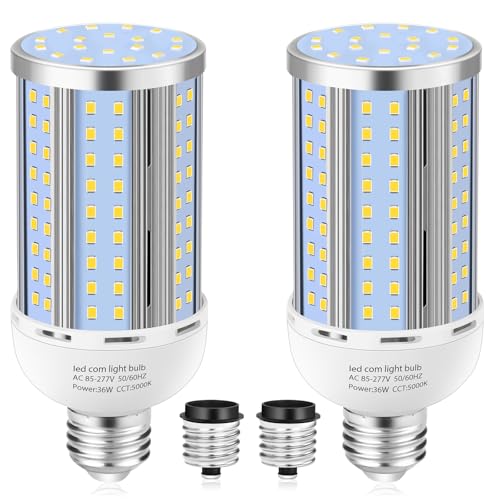
Best for retrofit projects and area-wide illumination with omnidirectional light. These 36W corn lights claim high lumen output per watt, suitable for outdoor and indoor spaces requiring broader light spread and quick instant-on performance.
- Best for: replacing higher-wattage bulbs in existing fixtures
- Why selected: high efficiency and wide beam for broad coverage
- Caution: ensure base compatibility (E26/E39) with existing fixtures
Buying Guide
What kind of outdoor lighting do you need?
Decide between wired or solar options. Wired flood lights provide steady power and predictable performance, while solar lights offer off-grid operation and easy installation in locations without electrical access.
How much brightness and coverage are required?
Brightness is measured in lumens. For streets and parking areas, aim for higher lumens (50,000–240,000 lm for large lots). Consider beam angles to avoid dark corners and overlapping zones.
What color temperature is best?
Daylight white (5000–6500K) is common for outdoor safety and visibility. Warmer tones (2700–3500K) are more inviting for residential spaces but may reduce perceived brightness.
Durability and weather resistance
Look for IP ratings (IP65+ for wet locations) and sturdy housings. Outdoor lights should resist rain, dust, and temperature swings without performance loss.
Installation and maintenance considerations
Solar lights reduce wiring and utility dependencies but require sufficient sun exposure. Wired fixtures demand professional or compliant DIY installation with appropriate mounting hardware.
Energy efficiency and long-term cost
Higher initial costs for efficient LEDs pay back through reduced electricity usage and longer lifespans. Check lumen-per-watt (lm/W) and overall system efficiency when comparing options.
FAQ
- What is the main difference between solar and wired LED street lights?
- How many lumens should I choose for a parking lot?
- Can I mix solar and wired lights in the same area?
- What maintenance is expected for these LED lights?
- How do I know which fixture fits my mounting height?
- Are LED street lights energy-saving compared to traditional bulbs?
Solar lights run on stored battery power and don’t require electrical wiring, while wired lights rely on mains power for uninterrupted operation.
Lighting requirements vary by area, but large parking lots commonly use fixtures delivering tens of thousands of lumens per fixture to ensure uniform coverage.
Yes, but ensure consistent color temperature and brightness to avoid mismatched lighting effects and safety concerns.
LEDs typically require minimal maintenance, mainly periodic cleaning and checking seals on weatherproof housings to preserve IP ratings.
Higher mounting heights require higher lumens and wider beam angles to cover ground effectively. Follow manufacturer recommendations for spacing and height.
Yes. LEDs typically use significantly less power for the same or greater brightness, producing substantial energy savings over time.