Best LED T8 Tube Series for Split Lighting: 8ft Models Compared
Answering the common buyer question: which 8-foot LED T8 tube solutions deliver split, versatile lighting for large spaces? This guide highlights five 8ft LED shop lights with T8-integrated designs that support easy plug‑and‑play wiring or ballast bypass, strong brightness, and long life. Best for garages, workshops, warehouses, and barns where high-output, energy efficiency, and simple installation matter most. The featured products are selected for users who want straightforward installation, reliable performance, and clear lighting without complicated rewiring.
| Product | Best For | Key Benefit |
|---|---|---|
| Phiwicsh 10-Pack 8ft LED Shop Light Fixture | High-output garages and long runs | 270° V‑shape distribution, 12,000 lm per light |
| Henwsi 8FT LED Shop Light Fixture | Budget-conscious large spaces | 72W, 9,500 lm with energy savings |
| SHOPLED 8FT Shop Light 100W 15,000 lm | Industrial wear and tear environments | ETL-listed, 50,000 hour life, 24/7 capable |
| JESLED 4FT LED T8 Type A+B Tube (4-Pack) | Upgrading existing T8 fixtures | Ballast-compatible or ballast-bypass options |
| PARMIDA 4FT LED T8 Hybrid Tube | Flexible installation with or without ballast | Single or double-ended, 18–20W, 2200 lm |
Phiwicsh 8ft LED Shop Light Fixture – 90W, 12,000 lm
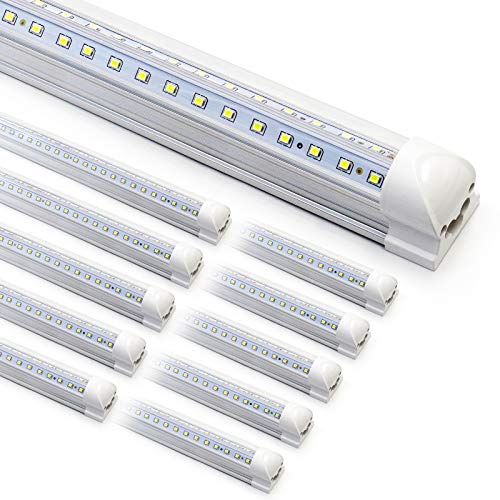
Best for: large garages and workshops that require maximum brightness and wide coverage. This fixture uses a V-shaped 270-degree design to deliver broad illumination along entire workspaces. It provides up to 12,000 lumens per light with an energy use of 90W, matching high-output needs in commercial or hobby spaces.
Selected for its high lumen output and seamless 4-piece linking capability, making long runs easier. A potential limitation is wiring complexity when expanding beyond four linked units; ensure proper daisy-chaining and power planning in large installations.
Henwsi 8FT LED Shop Light Fixture – 72W, 9,500 lm

Best for: users seeking energy savings with substantial brightness in an 8-foot form factor. Each unit emits at least 130–135 lm/watt, delivering ~9,500 lumens while consuming 72W. It’s designed for easy plug‑and‑play installation and can be linked in series to reduce wiring time.
Choose this if you prioritize a balance between brightness, efficiency, and cost. A note: ensure compatibility with your existing mounting hardware and connectors when expanding multiple fixtures in tight spaces.
SHOPLED 8FT Shop Light – 100W, 15,000 lm

Best for: commercial spaces that demand consistent, flicker-free lighting across large areas. The unit delivers 15,000 lumens at 100W with a 50,000-hour lifespan and is engineered for 24/7 operation, with a robust design for warehouse or workshop environments.
Selected for reliability in heavy-use settings. Caution: some users may prefer higher lumen per watt efficiency depending on space needs; verify ceiling height and drive layout to optimize light distribution.
JESLED 4FT T8 Type A+B Tube – 24W

Best for: upgrading existing T8 fixtures with flexible power options. This tube supports Type A (ballast) and Type B (ballast bypass) configurations, with single- or double-ended power. It provides 3,200–3,600 lm per tube depending on setup and is available in a 4-foot length for retrofit projects.
Better for: projects where ballast compatibility is uncertain or where future ballast changes are anticipated. Limitation: 4-foot length may require more fixture endpoints to achieve desired coverage in oversized rooms.
PARMIDA 4FT LED T8 Hybrid Tube – 18–20W

Best for: flexible installations with or without a ballast. The tube is UL-listed and supports single-ended and double-ended connections, with 18W (no ballast) or 20W (with ballast) options and about 2,200 lm, enabling straightforward retrofit in various fixtures.
Selected for its versatility in mixed environments where ballast status may change over time. Limitation: verify tombstone compatibility in your fixtures to avoid installation issues.
Buying Guide: Key Considerations for 8ft LED T8 Tubes
- Plug‑and‑play vs ballast bypass: If you want quick setup with existing ballasts, choose Type A compatible tubes. If you plan to remove ballasts later or want maximum efficiency, consider Type B or hybrid options.
- Brightness and coverage: Look for higher lumens per unit (e.g., 12,000–15,000 lm per eight-foot tube in multi-light runs) and a wide beam distribution (270-degree V-shape) to minimize dark corners.
- Energy efficiency and lifespan: Prioritize tubes with long rated lifespans (tens of thousands of hours) and high lumens per watt to reduce operating costs over time.
- Installation and mounting: Confirm whether the fixture supports linkable setups (three to four units in a row) and ensure you have compatible connectors, clips, and power wiring.
- Environment suitability: For cold environments or extreme temperatures, check operating temperature ranges and flicker-free performance.
- Compatibility with existing tombstones: Some tubes require non-shunted or shunted tombstones; verify fixture compatibility to prevent improper lighting or safety issues.
Frequently Asked Questions
- What is the main difference between plug‑and‑play and ballast bypass tubes?
- Are 8ft LED tubes brighter than traditional fluorescent tubes?
- Can I connect multiple 8ft tubes in a single run?
- What should I consider when upgrading a large workshop?
- Do these tubes work in freezer or cold environments?
- Is color temperature important for workshop tasks?
Plug‑and‑play tubes work with existing ballasts, enabling a simple swap. Ballast bypass tubes require rewiring to remove ballast, often improving efficiency and reducing future maintenance.
Yes, many 8ft LED tubes provide higher lumen output with lower wattage, plus longer lifespans and more stable color rendering compared to traditional fluorescent tubes.
Yes, most 8ft LED shop lights are designed toLinkable up to several pieces in sequence. Follow the manufacturer’s guidance on maximum connected units to avoid voltage drop or wiring issues.
Consider total lumen requirement, space layout, ceiling height, and how evenly the light will distribute. Factor in energy savings, maintenance access, and future expansion needs.
Some models advertise operation in cold conditions; check product specifications for temperature ranges to ensure reliable performance in your space.
Yes. A 6500K (daylight) tone is common for workshops because it improves contrast and reduces eye strain during detailed tasks; 5000K–6500K is a common range for general use.