Best 200W LED Grow Lights for Indoor Plants
Choosing the right 200W LED grow light helps indoor gardeners optimize seedling vigor, vegetative growth, and fruitful harvests. This guide compares five top 200W options to help buyers select the best fit for tent setups, space constraints, and budget goals. Each product is analyzed for who it’s best for, why it stands out, and any practical limitations to consider.
Buyer snapshot: The following table summarizes key points for the five highlighted options to aid quick comparisons.
| Product | Best For | Why It Stands Out | Potential Limitation |
|---|---|---|---|
| VIVOSUN LumaLight 200W | Seedlings to bloom in mid-size tents | Full spectrum with 730nm far-red; smart dimming and app control compatibility | Requires GrowHub for remote automation (sold separately) |
| Spider Farmer SF2000 | All growth stages in quiet, energy-conscious setups | High efficiency LEDs, deep canopy penetration, silent operation | Some users may prefer built-in dimmer without external control |
| TheOneGrow MA2000 | Compact tents and beginners | High efficiency, daisy-chain option, easy installation | Coverage may vary with height adjustments |
| VIPARSPECTRA P2000 | Scalable grows with daisy-chain farms | New diode layout for uniform PAR and deep canopy | Requires careful height/distance setup for optimal spread |
| KINGLED KP2000 | 3×3 ft tents and indoor gardens | Veg and Bloom modes with strong spectral mix for multi-stage growth | All-in-one feature set may require familiarization |
VIVOSUN LumaLight 200W LED Grow Light

Best for: Seedlings through bloom in mid-sized grow tents. The LumaLight uses full-spectrum emitters across white, blue, red, and far-red diodes (3000K, 5000K, 660nm, 730nm). This setup supports photosynthesis from seed to harvest, potentially speeding flowering and increasing yields. The diode layout aims for uniform PPFD over the full coverage area, helping plants perform consistently from center to edge.
Why chosen: The combination of balanced spectrum, strong intensity, and plant-friendly red and far-red balance makes it a solid all-rounder for versatile indoor gardens. The 4-level dimming (25% to 100%) provides flexible lighting to align with growth stages.
Limitation: Remote automation requires the Vivosun GrowHub (sold separately). For a hands-off schedule, you’ll need the extra equipment.
FECiDA 2026 Upgrade Professional 200W

Best for: Growers in 2×2 ft tents seeking strong light output with energy-conscious operation. This model delivers up to 200 watts actual power with a full-spectrum design intended for all growth stages, including seed starting, veg, and flowering. Stepless dimming supports precise brightness control for varying growth needs and potential savings on electricity.
Why chosen: The 200W actual power rating and stepless dimming allow careful tuning of intensity to optimize growth while managing energy costs. The full spectrum is described as sunlight-like, which can support healthy plant development across stages.
Limitation: The data emphasizes higher output but does not detail active safety features or long-term reliability beyond stated capabilities; verify mounting and heat management in your setup.
Spider Farmer SF2000 200W
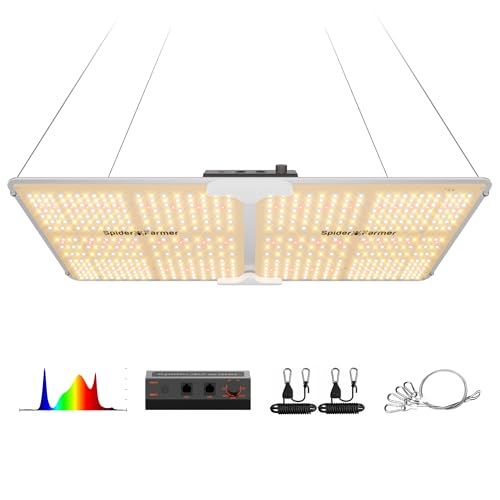
Best for: All growth stages in a quiet, energy-efficient setup. SF2000 uses upgraded LEDs with 2.7 µmol/J PPE and produces uniform full-spectrum light with deep canopy penetration. The light is fanless, enabling a silent operation which is advantageous in living spaces or recording areas.
Why chosen: The combination of high efficiency, uniform spectrum, and a strong canopy reach makes it a reliable option for growers prioritizing performance and low noise. It comes with a robust support framework and claims of high consistency across stages.
Limitation: The product emphasizes ongoing service and authenticity, which may mean ensuring you’re purchasing from an authorized seller to access promised support and warranty.
TheOneGrow MA2000 200W

Best for: Growers seeking a dimmable, daisy-chained solution for multiple lights in tents or vertical racks. The MA2000 combines full-spectrum light with a user-friendly dimming interface and easy daisy-chain integration for scalable setups.
Why chosen: It delivers a practical balance of efficiency and expansion capability. The daisy-chain feature helps scale lighting without adding complex control hardware, which is helpful for slightly larger setups or future expansion.
Limitation: Coverage and uniformity can vary with height and spacing; plan your canopy layout and adjust mounting height to maintain even light distribution.
KingLED KP2000 Growth Light

Best for: 3×3 ft tents and medium-sized indoor gardens. The KP2000 provides Veg and Bloom modes with a spectrum designed to support multiple stages, from seedlings to harvest. It aims to deliver strong PPFD across a 3×3 ft footprint.
Why chosen: The dual-mode setup (VEG and BLOOM) helps growers tailor light output to growth stage, while the comprehensive spectral mix supports diverse plant types—from leafy greens to fruiting crops.
Limitation: Users should maintain appropriate distance to avoid light stress, as higher brightness at close range can impact plant health if not managed properly.
Buying Guide: Key Factors To Consider
What size tent or growing space will you illuminate? For 2×2 ft to 2×4 ft tents, a 200W light with a balanced spectrum generally provides adequate PPFD across the canopy, but distance from plants and airflow affect performance.
Which spectrum matters most for your plants? A true full-spectrum includes red, blue, white, and some far-red or infrared wavelengths. Far-red (730–740nm) helps flowering responses in some crops, while UV can aid certain plant processes.
Do you need dimming or daisy-chain capabilities? Dimming lets you scale intensity through growth stages. Daisy chaining simplifies adding more lights for larger areas without extra controllers.
What about noise and heat? Light units with passive cooling or quiet fans reduce noise. Consider tent ventilation to manage heat buildup when multiple lights run together.
What is your budget and long-term plan? Higher efficiency LEDs can reduce electricity use and heat, potentially saving money over time. If you plan to expand, choose lights with scalable features like daisy chains or compatible hubs for automation.
FAQ
- What does 200W mean for grow lights? It refers to the electrical power draw under typical operation. Higher efficiency can yield more usable photons per watt.
- Can these lights replace natural sunlight? They are designed to supplement or replace artificial lighting indoors, especially in grow tents and indoor gardens with limited sun exposure.
- Is dimming necessary for all plants? Dimming helps tailor light to growth stages and plant sensitivity; seedlings often require less intensity than flowering plants.
- What is daisy chaining? It’s a method to connect multiple lights together so they share control, easing multi-light setups in larger grows.
- How do I space lights in a tent? Start with a height appropriate for your crop stage and adjust to avoid hotspots; monitor plant response and adjust accordingly.
- What should buyers verify before purchasing? Confirm spectrum, PPFD consistency, heat management, mounting hardware, and available control options to match your growing plan.