Best 10 Gauge Extension Cords for Highest Power Demands and Tough Outdoor Use
Yes—these are the best 10 gauge extension cords for demanding power needs. If you regularly run heavy tools, outdoor lights, or lawn equipment, a 10 gauge cord offers thicker conductors for safer, more stable power delivery and less voltage drop. This guide highlights five top options that emphasize durability, weather resistance, and clear visibility. It also explains who each cord is best for and why. For general outdoor lighting or light-duty tools, a lighter gauge may suffice, but for sustained high-draw devices, 10 gauge is the better choice.
The table below compares the five selected cords at a glance. Use this as a quick reference for choosing the best fit for your project.
| Product | Gauge | Length | Best For | Notable Benefit |
|---|---|---|---|---|
| POWGRN 25 Ft 10AWG Outdoor Extension Cord | 10 AWG | 25 ft | Heavy-duty outdoor jobs and landscaping | Extra-heavy duty, LED end indicator |
| PlugSaf 50 Ft 10 Gauge Outdoor Extension Cord with Light Indicator | 10 GA | 50 ft | Long reach with active power status | Three-prong, weatherproof, LED light |
| PlugSaf 50 Ft 10 Gauge Outdoor Extension Cord with Multiple Outlets | 10 GA | 50 ft | Powering multiple tools from one outlet | Three outlet splitter, ETL listed |
| HUANCHAIN 12 Gauge 25 Ft Outdoor Extension Cord | 12 GA | 25 ft | Budget-friendly outdoor use | Bright yellow for visibility, ETL listed |
| Deeklify 12 Gauge 50 Ft Outdoor Extension Cord | 12 GA | 50 ft | General outdoor power and garden tools | ETL/cETL certified, durable polyethylene sheath |
POWGRN 25 Ft 10AWG Outdoor Extension Cord

This 25-foot, 10-gauge cord is designed for heavy-duty outdoor use, including circular saws, lawn equipment, and construction tasks. It features a robust 10 AWG copper conductor, ETL/cETL listing, and a durable black jacket. The LED lighted end helps confirm power presence, and the jacket resists wear in harsh environments. Best for professionals and serious DIYers who need reliable performance over longer outdoor runs. Caution: the longer the run, the more important it is to fully unwind to prevent heat buildup.
PlugSaf 50 Ft 10 Gauge Outdoor Extension Cord with Light Indicator

Best for long outdoor runs where you need to monitor power status at a glance. This 50-foot, 10-gauge cord includes a light-indicator end to verify power delivery and has a rugged SJTW jacket rated for -40°F to 140°F operation. It’s well suited for landscapers, outdoor lighting setups, and construction sites. A limitation is that heavier-duty cords can be stiffer to coil at full length, which may affect storage and handling in tight spaces.
PlugSaf 50 Ft 12 Gauge Outdoor Extension Cord with Multiple Outlets

Although this is a 12-gauge option, it’s included for comparison because it adds multiple outlets and helps users see the trade-offs between gauge and functionality. It includes three outlets and an LED light end for power confirmation. Best for budget-conscious projects that still require outdoor resilience and the ability to power multiple devices simultaneously. Choose this if your devices do not require the higher current that 10-gauge cords handle with ease.
plapower Outdoor Extension Cord 50 Ft 12/3 Gauge

This 50-foot, 12/3 gauge option provides three-prong outlets with ETL listing and an LED end to help indicate power status. It’s a practical choice for general outdoor tasks where 12-gauge conductors suffice. Best for garden watering systems, exterior lighting arrays, or mid-range power draws. Limitation: gauge is lighter than 10 gauge, so high-draw tools should not run simultaneously for extended periods.
Deeklify 12 Gauge 50 Ft Heavy Duty Outdoor Extension Cord
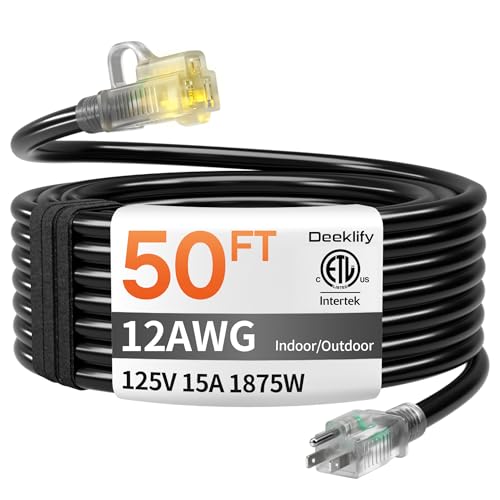
Best for heavy use around the home and garden when light-draw devices are running across a long distance. This 50-foot, 12-gauge cord is ETL/cETL certified, built with a polyethylene sheath, and designed to withstand harsh bending tests. It provides a solid balance of cost and durability for general outdoor power needs. Limitation: not as robust as 10-gauge cords for sustained high-current loads.
Buying Guide
What gauge should you choose?
Gauge indicates conductor thickness. Lower numbers (e.g., 10 gauge) handle higher currents with lower voltage drop over distance. If you routinely run high-draw tools or multiple devices at once, prioritize 10-gauge cords for safety and performance. For lighter or occasional outdoor power needs, 12-gauge cords can be adequate.
How long should the cord be?
Longer cords introduce more resistance and potential voltage drop. If you need extended reach, prefer thicker gauges to minimize power loss. Always unwind fully to avoid overheating and store with care to prevent kinking.
What about weather and safety features?
Look for ETL or cETL listings, rugged jackets (SJTW), IP ratings for waterproofing, and a lighted end to verify power status in dim environments. Bright-colored jackets (yellow) improve visibility and reduce tripping risk.
Outlets and adaptors
Extendable cords with multiple outlets can power several devices from one run, but ensure the total load stays within the cord’s rating. Assess whether you need three outlets or a single outlet with a light indicator to confirm power presence.
Storage and handling considerations
10-gauge cords are stiffer and heavier, so plan for proper storage reels or straps. For 50-foot runs, ensure you have ample space to lay out the cord fully during use to prevent overheating and kinks.
FAQ
- Q: Is a 10-gauge cord always better than a 12-gauge cord?
A: Not always, but 10-gauge cords handle higher current with less voltage drop, which matters for high-draw tools and long distances. - Q: What does ETL listed mean?
A: ETL listing indicates the product meets safety standards set by a third-party laboratory, suggesting safer use in electrical environments. - Q: Should I choose a cord with a light indicator?
A: Light indicators help confirm power presence, especially in outdoor or low-light conditions. - Q: How long can I safely run a 50-foot extension cord?
A: It depends on the device’s wattage and the cord gauge. Higher-draw devices benefit from thicker gauges to minimize voltage drop. - Q: Can I use these cords indoors?
A: These cords are designed for outdoor use but are commonly suitable for covered indoor areas; check the jacket rating and local code requirements. - Q: Do these cords support high-temperature environments?
A: Many 10-gauge cords are rated for wide temperature ranges, but verify the specific cord’s temperature rating before heavy-duty applications.