Best 3-Phase kWh Meters for Accurate Real-Time Power Monitoring
When managing energy usage in commercial, industrial, or multi-phase residential setups, a reliable 3-phase kWh meter is essential. This guide highlights top 5 3-phase kWh meters from Amazon, focusing on real-time readings, voltage compatibility, and data access options. Whether you need true power measurements for solar or net metering, or insightful usage history for billing, these meters cover diverse needs and installation scenarios.
| Product | Brand | Key Advantage |
|---|---|---|
| Eyedro 3-Phase Commercial & Industrial Energy Meter | Eyedro | Real-time kWh, W, A, V, PF; WiFi or Ethernet |
| Eyedro 3-Phase Commercial & Industrial Energy Meter (High-Resolution) | Eyedro | 24/7 usage history; true power data; higher sensor capacity |
| DAE P254-200-S KIT | DAE | UL/cUL listed; 0.5% revenue-grade accuracy; cloud metering option |
| DAE P153-200-S KIT | DAE | 1-phase option with 2 CTs; revenue-grade accuracy; cloud access |
| HZVEKCRI 100A – 1000A 3 Phase Panel Meter | HZVEKCRI | 3-phase with clamp sensor; RS485 communication |
Eyedro 3-Phase Commercial & Industrial Energy Meter
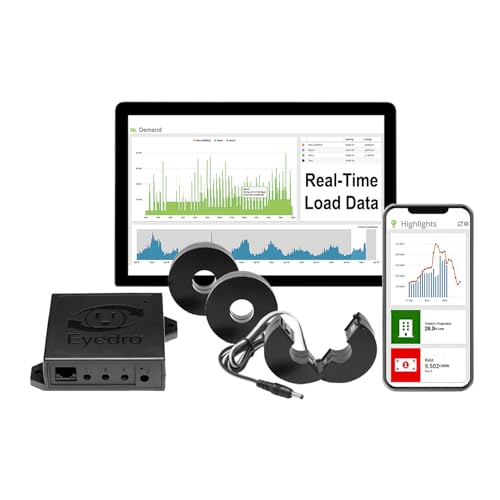
Eyedro’s 3-Phase Commercial & Industrial Energy Meter provides real-time readings across kWh, Watts, Amps, Volts, and Power Factor, with cost estimates. It supports both Solar and Net Metering scenarios, allowing a direct comparison between solar generation and consumption. The device offers flexible connectivity via WiFi (2.4 GHz) or wired Ethernet, which helps fit a range of network environments. Voltage options include up to 600V Delta and 480V/277V Wye, making it suitable for diverse commercial installations.
Eyedro 3-Phase Real-Time Energy Meter (High-Resolution)

This Eyedro model emphasizes high-resolution data with 24/7 usage history. It supports fixed, tiered, and time-of-use rate structures, and delivers hourly, daily, weekly, and monthly consumption and cost insights. Like the other Eyedro unit, it offers WiFi or Ethernet connectivity and supports broad voltage ranges up to 600V Delta and 480V/277V Wye. This version highlights true power data and detailed cost estimates aligned with modern energy management needs.
DAE P254-200-S KIT, 3-Phase kWh Submeter

The DAE P254-200-S KIT is a UL/cUL listed, ANSI-consistent 3-phase submeter with 200A capacity and RS485 communication. It includes three CTs and is suitable for 120-480V systems. It features a 0.5% revenue-grade accuracy and offers DAE Cloud Metering via CC2030 Gateway for real-time monitoring, monthly kWh, billing reports, and time-of-use (TOU) billing options. Indoor installation is straightforward, with optional outdoor enclosures available.
DAE P153-200-S KIT, 1-Phase Submeter

The P153-200-S KIT covers single-phase, 2-wire or 3-wire configurations with 200A capacity and 120/240V operation. It is designed for easy wiring with clear guidance and a 0.5% revenue-grade accuracy. It supports cloud metering via CC2030 Gateway, enabling real-time data access and monthly kWh reporting for tenants or facility managers. It’s suited for smaller commercial or residential energy projects requiring reliable submetering.
HZVEKCRI 3 Phase Panel Meter With Clamp Sensor

The HZVEKCRI 3 Phase Panel Meter covers 100A to 1000A with a clamp sensor and RS485 communication. It provides a multifunction approach to three-phase energy monitoring and includes an RS485 interface for data collection in larger systems. This meter is suitable for panel integrations where clamped current sensing and robust network communications are required, offering clear voltage and current readings across three phases.
Buying Guide
Key considerations when choosing a 3-phase kWh meter:
- Voltage and frequency compatibility: Ensure the meter supports your system’s voltage (e.g., 480V/277V, 600V delta) and 50/60 Hz operation.
- Phase configuration: Confirm whether you need 3-phase 4-wire (with neutral) or 3-phase 3-wire (no neutral) and the corresponding current rating (e.g., 200A, 600A).
- Accuracy and billing needs: Revenue-grade accuracy (often 0.5% or 1.0%) is important for TOU billing and tenant billing; verify compliance standards (ANSI C12.1, C12.20, UL/cUL listed).
- Data access and visualization: Look for real-time dashboards, historical usage, cost estimates, and compatibility with cloud metering or local data logging (RS485, Ethernet, WiFi).
- Installation environment: Indoor vs outdoor suitability, enclosure options, and ease of wiring (CTs, potential need for knockouts or specific panel mounting).
- Connectivity: Decide between WiFi, Ethernet, or optional gateway integrations for cloud services and remote monitoring.
- Scalability: If monitoring multiple panels or locations, consider meters that offer centralized data aggregation or multi-meter support.
- Support and documentation: Manufacturer technical support quality and availability, along with setup guides and reliability.
Perspective considerations:
- Residential/light commercial: Prioritize ease of wiring, compact form, and clear local display. A single-phase or 3-phase submeter may be more than enough, depending on load.
- Commercial/industrial: Emphasize 3-phase accuracy, robust communication options (RS485, Ethernet), and cloud/metering features for billing clarity and energy optimization.
- Solar and net metering: Real-time comparisons between generation and consumption are essential, alongside stable data access to support incentives and audits.
All models in this guide are designed to provide precise energy data and support various network configurations. When selecting, align the meter’s specifications with your electrical system, data needs, and whether you require cloud-based monitoring or local readouts for on-site energy management.