Best Inverter With MPPT Charge Controller: Top Picks for Off-Grid Power
Answering the demand for clean, efficient off-grid power, these inverter-charger setups combine MPPT solar charging with solid AC output. They’re best for small homes, cabins, RVs, and emergency backup systems. The top picks below balance strong solar charging, compatibility with multiple battery types, and practical features for real-world use.
Summary of selected products:
- SUMRY Solar Inverter Charger — 3600W inverter with built-in 120A MPPT controller, compatible with AGM, Gel, LiFePO4 batteries.
- Victron Energy SmartSolar MPPT (Bluetooth) — 50A MPPT controller, supports 12/24V, scalable with multiple devices, Bluetooth for monitoring.
- Ampinvt 80A MPPT Solar Charge Controller — versatile 12/24/36/48V auto-detect, high current, robust protection and data display.
- SWIPOWER 4000W Hybrid Solar Inverter — 4000W pure sine wave, 140A MPPT, battery-free option, 24V systems.
- POWLAND 100A MPPT Solar Charge Controller — multi-voltage 12/24/36/48V, intelligent 4-stage charging, high efficiency.
SUMRY Solar Inverter Charger 3600W With MPPT

Best for: Home energy systems that need a single, all-in-one unit. The SUMRY model combines a 3600W pure sine wave inverter, a 120A MPPT solar charger, and a 100A AC battery charger. This makes it suitable for battery-based setups or battery-less operation when PV input is sufficient. It works with AGM, Gel, Lead-acid, Li-ion, and LiFePO4 batteries, giving flexibility for mixed battery inventories.
Why selected: The integrated MPPT controller helps maximize solar harvest up to 4200W PV input. This reduces grid draw during sunny periods and supports a hybrid approach for off-grid living. It’s a practical choice when you want a single device that handles charging, storage, and conversion.
Limitations: When running without a battery, PV input must exceed 120V and grid must not be connected, or it may draw from the grid. A battery is recommended to minimize grid usage.
Victron Energy SmartSolar MPPT Solar Charge Controller

Best for: Systems prioritizing intelligent charging with synchronization capabilities. This Victron SmartSolar MPPT controller emphasizes maximizing power extraction and extending battery life. It’s well-suited for users who will add more solar or controllers over time and want centralized monitoring and coordination.
Why selected: The controller’s fast MPPT tracking and smart charge algorithms help extract maximum energy, even under partial shading. Its synchronization feature lets multiple controllers act in unison, benefiting larger or distributed solar arrays.
Limitation: This is a controller, not a complete inverter/charger unit. It’s most effective when paired with a compatible inverter and battery system in a well-planned setup.
Ampinvt 80A MPPT Solar Charge Controller
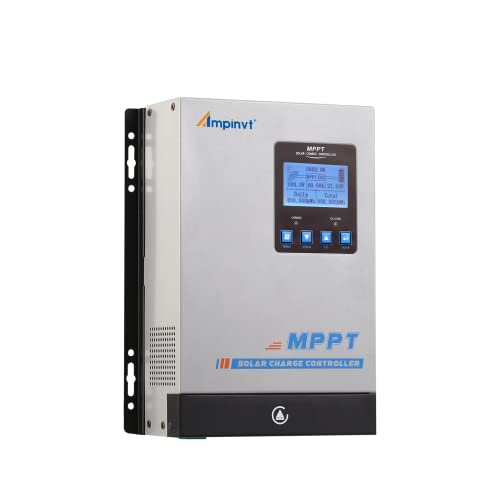
Best for: Medium to larger battery banks using 12/24/36/48V systems. This controller supports a broad voltage range and high current, making it suitable for ambitious solar setups that require robust charging power and protective features.
Why selected: It auto-identifies system voltages, provides LCD readouts, and includes real-time energy statistics with multiple load control modes. The four-level charging algorithm helps manage battery health and charging rates.
Limitation: The maximum PV input and enclosure limits should match your panel array’s specifications to avoid exceeding rated currents.
SWIPOWER 4000W Hybrid Solar Inverter

Best for: Off-grid homes or RVs that need a powerful pure sine wave inverter with a strong MPPT controller. The 4000W output covers most common appliances, while the 140A MPPT expands solar harvest potential for larger arrays.
Why selected: It supports operation with or without batteries, giving flexibility for battery-free daytime operation. The 6.25″ LCD and touch controls simplify monitoring and management of power flow, making it a practical choice for users prioritizing visibility and control.
Limitation: If you need grid-tied functionality, this unit is designed for off-grid use—it won’t feed power back to the utility grid.
POWLAND 100A MPPT Solar Charge Controller

Best for: Systems that demand broad battery compatibility and reliable high-current charging. The 100A MPPT controller supports 12/24/36/48V configurations and claims stable, efficient energy harvesting with protective features.
Why selected: It provides multi-voltage compatibility and a four-level charging algorithm to protect and optimize battery health. The controller is designed for straightforward integration with various solar panel arrays.
Limitation: The datasheet emphasizes protection modes; ensure your battery bank and inverter match the controller’s supported voltage and current ranges to avoid underperforming setups.
Buying Guide
What should you look for in an MPPT inverter charger?
Key factors include battery compatibility (12/24/36/48V), maximum PV input power and voltage, and whether the unit supports a battery-free operation during daylight. Consider whether you need a pure sine wave output for sensitive devices, and ensure the inverter’s continuous wattage matches your load.
Do you need hybrid versus standalone MPPT controllers?
Hybrid inverters combine an inverter, charger, and MPPT controller in one unit, simplifying installation and reducing cabling. Standalone MPPT controllers work best when you already own an inverter or plan to scale gradually. Choose per your system architecture and future expansion plans.
How important is battery type compatibility?
Many MPPT controllers support multiple battery chemistries (Lead-Acid, AGM, Gel, LiFePO4, Lithium-ion). If you anticipate swapping batteries or using a mix, confirm compatibility and charging profiles for each type to prevent reduced lifespan.
What about monitoring and integration?
Controllers with Bluetooth, WiFi, or LCD displays offer real-time data, efficiency metrics, and system health. If you manage a larger system, synchronization features across multiple controllers can optimize performance and reduce battery aging.
Installation considerations
Check recommended PV input power ranges, allowable array voltage, and enclosure safety. Ensure proper cable sizing, adequate cooling, and strain relief for outdoor installations. Plan for future expansions—more panels, additional controllers, or extra battery banks.
FAQ
- What is an MPPT charge controller?
An MPPT controller tracks the maximum power point of the solar array to extract maximum energy and efficiently charge the battery. - Can these inverters work without batteries?
Some models support battery-free operation using solar input to power loads during daytime, but grid isolation and PV voltage constraints apply. - What battery types are compatible with these units?
Common options include AGM, Gel, Lead-Acid, LiFePO4, and other lithium chemistries, depending on the model. - Why choose a 12V versus 48V system?
Higher system voltages (like 48V) reduce current for the same power, minimizing wiring losses and enabling larger inverter capacities. - How many MPPT controllers can you network?
Some models/systems support multiple controllers sharing a single battery bank to optimize energy harvest across arrays. - Is a pure sine wave necessary for home appliances?
Most modern electronics tolerate square waves poorly; pure sine wave outputs reduce noise and protect sensitive devices.