Best Inverter With Built in Battery for on-the-Go Power
Answering your search for a reliable inverter with a built-in battery, these picks combine portable power with clean, stable output. Each option targets different user needs—from RV adventures and off-grid camping to emergency home backup. The top choices below are best for campers, contractors, and car travelers who want a ready-made power solution without extra battery packs.
Summary of selected products
| Product | Best For | Key Benefit | Note |
|---|---|---|---|
| BELTTT 2000W Pure Sine Wave Inverter | Home backup, RVs | High continuous power with 2000W and 4000W surge | Built-in battery not specified, check compatibility |
| Cantonape 3000W Power Inverter | Car, truck, boat | Multiple outlets with LCD and remote control | Requires separate battery supply |
| POWERFUEL 1200W Inverter | Road trips, camping | Compact with 3 outlets and fast USB charging | Lower continuous wattage |
| Azocek 220W Power Inverter | DeWALT 20V battery users | Direct battery-powered portability | Low wattage, best for small devices |
| SUMRY Hybrid Solar Inverter 4000W | Off-grid enthusiasts | High power with MPPT and battery-friendly design | More complex setup, solar-ready |
BELTTT 2000W Pure Sine Wave Inverter

Best for users needing robust 12V to 110/120V conversion with a quiet, efficient profile. This BELTTT unit delivers 2000W continuous power and up to 4000W surge, suitable for TVs, home theater, and other sensitive electronics. The built-in LCD provides real-time input/output, battery, and load status for quick troubleshooting. Its high efficiency reduces energy waste in portable setups.
- Best for RVers and off-grid setups needing strong sustained power.
- Better for: devices with moderate startup spikes, like TVs or projectors.
- Avoid this if you require a built-in, long-duration battery pack; verify if a built-in battery is included, as data highlights a converter with external battery options.
Cantonape 3000W Power Inverter

This 3000W inverter provides a robust 6000W surge with four AC outlets and four USB ports, designed for vehicles and larger equipment. It features an intelligent LCD that shows voltage, battery capacity, and load, plus detailed fault codes for easier diagnostics. A remote control is included for convenient remote operation.
- Best for: multi-device charging on road trips or work sites.
- Better for: larger appliances that require steady power, like power tools or small kitchen electronics.
- Limitation: once again, a built-in battery is not explicitly stated; plan to power from an attached battery bank or vehicle battery.
POWERFUEL 1200W Inverter
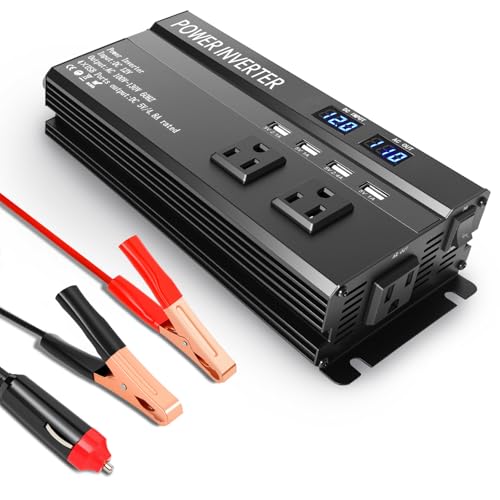
Compact and travel-ready, this 1200W inverter offers three AC outlets and four USB ports with smart temperature-controlled cooling. The LCD screen displays input/output voltage and battery status, helping keep devices safe during operation. Ideal for on-the-go charging of phones, laptops, and small electronics.
- Best for: daily essentials during road trips or camping.
- Better for: users who want quiet operation and simple monitoring.
- Limitation: lower continuous power compared to larger units; not suited for heavy appliances.
Azocek 220W Power Inverter

Designed for DeWALT 20V batteries, this compact inverter converts 20V DC to 110V-120V AC with one AC outlet and multiple USB ports, plus a USB-C PD fast charging option. It is best for portable power on remote sites or quick charging needs where a DeWALT battery powers devices.
- Best for: tool users needing portable power from existing 20V batteries.
- Better for: charging phones, tablets, and small electronics on the go.
- Limitation: low wattage means not suitable for high-demand devices.
SUMRY Hybrid Solar Inverter

SUMRY’s 4000W DC 24V to AC 120V unit pairs a 140A MPPT charge controller with a pure sine wave output, supporting battery-less or AGM lithium configurations. It features a tempered glass cover and a large LCD for real-time data. This is designed for serious off-grid setups and solar integration.
- Best for: off-grid enthusiasts seeking high power and solar-ready charging.
- Better for: homeowner or camper who can pair with an appropriate battery bank.
- Limitation: setup is more complex; ensure compatibility with your solar array and battery type.
Buying Guide
Key considerations when choosing an inverter with a built-in battery or battery-ready design:
- Power needs: Match continuous wattage and surge to your essential appliances. Higher wattage handles more devices but may require a larger battery and cooling.
- Battery architecture: Some units assume external batteries or vehicle power; verify if the battery is built-in or needs to be added.
- Output waveform: Pure sine wave is best for sensitive electronics, ensuring smooth operation and longevity.
- Charging and inputs: Look for MPPT controllers for solar compatibility, and monitor ports (LCD, USB-C, USB-A) for device management.
- Portability vs. capacity: Smaller units are lighter but limited in load; larger units suit home backup or heavy-duty usage.
- Cooling and protection: Temperature-controlled fans and protections against overload, short-circuit, and voltage extremes extend device life.
- Display and diagnostics: An informative LCD helps track voltage, battery level, and fault codes for quick troubleshooting.
FAQ
- Do these inverters include built-in batteries? Some models are pure inverters and require an external battery or vehicle power; verify the product details for battery configuration.
- What household devices can I run with a 2000W inverter? Most TVs, consoles, laptops, and small kitchen appliances can run under 2000W, but avoid high-draw appliances like full-size air conditioners or microwaves during startup.
- Is a pure sine wave necessary for sensitive electronics? Yes. Pure sine wave minimizes voltage irregularities and protects electronics during startup and operation.
- Can I use solar to recharge a built-in battery inverter? Look for MPPT charge controllers and solar compatibility in the product specs to ensure efficient solar charging.
- What should I consider for vehicle use? Ensure the inverter has appropriate ports, remote control, and a design suitable for mobile installation and vibration tolerance.
- Are remote controls necessary? They add convenience for turning the device on/off from a distance, especially in tight spaces.