Best Infrared Leak Detectors for Refrigerant Detection in HVAC Systems
Choosing an infrared refrigerant leak detector helps HVAC technicians identify leaks quickly and accurately across CFCs, HCFCs, HFCs, HFOs, and blends. This guide highlights five top infrared-based models, comparing sensor life, sensitivity, and usability to help you select a unit that minimizes downtime and maintenance costs.
The following table summarizes five recommended infrared refrigerant leak detectors, based on sensor technology, longevity, and usability features.
| Product | Sensor Type | Key Advantage | Approx. Sensor Life |
|---|---|---|---|
| Elitech ILD-200 | Infrared | Long infrared sensor life; wide halogen gas detection | Up to 10 years |
| Fieldpiece DR82 | Infrared | Ultra-sensitivity for micro leaks; durable IP54 sensor | 10 years |
| Elitech ILD-300 | Infrared | Ten-year infrared sensor; TFT display for clarity | Up to 10 years |
| Elitech IR-200 | Infrared & Heated Diode (two-sensor) | Dual sensors for maximum accuracy and versatility | Up to 10 years |
| TOPTES RT-389 | Infrared/semiconductor sensor | Three sensitivity modes; flexible alarms and gooseneck | Various parts; long life depends on use |
Elitech ILD-200 Max Infrared Leak Detector
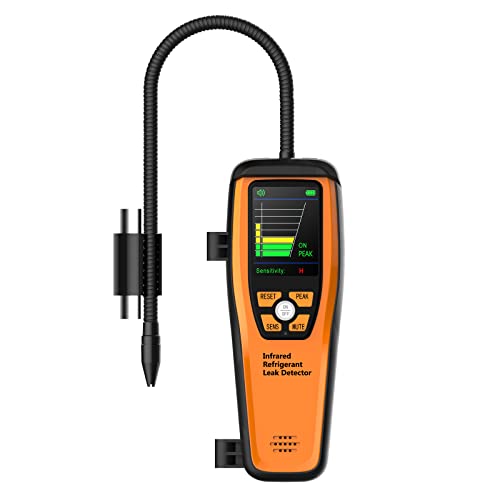
The ILD-200 uses an infrared sensor designed for strong anti-interference and quick response times. It targets a broad range of halogenated refrigerants, including R11, R22, R404a, R410a, R600a, and R1234yf, as well as blends such as AZ-50 and HP62. With adjustable sensitivity (High/Medium/Low) and a maximum sensitivity around 0.14 oz/year, this unit is suitable for automotive, residential, and commercial HVAC inspections. The sensor life and halogen gas compatibility position it as a versatile choice for technicians dealing with mixed refrigerants.
Fieldpiece DR82 Infrared Leak Detector

Fieldpiece DR82 is designed for ultra-sensitivity, capable of detecting leaks under 0.03 oz/yr. It supports all refrigerants including CFCs, HCFCs, HFCs, and HFOs, and its IP54-rated sensor resists moisture and oil exposure. A long-lasting sensor ensures reliability across multiple service calls, making it a strong option for technicians who work in challenging job sites where environmental conditions vary.
Elitech ILD-300 Infrared Leak Detector

The ILD-300 advances with a 10-year infrared sensor lifetime and a TFT display for clearer readings. It maintains high sensitivity with adjustable High/Medium/Low levels, reaching up to 0.1 oz/year. The TFT screen shows sensitivity levels, leakage alerts, battery status, and more for straightforward operation in busy environments, plus the extended sensor life reduces maintenance costs over time.
Elitech ILD-200 Max High-Precision Detector
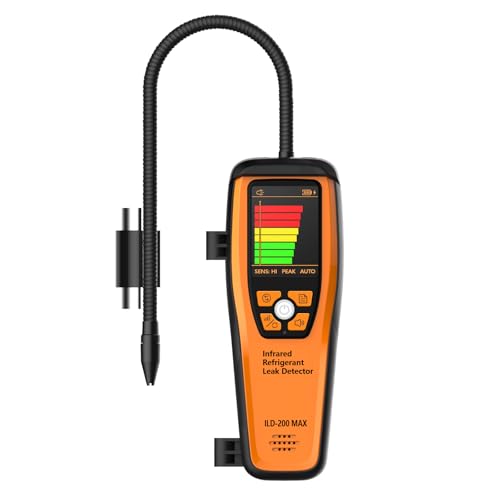
The ILD-200 series combines infrared and heated diode sensors in one unit, enabling quick switching between detection modes. This versatility helps technicians maximize accuracy across halogenated refrigerants. It supports a maximum sensitivity up to 0.14 oz/yr and detects a wide range of gases, including R11, R22, R404a, R410a, R600a, and R1234yf. The dual-sensor capability helps reduce false positives and expand detection capabilities in mixed refrigerant environments.
Elitech ILD-100H Heated Diode Infrared Detector

The ILD-100H emphasizes a heated diode sensor, delivering accuracy across halogen refrigerants with a TFT screen for clear readings. It offers a higher sensitivity range with adjustable levels up to 0.1 oz/year, making it well-suited for field technicians who need dependable performance in various environments. The TFT display provides instant visibility of readings, alerts, and battery status during inspections.
Elitech Inframate C Infrared R-744 CO2 Detector

The Inframate C targets CO2 leaks with an advanced infrared sensor designed for stability and reduced contamination risk. It features a large TFT LCD display and a high sensitivity capable of detecting leaks as low as 6 g/year. The sensor life and anti-interference design support reliable operation in environments with varying gas mixes, particularly in industrial settings where CO2 leakage is a concern.
TOPTES RT-389 Rechargeable Infrared Leak Detector

TOPTES RT-389 offers three sensitivity modes and three alarm types, including a visual, sound, and vibration alarm system. Its 14.5-inch flexible gooseneck enhances reach in tight spaces, and the dual display modes—PPM curve and trend graph—provide real-time and historical leak data. This makes it a practical option for automotive, home, and commercial HVAC applications where space is limited and precise monitoring is required.
Buying Guide: Key Considerations For Infrared Refrigerant Leak Detectors
- Sensor technology and life: Infrared sensors typically offer long lifespans (often up to 10 years) with lower maintenance compared to heated diode sensors. Some models combine infrared and diode sensors for versatility and accuracy.
- Sensitivity and range: Look for adjustable sensitivity (Low/Medium/High) to match job site conditions. Higher sensitivity helps detect small leaks but may increase false positives if not managed properly.
- Gas compatibility: Ensure the detector covers common halogenated refrigerants (CFCs, HCFCs, HFCs, HFOs) and blends used in your operations.
- Display and alerts: TFT/LCD screens provide clear readings, leak intensity bars, battery status, and alerts. Dual audio-visual alerts support use in noisy environments.
- Durability: IP ratings (like IP54) indicate resistance to dust and moisture. A rugged design is beneficial for fieldwork and service calls.
- Ergonomics and accessories: Consider gooseneck length, weight, and display readability. Some units include two sensors, quick mute, or multiple alarm modes for convenience.
- Maintenance and cost of ownership: A longer sensor life reduces replacement costs. Evaluate warranty terms and ease of calibration or sensor replacement.
- Ease of use: TFT displays, intuitive menus, and straightforward calibration improve on-the-job efficiency and safety.
Infrared leak detectors provide rapid, non-contact detection of refrigerant leaks across a spectrum of halogenated gases. When selecting a model, balance sensor lifetime, detection sensitivity, gas compatibility, and the practicality of use on typical work sites to ensure reliable, efficient leak detection for HVAC/R systems.