Best Indoor Outdoor Temperature Gauge Wireless for Your Home
Looking for a reliable wireless indoor outdoor temperature gauge that covers multiple locations? This guide highlights top options that deliver accurate readings, easy setup, and real-time data. Ideal buyers include homeowners wanting precise climate awareness, renters needing portable setups, and gardeners monitoring greenhouse conditions. Below you’ll find five strong picks, a quick comparison, and a buying guide to help you choose.
| Product | Key Benefit | Best For |
|---|---|---|
| U UNNI Indoor Outdoor Thermometer Hygrometer | High-precision Swiss sensor; 330 ft range | Large homes, multi-room monitoring |
| Newentor Weather Station | Wide display; 3-channel sensor support | Multi-location monitoring with clear visuals |
| DreamSky Weather Station | Large display; atomic clock synchronization | Easy-to-read data from a distance |
| TempPro TP60 | Long 500 ft range; wide temperature/humidity range | Rural or sprawling properties |
| AcuRite Wireless Weather Station | Hyperlocal forecast; simple setup | Starter home weather tracking |
U UNNI Indoor Outdoor Thermometer Hygrometer

The U UNNI model uses a Swiss-made sensirion sensor for high accuracy, with indoor temperatures from +14.2ºF to +122ºF and outdoor temperatures from -58ºF to +158ºF. Indoor/outdoor humidity ranges 1% to 99%, with temperature accuracy ±0.5ºF and humidity accuracy ±2%. It features patented wireless technology with a 330 ft data radius and updates every 30 seconds. Best for homeowners who want real-time, cross-location climate data and a backlit display for dim rooms. A limitation is the data range can vary in thick walls or RF-heavy environments.
- Best for: Large homes, or setups spanning several rooms.
- Why selected: High-precision sensor and long-range transmission.
- Caution: RF interference may affect range in some layouts.
Newentor Weather Station Wireless Indoor Outdoor Thermometer

This Newentor station features a 7.5″ color LCD, showing inside/outside temperature and humidity, 3-channel wireless sensors, and weather forecast for the next 12-24 hours. It also displays time, date, moon phase, and barometric pressure. It’s ideal for households needing a visually clear overview of multiple spaces. A potential drawback is the need for compatible remote sensors to monitor additional locations beyond the included one.
- Best for: Homes needing a large, easy-to-read display.
- Why selected: Multi-location monitoring and built-in forecast.
- Caution: Additional sensors may be required for extra rooms.
DreamSky Weather Station Indoor Outdoor Thermometer

DreamSky offers a large, easy-to-read display with an Atomic Clock and dimmable backlight. It supports multiple indoor/outdoor sensors and provides digital readings for temperature, humidity, and forecast. Its WWVB accuracy ensures time precision and auto-DST adjustments. This model is well-suited for bedrooms or living spaces where a bold display is beneficial. A limitation is that it may require careful placement to optimize sensor reception for all locations.
- Best for: Quick, readable data with time synchronization.
- Why selected: Atomic clock accuracy and large display.
- Caution: Sensor placement affects multi-location readings.
TempPro TP60 Wireless Indoor Outdoor Thermometer

The TempPro TP60 touts a 500 ft range and a rugged, wall-mountable design. It tracks inside and outside temperature and humidity with max/min recordings and trend arrows to indicate warming or cooling. This is a strong pick for larger properties or outdoor spaces like a greenhouse or garage. The device includes batteries but may require alignment for best range in some settings.
- Best for: Large properties needing long-range sensing.
- Why selected: Extended range and comprehensive trend data.
- Caution: Long-range performance depends on line-of-sight and obstacles.
AcuRite Wireless Home Weather Station
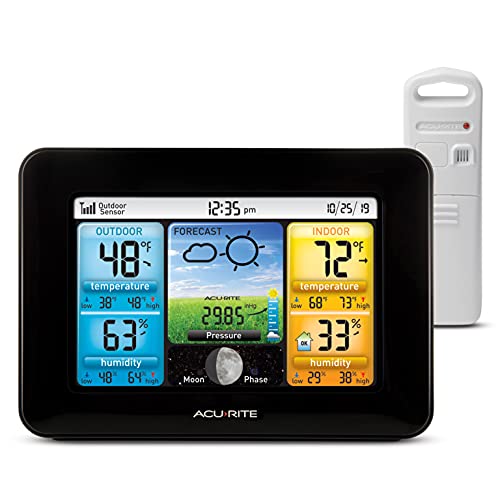
AcuRite’s system provides a straightforward setup with a color display and a sensor for indoor/outdoor readings. It offers hyperlocal weather forecasting by relaying information from the outdoor sensor. This model is a solid option for first-time adopters who want a reliable, simple weather station with actionable data. A caveat is that the included sensor range and features may be lighter than premium multi-sensor kits.
- Best for: Beginners seeking an easy, reliable setup.
- Why selected: Clear display and practical forecast capabilities.
- Caution: Fewer sensors may limit multi-location monitoring.
Buying Guide: Key Considerations for Wireless Indoor Outdoor Gauges
- Range and signal reliability: Evaluate whether the 300–500 ft range meets your home layout and potential obstacles. Look for models with proven wireless technology and easy re-pairing if signal is lost.
- Display and readability: A larger, backlit display helps in kitchens, hallways, or bedrooms. Consider color screens or bold digits for quick glance readings.
- Sensor count and placement: Decide how many remote sensors you need. Some systems support 2–3 sensors; plan sensor placement for accurate indoor vs. outdoor data in each zone.
- Data accuracy and sensors: Look for devices with proven, high-accuracy sensors (e.g., Swiss-made sensirion) and acceptable accuracy ranges for temperature and humidity.
- Power and maintenance: Check battery life, backlight options, and whether the unit supports USB power or relies on battery cells. Longer battery life reduces maintenance.
- Forecasting features: Some models include weather forecasts, dew point, heat index, and mold indicators. Know which features are essential for your usage.
- Timekeeping and clocks: If atomic clock synchronization matters, choose models with WWVB or similar time signals to avoid manual adjustments.
- Ease of setup: Systems with simple mounting, included sensors, and straightforward pairing appeal to non-technical users.
- Expansion potential: If you plan to monitor more locations later, pick a model that supports additional remote sensors.
Frequently Asked Questions
- What is an indoor outdoor wireless thermometer?
A device that measures indoor and outdoor temperature and humidity and transmits data to a central display or receiver without wiring. - Do wireless weather stations require Wi-Fi?
Some do for online features, but many operate via non-Wi-Fi RF transmission between sensors and a display unit. - How far can these sensors reliably transmit?
Most models provide 300–500 ft under optimal conditions; walls, metal, and obstacles can reduce range. - Can I monitor multiple locations with one system?
Yes, many systems support 2–3 remote sensors; some allow expansion with additional sensors. - What should I consider for placement?
Place the outdoor sensor in a shaded, ventilated area away from direct sun or heat sources; indoor sensors should be in representative rooms for accurate readings. - Are atomic clocks necessary?
Not strictly, but atomic clocks enhance accuracy for time-based displays and automatic DST adjustments.