Best Indoor Outdoor Infrared Heaters for All-Season Warmth and Comfort
Dealing with chilly indoors or cool outdoor nights? An infrared heater designed for both indoor and outdoor use can provide immediate, efficient warmth where you need it. This guide highlights five top options that balance portability, safety, and practical mounting choices. It’s ideal for homeowners, small business patios, garages, and covered outdoor spaces looking for reliable warmth without air-warming inefficiencies.
Summary at a glance
- DR. Infrared Heater Portable Infrared Indoor/Outdoor with Remote Control (no thermostat) – Best for flexible spaces and quick heat in homes, patios, and garages.
- Colliford Outdoor Electric Patio Heater – Best for covered patios and workshops needing adjustable wattage and portability.
- Paraheeter Electric Outdoor Heater – Best for wall/ceiling mounting with versatile 3-in-1 mounting options.
- DR. Infrared Heater With Digital Thermostat – Best for precise temperature control in indoor/outdoor areas.
- DR. Infrared Heater DR-239 3000W – Best for larger spaces and commercial-style setups with reliable IP55 rating.
Buyer profile table
| Product | Best For | Mounting Options | Notable Feature |
|---|---|---|---|
| DR. Infrared Heater (Remote, No Thermostat) | Flexible spaces | Portable | Remote control |
| Colliford Patio Heater | Covered patios and workshops | Portable | Three wattage settings |
| Paraheeter 1500W | Wall/Ceiling/Tripod use | Wall/Ceiling/Tripod | 3-in-1 mounting |
| DR. Infrared Thermostat Model | Precise ambient control | Wall/ceiling | Digital display |
| DR-239 3000W | Large spaces | Wall/Ceiling | High power |
DR. Infrared Heater Portable Infrared Indoor/Outdoor (Remote, No Thermostat)
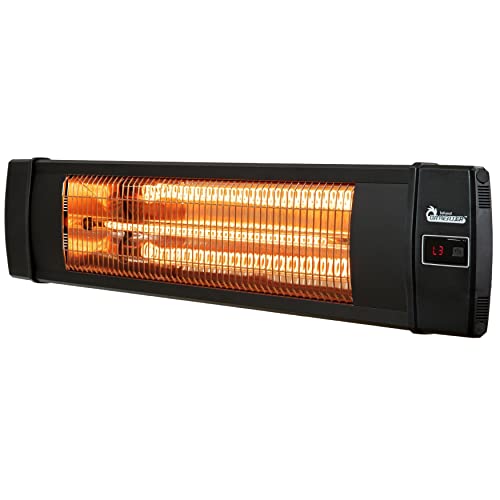
This heater is IP55 rated for indoor and outdoor use, making it suitable for home spaces, garages, and outdoor patios. It provides clean, instant infrared heat with three power settings: 900W, 1200W, and 1500W at 120V. Best for buyers seeking straightforward operation without complex programming. The model operates with a remote and does not include a thermostat, which can simplify usage in basic setups. Caution: as with any heater, ensure proper clearance from flammable materials and adequate ventilation.
Colliford Outdoor Electric Patio Heater

Best for: small to medium outdoor spaces that need adjustable heat without installation. This 750W/1000W/1500W portable heater covers a range of spaces from a cozy balcony to a larger workshop. It features a built-in tip-over switch for safety and does not require professional installation, making it ideal for seasonal use. Limitation: portability can be less practical in high-wind outdoor areas; use it on stable ground and under cover when possible.
Paraheeter 1500W Infrared Outdoor Heater

Best for: spaces requiring flexible mounting and eco-friendly operation. This 1500W carbon infrared heater can be mounted on walls, ceilings, or used with an adjustable tripod. It emphasizes quick heat with infrared warmth and claims lower operating costs (about one-tenth of propane). Safety includes a protective grille, grounded plug, and automatic shut-off on tipping. Caution: ensure foam padding is removed before operation to avoid overheating or damage.
DR. Infrared Heater With Thermostat

Best for: spaces needing precise ambient temperature control. This model adds a digital display and a corded thermal sensor to regulate heat automatically. It supports multiple mounting options, allowing wall, ceiling, or hanging installation. A potential limitation is that digital controls require power stability and may be more complex to operate for users preferring basic on/off operation.
DR. Infrared Heater DR-239 3000W

Best for: larger spaces, commercial or residential high-demand areas. The DR-239 delivers about 10,260 BTU / 3000W of carbon infrared heat with a robust 220V-240V setup and included mounting kit. IP55 weatherproofing supports outdoor use in sheltered areas. Limitation: higher power requirements mean it may need appropriate electrical infrastructure and dedicated circuits.
Buying Guide: Infrared Heaters For Indoor And Outdoor Use
What to consider when choosing an indoor/outdoor infrared heater:
- Heat output and space size: match wattage (750W–3000W) to the area you need to heat. Higher wattage suits large patios or garages; lower wattage is better for small decks or rooms.
- Mounting flexibility: decide between portable, wall-mounted, ceiling-mounted, or tripod setups. 3-in-1 options offer the most versatility for changing layouts.
- Weather resistance: IP ratings (IP55/IPX5) indicate suitability for outdoor use and exposure to moisture.
- Safety features: tip-over switches, domed grilles, automatic shut-off, and sturdy mounting reduce risk in busy spaces.
- Control methods: remotes and digital displays provide precise temperature and convenient adjustments; consider whether thermostat control is essential for you.
- Operating costs: infrared warmth targets people and objects rather than heating the air, often offering energy savings versus propane or gas heaters.
- Installation considerations: some units require electrical work or stable mounting points; ensure your space meets voltage and clearance requirements.
Frequently Asked Questions
- What is infrared heat and how does it differ from convection heaters?
Infrared heaters warm objects and people directly through radiant energy, rather than heating the surrounding air, which can improve comfort in outdoor spaces. - Can these heaters be used year-round outdoors?
They can extend outdoor usability in sheltered areas, but effectiveness depends on wind, ambient temperature, and the heater’s wattage. - Do infrared heaters require special wiring?
Larger units (like 3000W models) may require appropriate electrical circuits; check local electrical codes and installation guidelines. - Are these heaters safe for indoor use?
Yes, many models are rated for indoor and outdoor use, but ensure proper clearance from walls, ceilings, and flammable materials. - How do I choose between freestanding and mounted heaters?
Freestanding units offer portability and quick setup; mounted units save space and provide steady heat in fixed locations. - Do these models include thermostats?
Some include thermostats or digital controls for automatic operation; others rely on manual power settings.