Best in-Wall Volume Controls for Home Audio
In-wall volume controls let you tailor sound exactly where you want it, without bulky receivers or remote clutter. This guide highlights five reliable options, covering high-power needs, impedance matching, and convenient multi-room setups. Each product is paired with key features to help you compare performance and compatibility for a typical American home. Below is a quick summary of the selections.
| Product | Brand | Key Feature | Power Handling |
|---|---|---|---|
| OSD Audio SVC100 | OSD Audio | 100W, impedance matching, multiple zones | 100 W per channel |
| OSD Audio SVC300 | OSD Audio | 300W, impedance matching, multi-speaker support | 300 W per channel |
| OSD Audio VMS100 | OSD Audio | 100W peak, slider control, multi-room ready | 100 W peak |
| Herdio 100W Volume Control | Herdio | 12-position knob, 8-speaker support | 100 W |
| RECOIL VC-R100 | RECOIL | 100W, 12-step rotary control, multi-room | 100 W |
OSD Audio SVC100: High-Power In-Wall Volume Control
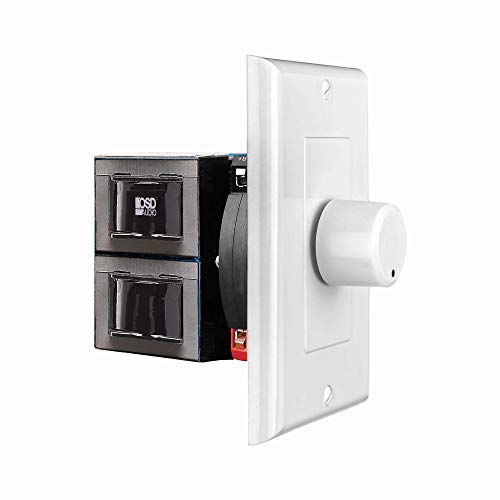
The SVC100 is a 100-watt-per-channel in-wall volume control designed for multi-room systems. It uses front-mounted jumpers to accommodate up to eight pairs of 8-ohm speakers, enabling independent volume management for different zones. The unit emphasizes impedance protection to stabilize loads back to the amplifier and reduce the risk of overheating. Ideal for homes that want reliable, hard-wired control in common living areas or dedicated media rooms, it maintains a clean signal with minimal bass roll-off.
OSD Audio SVC300: High-Power In-Wall Control

For larger setups, the SVC300 offers 300 watts per channel with adjustable impedance jumpers. This model supports multiple pairs of 8-ohm speakers and enables separate volume control across zones, helping households balance loud outdoor areas with quieter living spaces. It applies impedance protection to keep amps safe during parallel wiring and ensures consistent performance across rooms that demand higher power without distortion.
OSD Audio VMS100: Slider In-Wall Volume Control
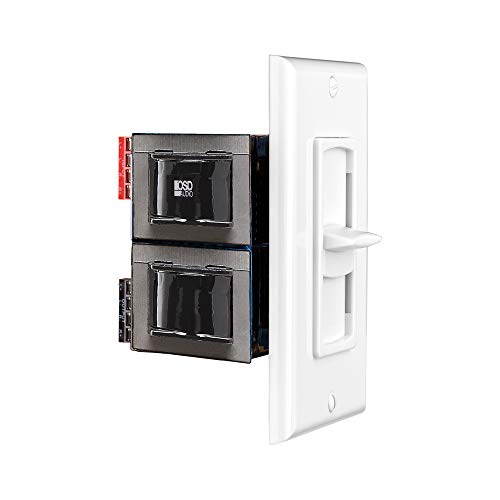
The VMS100 uses a slider mechanism for smooth volume adjustments and is rated at 100 watts peak. It supports up to eight pairs of eight-ohm speakers and features adjustable jumpers for impedance matching. Its design is well-suited for dining rooms, saunas, porches, or other zones where in-wall control is preferred but space is limited. The unit also protects the amp by stabilizing the load and preventing overheating from parallel speaker connections.
Herdio 100W In-Wall Volume Control

The Herdio volume control features a flush-mount design with 12 distinct positions for precise sound adjustment. It supports up to eight speakers and emphasizes smooth, quiet operation with minimal contact noise. The unit is built for durability and broad compatibility, suiting both professional install scenarios and residential settings where consistent, high-quality audio balance is needed across rooms.
RECOIL VC-R100: 100W Impedance Matching Wall Mount

The VC-R100 provides 100 watts per channel with impedance matching and adjustable jumpers for up to eight pairs of 8-ohm speakers. Its 12-step rotary control gives precise volume management across multiple rooms without sacrificing full-range audio. The flush plate integrates neatly into standard wall spaces, making it a versatile choice for home theaters, living rooms, or office environments where zone control is essential.
Buying Guide: Key Considerations For In-Wall Volume Controls
- Power handling: Match the in-wall controller to the sum of speakers and the amp’s capabilities in each zone. Higher wattage helps prevent distortion in larger spaces or outdoor areas.
- Impedance matching: Look for devices with adjustable jumpers or built-in impedance protection. Proper matching protects amplifiers and maintains consistent sound across zones.
- Speaker compatibility: Ensure the unit can drive the number of speakers you plan to use, typically up to eight pairs (16 total channels in some homes). Verify whether 8-ohm speakers are supported or if lower impedances are allowed.
- Control type: Rotary knobs versus sliders offer different user experiences. Sliders can provide fine-grain level adjustments, while knobs offer quick, tactile changes in busy spaces.
- Installation: In-wall units should fit standard gang boxes and align flush with wall surfaces. Consider whether you need remote accessibility or wall switches for convenient in-room control.
- Durability and build quality: Look for metal or high-grade plastic housings, and verify that the device operates smoothly over long-term use to avoid crackling or noisy contacts.
- Reliability in multi-room setups: If planning a whole-house audio system, choose models with stable impedance protection and robust positional settings to minimize crosstalk between zones.
- Wiring plan: Create a clear diagram of speaker runs and connection points before installation. Proper parallel wiring can maximize speaker count but requires careful impedance management.
- Future expandability: Consider whether you might add more speakers or zones later. A modular or scalable design can simplify upgrades without replacing the entire system.
- Acoustic goals: Higher-power devices are not always better for small rooms. Choose a unit that provides clear, undistorted control without overpowering the listening environment.