Best in Line Flow Sensor Options for Fluid Measurement
Direct answer: In-line flow sensors are compact, reliable ways to monitor fluid flow in pipes for hobbies, home systems, and small-scale equipment. This guide highlights five solid options and clarifies which buyers they suit best. Whether you’re retrofitting a DIY project, protecting pumps, or monitoring water flow in a filtration system, these sensors help you detect flow presence, rate, and changes clearly. The following selections are suitable for different setups, from educational projects to small pools and household water lines.
| Product | Best For | Key Benefit |
|---|---|---|
| Digiten G3/4″ Male Thread | Home hobbyists and small systems needing robust measurement | Stable, reliable flow reading in 1–30 L/min range |
| JESSINIE YF-S201C (2 Pack) | Budget projects and easy installation in tight spaces | Transparent body for visual observation and easy mounting |
| SENSTREE G1/2” Flow Sensor | Educational setups and Raspberry Pi/Arduino experimentation | Compact, simple integration with common hobbyist platforms |
| DIGITEN FS-C02 G3/4″ BSP | Systems requiring safety shutoff and electrical isolation | Brass body with ROHS-compliant materials and 0–2A/0–220V options |
| briidea Flow Switch for Hayward Systems | Pool or spa applications using Hayward equipment | Compatibility with Hayward Goldline and built-in safety monitoring |
Digiten G3/4″ Male Thread Water Flow Sensor
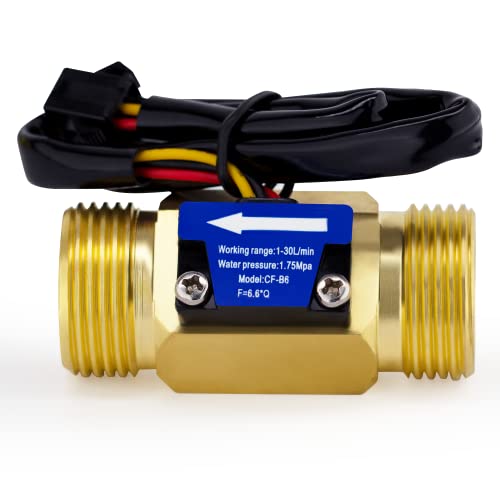
Best for: Small- to medium-scale DIY projects needing a sturdy inline flow sensor with wide operating limits. This model’s metal and compact design suit home workshop setups where reliable flow measurement matters.
- Brass or robust housing with inline threading for 3/4″ connections.
- Measurement range typically supports 1–30 L/min, suitable for many water-based applications.
- Stable operation across varying temperatures and pressures.
Limitations: Data lists general environmental resilience but provides no explicit warranty or certification details. Best when mounted in accessible positions for maintenance checks.
JESSINIE Flow Sensor YF-S201C (2 Pack)

Best for: Budget-conscious projects and quick installations where a transparent body helps observe flow visually. The two-pack option is useful for paired sensors on multi-line setups.
- Transparent valve body with a wear-resistant, stainless steel bead rotor.
- Lightweight, compact, and easy to install in tight spaces.
- Includes a Hall sensor and plastic valve body assembly.
Limitations: The product emphasizes general materials and assembly; confirm compatibility with your power supply (3.5–24V DC) and your system’s wiring before use.
SENSTREE G1/2” Flow Sensor

Best for: Educational projects and beginner-friendly integrations with microcontroller platforms like Arduino or Raspberry Pi. The compact form factor makes it easy to incorporate into small-scale experiments.
- NPT threaded for common plumbing connections.
- Range of 1–30 L/min suitable for standard water circuits.
- Lightweight with straightforward installability.
Limitations: Detailed specifications on materials beyond basic durability are not specified. Verify compatibility with your exact voltage and signal interface for your project.
DIGITEN FS-C02 G3/4″ BSP Flow Switch

Best for: Systems requiring a safety shutoff function and robust electrical compatibility. It’s well suited for pumps and heating equipment where flow absence should trigger a power cut.
- Brass body with ROHS-compliant materials for safer operation.
- 3/4″ BSP male thread fits common inline installations.
- Electrical options supporting 0–2A and 0–220V (AC or DC) provide flexible integration.
Caution: When wiring loads, add a relay to protect switching devices. Ensure proper wiring and external relays to handle loads safely.
briidea Flow Switch for Hayward Systems

Best for: Pool and spa installations using Hayward Goldline equipment. It provides compatibility across several Hayward models and helps protect plumbing and equipment from flow issues.
- Compatible with Hayward Goldline systems and multiple salt systems.
- Monitors water flow to prevent chlorine gas buildup and protect equipment.
- Designed for integration with various Hayward control logic and salt cells.
Limitation: This option targets specific pool system ecosystems; verify compatibility with your exact Hayward model before purchase.
Buying Guide: Key Purchase Considerations
What flow range do you need? Most inline sensors in this guide read around 1–30 L/min, suitable for small pipes and hobby projects. For higher-flow systems, seek models rated for greater flow rates and verify the impeller and bearing materials.
What material matters? Brass and stainless components offer durability and chemical resistance essential in water and pool applications. Ensure ROHS-compliant materials if you’re dealing with drinking water or sensitive electronics.
Do you need a visibility feature? A transparent body helps monitor rotor status and flow visually, useful for troubleshooting and educational use.
Is electrical integration important? Some sensors include Hall effect sensors and require specific DC voltages. Others offer 0–220V AC/DC compatibility or require relays for load protection. Plan the wiring and control logic accordingly.
Do you require safety or shutoff features? Flow switches with built-in safety or automatic shutoff are ideal when you must prevent dry-running conditions or protect pumps and heating elements.
Frequently Asked Questions
- What is an in-line flow sensor used for? — It measures the flow rate of liquids within a pipe and can trigger actions in control systems or alarms when flow changes occur.
- What materials are common for these sensors? — Common materials include brass, plastic, and stainless components; compatibility depends on the liquid and environment.
- Do these sensors require a power supply? — Yes, most operate with low-voltage DC (e.g., 3.5–24V) or provide interfaces for AC/DC signals; some require external relays for switching loads.
- Can I use these with microcontrollers? — Yes, many sensors integrate with Arduino or Raspberry Pi via Hall effect outputs or simple signal lines; check voltage and output type.
- Are inline flow sensors suitable for pools or spas? — Some models are designed for pool systems and Hayward-compatible equipment; confirm model compatibility with your pool controller.
- What installation precautions are important? — Ensure correct threading (BSP vs NPT), proper sealing, and electrical isolation where required to prevent leaks and shorts.