Best in Line Battery Backup Options for Home and Office Power Needs
If you need reliable short-term power during outages to keep essential devices online, a line-interactive or standby UPS is the right choice. This guide compares five common UPS models to help buyers choose networks, computers, routers, and workstations with minimal downtime. The top picks are suited for home offices, small businesses, or media setups where staying connected matters. The following table summarizes key details to compare at a glance.
| Product | Capacity | Type | Best For |
|---|---|---|---|
| APC BE600M1 | 600VA / 330W | Line-Interactive | Home office essentials; short outages |
| CyberPower CP1500PFCLCD | 1500VA / 1000W | PFC Sinewave | PCs, workstations, network gear |
| CyberPower CP1500AVRLCD3 | 1500VA / 900W | Line-Interactive | Servers, gaming rigs, peripherals |
| CyberPower EC850LCD | 850VA / 510W | Ecologic/Line-Interactive | Compact setups; basic power protection |
| GOLDENMATE 1000VA/800W Lithium UPS | 1000VA / 800W | LiFePO4, Sinewave | Longer life, quieter operation; desks and small offices |
APC UPS Battery Backup BE600M1 (600VA/330W)
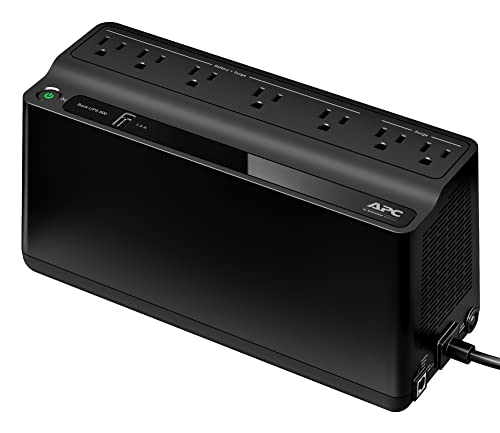
The APC BE600M1 provides essential battery backup and surge protection for a desktop computer, Wi‑Fi router, and other desk devices. With seven outlets, five of which are battery-backed and surge-protected, this unit focuses on keeping critical equipment online during short outages. Best for a minimal home office setup where basic connectivity is a priority. The included USB charging port adds convenience for peripheral devices. A potential limitation is the relatively short runtime at higher loads, which is typical for compact 600 VA units.
Why selected
- Compact, affordable option for small desks
- Supports safe shutdown and keeps router alive during outages
- Surge protection guards against everyday power events
CyberPower ST425 Standby UPS (425VA/260W)

CyberPower ST425 delivers eight outlets with four backed by battery and surge protection and four surge-only outlets, making it suitable for home offices with multiple peripherals such as printers, routers, and game consoles. It uses a right-angle plug and a five-foot cord for flexible placement. Best for users who need a balance of outlets and a compact footprint. Limitation: the standby design provides modest runtime compared with larger line-interactive models.
Why selected
- Ample outlets for a small workstation
- Clear LED status indicators help monitor power events
- Good option when you need separate battery-backed and surge-only outlets
GOLDENMATE 1000VA/800W Lithium UPS (LiFePO4)

This lithium-powered UPS uses a LiFePO4 battery pack designed for longer life and more charge cycles than traditional lead-acid units. It includes eight outlets with both surge protection and battery backup, plus an integrated cooling system for efficient operation. Best for users seeking extended runtime and a compact form factor for desk or shelf placement. Caution: LiFePO4 chemistry requires proper handling and may have different charging characteristics than lead-acid models.
CyberPower CP1500AVRLCD3 (1500VA/900W)

CyberPower CP1500AVRLCD3 is a line-interactive UPS designed for larger workstations and network equipment. It features 12 outlets, with a mix of battery-backup and surge protection, and an integrated LCD that displays important battery and power conditions. Best for users who want reliable protection for a PC, network gear, and peripherals with clear on-device status. Limitation: heavier and bulkier than compact models, making placement less flexible.
CyberPower CP1500PFCLCD PFC Sinewave UPS (1500VA/1000W)

This model provides a true sine-wave output suitable for systems with active PFC power supplies and other sensitive equipment. It includes 12 outlets (six battery-backed, six surge-protected) and two USB ports for charging. Best for power users who need clean, stable power for demanding desktops or small servers. A potential limitation is higher cost and larger footprint compared to smaller UPS units.
CyberPower EC850LCD Ecologic UPS (850VA/510W)

CyberPower EC850LCD focuses on energy efficiency with ECO mode and a compact 12-outlet design, six of which provide battery backup and surge protection. It is well-suited for home offices that want to reduce standby energy use while protecting essential devices. Limitation: lower total backup capacity means shorter runtimes on higher loads.
Buying Guide: How To Choose The Right In-Line Battery Backup
- Runtime needs: Estimate how long you must keep a computer, router, and modem on during outages. Larger VA ratings and higher wattage translate to longer runtimes for the same load.
- Power quality: If your devices include power-hungry PCs or data-sensitive equipment, choose UPS models with sine-wave output or PFC compatibility to prevent resets and keep devices calm during transitions.
- Outlets and layout: Consider the mix of battery-backed and surge-only outlets, transformer spacing, and plug orientation to accommodate your desk layout and peripherals.
- Form factor and noise: Desk-friendly, compact designs save space; larger units may be better for a full small-office setup. Some models include cooling or fans—note any noise considerations if placed near a workspace.
- Battery life and maintenance: Lithium-based UPS units often offer longer lifespans and lighter weight but may have different replacement needs. Traditional lead-acid backups require more routine maintenance awareness.
- LCD and monitoring: Models with a readable LCD panel let you quickly assess battery status, load, and potential faults, reducing downtime risks.
- Safety and certification: Look for UL or equivalent certifications to ensure compliance with electrical safety standards for homes and offices.
Key Comparisons At A Glance
- Best for compact desks: APC BE600M1 or CyberPower EC850LCD for space-conscious setups with basic protection.
- Best for longer outages and heavier loads: CyberPower CP1500PFCLCD or CP1500AVRLCD3 for PCs and network gear requiring more runtime.
- Best for longevity and modern design: GOLDENMATE 1000VA with LiFePO4 provides longer battery life and cleaner energy in a compact form.
FAQ
- What is the difference between line-interactive and standby UPS?
– Line-interactive UPS continuously conditions power and switches to battery during outages, while standby UPS provides basic battery backup with less immediate power conditioning for smaller setups. - How many devices should a UPS power during an outage?
– It depends on the total wattage of connected devices and the UPS rating. Start with essential devices like a PC, monitor, router, and modem to maximize usable runtime. - Is a higher VA rating always better?
– Generally yes for longer runtimes and more connected devices, but consider the physical size, cost, and whether your load justifies the rating. - Do outdoor or garage setups need different UPS specs?
– Yes. Look for models with appropriate protection and safety ratings for environmental exposure and ventilation, and avoid placing directly in outdoor conditions unless rated for it. - Can I mix UPS brands?
– It’s possible to mix brands if they meet compatible electrical characteristics, but consistency in protection levels and surge filtering helps ensure predictable performance.
All five products above offer practical protection for essential electronics during power interruptions. When selecting, prioritize runtime needs, device sensitivity, and space constraints to ensure reliable network and computer uptime without unnecessary expense.