Best Immersion Well Temperature Sensors for Liquid Monitoring
Immersion well temperature sensors protect probes while delivering accurate liquid readings. This guide highlights top picks suited for HVAC, industrial cooling, and process control. Each selection shines in environments with flow, pressure, or harsh liquids, and helps keep sensors safe from damage while maintaining fast response times. Best for installers needing durable, straightforward retrofit options and for engineers seeking robust RTD or thermistor options for steady temperature tracking.
| Product | Type | Probe/Sensor | Length / Size | Best For |
|---|---|---|---|---|
| Honeywell Immersion Well, Copper, 1/2NPT, 3 in. Depth | Immersion well | Various sensors | 3 in | Compact installations where space is limited |
| Honeywell, Inc. 123869A Well Assembly, Copper, 3 inch length | Immersion well assembly | Various sensors | 3 in | Reliable, factory-style assemblies for HVAC systems |
| Siemens 544-577-25 Liquid Immersion Temperature Sensor with 1000-Ohm Platinum, 2.5-Inch | Immersion sensor | Platinum RTD | 2.5 in | High-precision liquid measurements |
| Siemens 544-577-40 Liquid Immersion Temperature Sensor with 1000-Ohm Platinum, 4-Inch | Immersion sensor | Platinum RTD | 4 in | Longer immersion depth for challenging flows |
| Siemens 536-767-25 Liquid Immersion Temperature Sensor, 100 Ohm Platinum RTD, 2.5-Inch Probe | Immersion sensor | Platinum RTD | 2.5 in | High-accuracy RTD with standard signaling |
The table above showcases a mix of copper immersion wells for simple installations and Siemens RTD immersion sensors for higher precision. The selections emphasize compatibility with liquid media, protection for sensing elements, and practical probe lengths for various duct and immersion configurations. Consider compatibility with your existing sensors, mounting fittings, and wiring when choosing a model.
Honeywell Immersion Well, Copper, 1/2NPT, 3 in. Depth
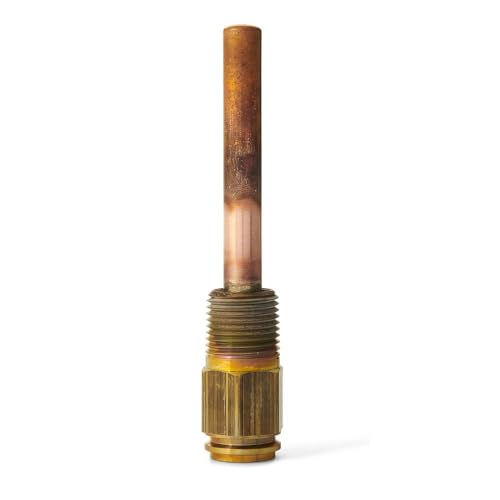
Best for compact installations where a short immersion depth is sufficient. This copper thermowell protects sensors from flow and harsh environments while allowing accurate liquid temperature readings without substantial insulation. Suitable for basic HVAC or process lines, it accommodates 1/2 NPT fittings for straightforward integration. Caution: shorter wells may not suit high-flow or high-velocity streams where deeper immersion improves stability.
Honeywell, Inc. 123869A Well Assembly, Copper, 3 inch length

Best for retrofit HVAC projects that require a ready-to-install well assembly. The 3-inch copper well provides robust protection in moderate flow environments and is compatible with a variety of sensor types. Choose this for stable, maintenance-friendly installations where standardization across multiple zones helps simplify servicing. Limitation: assembly may be larger than ultra-compact duct integrations.
Siemens 544-577-25 Liquid Immersion Temperature Sensor with 1000-Ohm Platinum, 2.5-Inch

Best for high-precision liquid measurements where a 1000-ohm Platinum RTD provides tight tolerances. The 2.5-inch immersion length supports compact installations while delivering stable readings in steady-state flows. Good for commercial cooling loops or process control where accuracy matters. Caution: shorter probes may be more sensitive to dynamic flow shifts in aggressively varying streams.
Siemens 544-577-40 Liquid Immersion Temperature Sensor with 1000-Ohm Platinum, 4-Inch
Best for challenging installations requiring deeper immersion. The 4-inch probe length supports measurement in deeper reservoirs or thicker liquid columns, while the Platinum RTD delivers consistent accuracy. Suitable for large HVAC fans, industrial coolers, or tanks with higher stratification. Limitation: longer probes can increase response time in fast-moving streams if not positioned optimally.
Siemens 536-767-25 Liquid Immersion Temperature Sensor, 100 Ohm Platinum RTD, 2.5-Inch Probe

Best for systems needing standard RTD signaling with high accuracy. The 2.5-inch platinum RTD probe provides a reliable balance of response time and stability in moderate flow. This model pairs well with control modules that expect a platinum RTD input in process or building automation. Caution: ensure signal compatibility with existing controllers if 4-20 mA options are preferred elsewhere in the system.
Honeywell C7735A1000 Discharge Air Temperature Sensor

Best for discharge air temperature sensing in HVAC applications where integration with air handling units is desired. While primarily a discharge sensor, its inclusion here highlights alternatives for mission-specific temperature monitoring in air streams. Best used in tandem with well assemblies if direct immersion in liquids is not required. Limitation: not a traditional liquid immersion well product, so verify application fit before pairing with liquid probes.
Buying Guide: Key Purchase Considerations
- Immersion depth and probe length: Choose a length that matches the liquid column and flow characteristics to ensure accurate readings and quick response times.
- Sensor type: Platinum RTD offers high accuracy and stability; thermistors can be cost-effective for less demanding environments but may drift over time.
- Material and corrosion resistance: Copper wells are common for HVAC and mild environments; consider stainless steel or coated wells for aggressive liquids or high-pressure systems.
- Fitting and connection: Ensure compatibility with your existing wiring, transmitter, or controller, and verify NPT or other thread standards for leak-free integration.
- Environmental exposure: In ducts or hot spaces, select wells designed to minimize heat transfer and protect the sensor element from moisture and contaminants.
- Maintenance and accessibility: Favor assemblies with straightforward maintenance access and standard replacement parts to reduce downtime.
Frequently Asked Questions
- What is an immersion well temperature sensor used for?
It protects the sensing element while allowing accurate liquid temperature readings in flowing liquids or dynamic environments.
- When should I choose a platinum RTD over a thermistor?
RTDs provide higher accuracy and stability over time, making them better for critical process monitoring; thermistors can be suitable for less demanding, lower-cost applications.
- How do I determine the right probe length?
Consider the liquid depth, container geometry, and flow rate. Deeper wells suit taller tanks; shorter wells fit compact ducts or piping runs.
- What installation considerations minimize measurement error?
Avoid placing wells in turbulent zones; ensure proper spacing from fittings and valves to reduce flow-induced fluctuations.
- Are copper wells compatible with all liquids?
Copper works well in many HVAC and mild environments, but harsher chemicals or higher-pressure systems may require stainless steel or protective coatings.
- Can these sensors be used in both air and liquid systems?
Some immersion sensors are designed for liquids only, while others may be adapted for air streams; always verify media compatibility with the sensor type.