Best Hydronic Floor Heat Thermostats for Warm, Efficient Comfort
If you’re upgrading a hydronic floor heating system, the right thermostat can optimize comfort and energy use. This guide highlights five reliable options, from non-programmable basic models to feature-rich programmable controllers. The top picks suit different buyers: DIY renovators seeking simple control, tech-minded homeowners wanting floor and ambient sensing, and installers needing GFCI protection for safety. A quick summary table follows to help you compare at a glance.
| Product | Best For | Key Benefit | Limitations |
|---|---|---|---|
| Honeywell TH6100AF2004 | Mid-range upgrade | Slab sensor compatibility | Limited details in listing |
| Aube by Honeywell TH135-01-B/U | Remote control via phone | Remote input enables mode changes by phone | Requires compatible relay/accessories |
| Azel D-508F | Digital dual-sensor control | Two sensor temperatures displayed | Non-programmable |
| Honeywell TL8100A1008 | 7-day programmable | Multiple heating applications | Basic features compared to smart models |
| OJ Microline UTN4 | Budget with safety | Built-in Class A GFCI | Non-programmable |
Honeywell TH6100AF2004 T6 Pro-1 Heat Slab Sensor Thermostat

Best for: remodel projects needing slab-sensor compatibility and reliable performance. The product is listed as made in the United States, with compact packaging dimensions. It’s positioned for straightforward replacement in hydronic floor heating setups, particularly where slab sensing is desired. This model emphasizes durability and ease of integration in standard underfloor installations.
Why selected: It provides a practical option for users seeking a proven, non-advanced thermostat with slab-sensor capabilities and familiar Honeywell quality. The listing highlights its U.S. origin and compact packaging as ergonomic benefits.
Caution: The available data does not detail programming capabilities or advanced sensor options beyond slab sensing. Verify compatibility with your specific hydronic circuit before purchase.
Aube by Honeywell Home TH135-01-B/U Hydronic Heating Non-Programmable Thermostat

Best for: homes needing simple, reliable hydronic control without programming. This non-programmable unit supports both hydronic floor heating and central heating, and can work with electric heat via a relay when paired with compatible accessories. It also offers remote input features to adjust temperature modes by phone when paired with a suitable controller.
Why selected: It suits buyers who want a straightforward, durable thermostat with broad compatibility, including 24-Volt systems and remote operation potential. The ability to adapt to different heating sources adds flexibility in retrofit scenarios.
Limitation: The setup may require additional accessories for full remote control and certain relay configurations. Check compatibility with your relay options and installation environment.
Azel D-508F: NON-PROGRAMMABLE Digital Slab Sensing Thermostat

Best for: users needing a dual-sensor readout for ambient and floor temperatures with clear digital displays. The Azel D-508F provides two-sensor visibility and fixed control modes for precise slab and ambient temperature management in hydronic radiant floor systems.
Why selected: The dual-display capability helps ensure comfortable floor performance by showing both ambient and floor temperatures simultaneously, aiding accurate setpoint adjustments. This is useful in rooms with variable heat requirements.
Caution: It is non-programmable, so users who want automatic daily scheduling should consider other programmable options. Make sure the sensors and modes align with your floor-warming strategy.
Honeywell TH1100DV1000/U Pro 1000 Vertical Non-Programmable Thermostat

Best for: basic, dependable control of multiple heating configurations. The TH1100DV1000/U is a non-programmable model featuring compact dimensions and a Premier white finish, suited for simple, reliable hydronic baseboard or radiant heating control in U.S. installations.
Why selected: It provides a straightforward choice for homeowners prioritizing simplicity and standard load handling with a familiar, American-made footprint.
Limitation: Lacks programmable scheduling and advanced energy-management features found in more modern thermostats; limited to basic on/off control.
Programmable Thermostat for House Radiant Underfloor Heating — BOWSEN
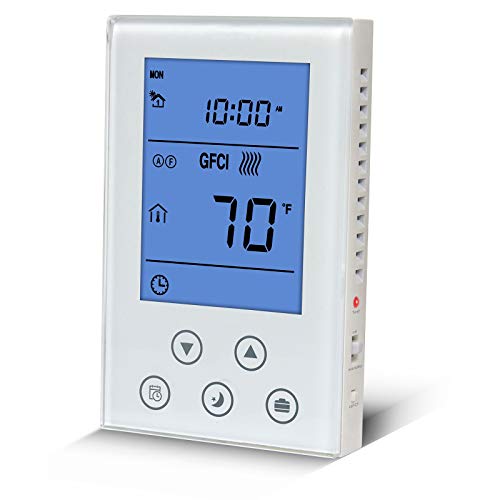
Best for: underfloor radiant heating systems requiring 120/240V operation with floor and air sensing. This model supports dual sensing, built-in GFCI, and compatibility with 120V and 240V circuits up to 3600W at 240V (1800W at 120V). The GFCI protection is integrated for safety in floor warming applications.
Why selected: The built-in GFCI and dual-sensing features support safer operation and more precise temperature control for floor coverings. It is a strong choice for systems that require safeguards against electrical faults.
Caution: The GFCI function requires proper testing after installation to ensure safety. If trips occur, troubleshooting steps are indicated; follow the unit’s safety guidance exactly.
Honeywell TL8100A1008 Programmable Hydronic Thermostat

Best for: homes needing flexible seven-day programming across multiple heating zones. The TL8100A1008 supports controls for baseboards, convectors, radiant ceilings, and central heating, making it a versatile option for diverse hydronic layouts.
Why selected: Its seven-day programming and broad application range help optimize comfort schedules and energy use across different rooms or zones. This makes it a practical upgrade for steady, scheduled heating needs.
Limitation: It may lack advanced connectivity features found in newer smart thermostats, focusing instead on reliable programmable control.
Buying Guide: Hydronic Floor Heat Thermostat Considerations
What type of control do you need?
Non-programmable thermostats are simple and reliable for basic on/off control. Programmable models offer scheduling to align heating with daily routines, potentially saving energy. Consider whether you need remote control via phone or app.
Do you require dual sensing or single sensing?
Dual-sensing units display and manage ambient and floor temperatures, aiding precise comfort. If floor temperature is critical for your flooring material, a dual-sensing model is beneficial.
Is GFCI protection important?
For underfloor heating, built-in GFCI offers safety against electrical faults. Units like the OJ Microline UTN4 and BOWSEN models integrate Class A GFCI or GFCI protection—useful in wet or high-traffic installations.
Voltage compatibility and power handling
Most hydronic thermostats operate on 120V or 240V. Check the maximum wattage the thermostat supports to ensure it matches your system’s load. Some models support dual voltage for flexible wiring options.
What installation considerations matter?
Review compatibility with your existing boiler or manifold, sensor placement (ambient vs. floor), and whether you need remote sensing or relay accessories. Ensure the thermostat’s dimensions fit your electrical box and mounting space.
Smart features and future-proofing
While many options are non-programmable, programmable or remote-capable models offer energy-saving potential and easier future upgrades. If you foresee expanding your smart home, choose a model with compatible remote or integration options.
FAQ
- What is a hydronic floor heat thermostat? A thermostat that controls hot water flow in hydronic radiant floor systems, regulating temperature for comfort and efficiency.
- Do I need a GFCI on a radiant heating thermostat? GFCI protection helps prevent electrical shock in wet environments. It is often recommended for in-floor heating installations.
- Should I choose programmable or non-programmable? Programmable thermostats save energy by scheduling heating; non-programmable models are simpler and easy to use for basic control.
- Can these thermostats control both ambient and floor temperature? Some models offer dual sensing to monitor both ambient and floor temperature for better control.
- Will my existing boiler work with these thermostats? Most hydronic thermostats are designed to work with common boiler setups, but verify voltage, relays, and wiring requirements for your system.
- Are these compatible with smart home systems? Many non-smart thermostats are standalone; some programmable models offer remote inputs or app compatibility, but confirm compatibility before buying.