Best Humidity Switches for Dehumidifiers and Humidistat Controllers
Choosing the right humidity switch or humidistat controller can simplify keeping indoor environments within a target humidity range. Whether you’re managing a greenhouse, a grow tent, a mushroom chamber, or a reptile enclosure, a reliable humidity switch helps automate dehumidification, humidification, and ventilation. This guide highlights five top picks, summarizes their strengths, and provides practical buying tips to match your application needs.
| Product | Brand | Key Use |
|---|---|---|
| DIGITEN Humidity Controller Pre-Wired Digital Humidistat | DIGITEN | Humidity control with temperature display; dual-stage control |
| Leviton Humidity Sensor Switch for Bathroom Exhaust Fan | Leviton | Automated ventilation and moisture control |
| MEISAIL Humidity Controller Greenhouse Shiitake | MEISAIL | Grow tent and greenhouse humidity management |
| [New Generation] Ortis In-Wall Humidity Sensor Switch | Ortis | Auto/Manual control for bathroom ventilation |
| VIVOSUN Humidity Controller, 1200W | VIVOSUN | Dual-stage control for humidifier/dehumidifier and fan |
Introduction (continued): The products below offer a range of sensing accuracy, ease of installation, and control options—from simple plug-and-play models to wall-mounted, in-wall controllers with digital displays. Each section presents practical details to help you compare performance, compatibility, and setup for your space.
DIGITEN Humidity Controller: Pre-Wired Humidistat

The DIGITEN humidity controller features a high-precision Swiss-imported humidity sensor capable of regulating and maintaining humidity from 5% to 99% RH. With a digital signal chip, accuracy is maintained within ±3% RH. It also provides real-time temperature readings to help you monitor ambient conditions. This non-programmable device is plug-and-play: set your target humidity and let it automatically manage connected equipment. Suitable for mushroom rooms, reptile enclosures, greenhouses, and grow tents where straightforward control is preferred.
Key considerations:
- Pros: High humidity precision, temperature display, simple plug-and-play setup.
- Cons: No programmable schedules; fixed control logic.
- Best for: Environments needing reliable humidity maintenance with minimal setup.
Leviton Humidity Sensor Switch for Exhaust Fans

Leviton’s humidity sensor switch automates bathroom ventilation by turning the fan on or off in response to moisture levels. Its slim profile fits most wall boxes, making installation straightforward. The switch is flexible enough to be installed with or without a neutral wire, expanding compatibility with existing electrical setups. Ideal for bathrooms, laundry rooms, or small damp spaces where automatic moisture control is desired without complex programming.
Key considerations:
- Pros: Automatic ventilation, easy installation, flexible neutral-wire options.
- Cons: Focused on ventilation; may not control humidifiers directly.
- Best for: Auto-triggered exhaust in damp areas with simple wiring needs.
MEISAIL Humidity Controller For Grow Spaces

MEISAIL’s humidity controller is designed for greenhouse and grow-tent environments, including shiitake cultivation. The device features a blue dual-display for clear readability and a Swiss sensor chip with a typical error range within the 5%–95% humidity spectrum (±2% within range at room temperature). The unit employs waterproofing and moisture-proof technology for reliable operation in humid settings, making it suitable for cultivation spaces where precise humidity control is essential.
Key considerations:
- Pros: Dual-display, robust sensing, humidity-focused control.
- Cons: Interface and language may appear less polished; check for firmware updates if available.
- Best for: Cultivation spaces requiring stable humidity with reliable sensor performance.
Ortis In-Wall Humidity Sensor Switch
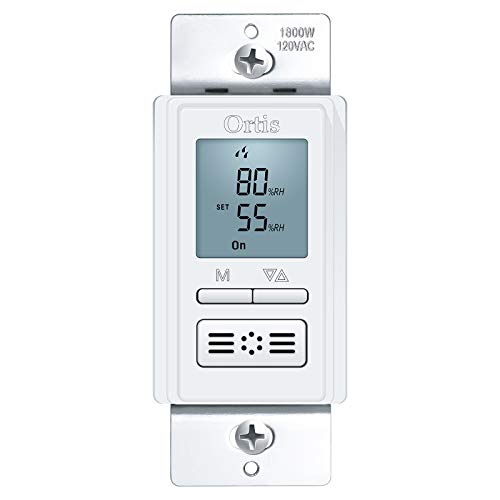
This new-generation Ortis in-wall switch offers auto and manual modes for bathroom ventilation. It features an in-wall installation footprint and supports humidity-triggered fan operation, with the ability to connect a humidifier for additional moisture when needed. The device provides adjustable auto run times (1–60 minutes) and manual run/off modes, delivering flexible control for maintaining a dry bathroom or a comfortable humidified space in dry weather.
Key considerations:
- Pros: Auto/manual modes, flexible run-time settings, support for humidifier connection.
- Cons: In-wall installation may require electrical work.
- Best for: Bathrooms where precise humidity and user-controlled run times are important.
VIVOSUN Humidity Controller With Dual Relays

VIVOSUN’s humidity controller offers dual relay outputs to simultaneously manage a humidifier and a dehumidifier or a fan. It controls humidity by setting target and differential values and automatically switches between humidification and dehumidification. The unit includes high- and low-humidity alarms, a sensor fault alarm, and compressor delay protection for safety. Its large dual LED displays provide real-time and setpoint data, with a 5.9-foot power cord and a hanging tab design for flexible installation.
Key considerations:
- Pros: Dual relays, alarms and protections, user-friendly display.
- Cons: Slightly bulkier than single-relay options.
- Best for: Greenhouses, grow tents, and rooms requiring coordinated humidity control and reliable alerts.
Buying Guide: Key Purchase Considerations
- Application needs: Determine whether you require humidity-only control or combined humidity with temperature sensing. Consider if you need automatic control for humidifiers, dehumidifiers, or fans, or if a simple on/off switch suffices.
- Sensor accuracy: Look for sensors with tight tolerances (±2% to ±3% RH in typical ranges) and temperature readouts if needed for monitoring, not necessarily control.
- Mounting and wiring: Decide between plug-in, table-top, or in-wall installations. Confirm whether a neutral wire is required and assess compatibility with existing electrical boxes.
- Control features: Choose between single-stage versus dual-relay devices, auto/manual modes, programmable run times, and alarm capabilities for alerts on out-of-range conditions.
- Environment and protection: For humid or wet environments, prioritize models with waterproof or moisture-proof construction, splash resistance, and protective housings when necessary.
- Ease of use and visibility: Large LED or digital displays facilitate quick readings and setpoint adjustments, reducing the chance of misconfiguration in dim spaces.
- Compatibility: Verify electrical load ratings (amp/HP) for connected devices to avoid overloading circuits and ensure safe operation.
- Maintenance and support: Check whether the device offers diagnostic indicators, fault alarms, and user manuals with clear setup instructions.
- Budget and scalability: If you anticipate expanding your setup, choose a model with flexible wiring and additional control options to accommodate future needs.
- Safety considerations: Ensure devices include proper insulation, grounded wiring, and compliance with local electrical codes for safe installation.
When selecting a humidity switch for a dehumidifier or humidistat controller, prioritize reliability, ease of setup, and the ability to match your space’s specific humidity targets. The right unit can provide consistent environmental conditions with minimal manual intervention, supporting healthier plants, animals, or products while protecting equipment from moisture-related issues.