Best Home Electricity Storage Systems for Efficient Power Management
Power reliability and energy efficiency are top priorities for modern homes. This guide highlights five leading home electricity storage products that help monitor usage, optimize solar or grid energy, and manage power more intelligently. From whole-panel monitoring to plug-in meters and advanced energy storage solutions, these options are designed for American households seeking better visibility and control over electricity costs and consumption.
| Product | Brand | Key Feature |
|---|---|---|
| Smart Home Energy Monitor with 16 50A Circuit Sensors | Fusion Energy | Real-Time Power Usage & Cost Tracking |
| KETOTEK Watt Meter Plug | KETOTEK | On-the-go Appliance Energy Monitoring |
| Refoss Smart Home Energy Monitor | Refoss | Local Data, Open API, Home Assistant |
| HBN Watt Meter Plug | HBN | 9 Display Modes, Backlit Screen |
| ECO-WORTHY Home Power Station | ECO-WORTHY | Large Battery Pack With UPS |
Smart Home Energy Monitor With 16 50A Circuit Sensors

The Fusion Energy monitor is designed for comprehensive power awareness across residential panels. It supports single-phase up to 240VAC line-neutral and three-phase configurations up to 415Y/240VAC, making it versatile for various homes, including rental properties. Its clamp-on 16-sensor setup enables detailed tracking of major loads such as air conditioning, water heating, and large appliances. The device provides real-time power insights and can log solar net metering data, helping users spot energy savings opportunities and prevent costly repairs. A one-year warranty adds a layer of assurance for ongoing use.
Key features include wide compatibility with multiple phase configurations, real-time remote monitoring, and granular load tracking across 16 branch circuits. The system can automatically match branch lines to different phases, though some busbar-only panels may require alternative sensors. This monitor is well-suited for homeowners or property managers who want a single, centralized view of electricity usage across a home or small building.
KETOTEK Watt Meter Power Meter Plug

The KETOTEK plug-in meter is a compact energy monitor that sits between a wall outlet and an appliance. It offers a straightforward interface with a 5-button control, allowing users to quickly switch between parameters such as KWh, cost, voltage, current, and frequency. The device displays true RMS voltage and current, power factor, and maximum/minimum power readings. It includes overload and alarm features to warn users when consumption exceeds customized thresholds, helping prevent unexpected spikes in electricity bills. This model is ideal for monitoring individual devices like computers, TVs, or refrigerators.
With its user-friendly LCD and immediate feedback on electricity cost and usage, it helps households identify energy-hungry devices and adjust usage patterns. The plug-in form factor makes it an affordable entry point for energy monitoring or for households experimenting with demand management before investing in whole-home systems.
Refoss Smart Home Energy Monitor
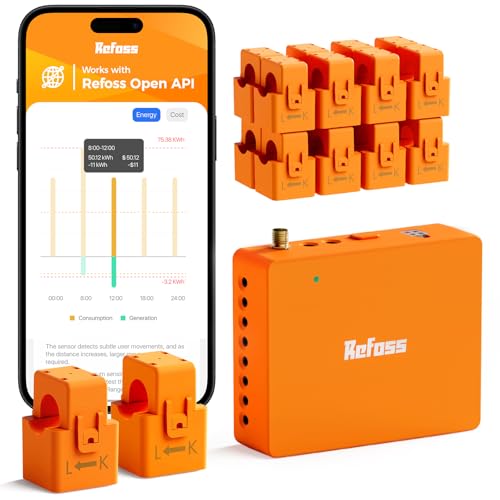
The Refoss energy monitor emphasizes local control and privacy, offering open API and MQTT for integration with Home Assistant and other smart-home platforms. Its clamp-on design supports two main 200A sensors along with 16 branch sensors rated up to 60A each, suitable for single-phase through three-phase Wye configurations (excluding Delta). Local data storage ensures energy data remains private, while still enabling automation and detailed energy management. Native Home Assistant integration allows for seamless automations to manage loads, solar surplus, and time-of-use strategies.
Smart automation features enable efficient use of solar energy by prioritizing higher-value loads for daytime operation and directing excess solar to heat pumps or dishwashers. Users can implement net-metering strategies and energy-saving routines that integrate with solar production for optimized self-consumption and reduced grid reliance.
HBN Watt Meter Plug With Backlight

The HBN watt meter plug includes a backlit LCD with a wide viewing angle for visibility in any room. It supports nine data display modes, including power (W), energy (kWh), voltage (V), current (A), power factor (PF), and estimated electricity cost. The device demonstrates its value by letting users quickly switch between data types to analyze usage patterns, identify standby power, and estimate costs over time. The automatic backlight-off feature conserves energy while maintaining legibility when needed.
With its broad display options and straightforward operation, this plug-in monitor is ideal for households looking to track individual device energy profiles without installing a full home energy system. It complements larger monitors by providing quick, actionable insights at the outlet level.
ECO-WORTHY Home Power Station

The ECO-WORTHY Home Power Station is a high-capacity energy storage system designed for home backup needs and solar integration. It features a 30720Wh LiFePO4 battery pack and a 10000W pure sine wave inverter with a 48V (51.2V) nominal rating. The system supports 120V/240V AC outputs and includes CAN/RS485 communication, Bluetooth/Wi‑Fi monitoring, and a full-metal shell for durability. It also provides UPS automatic switching to seamlessly transfer from grid to battery during outages, enabling continuous power for essential loads. A 125A circuit breaker adds protection for safe operation in a home environment.
UL certifications and compliance with safety standards are noted, including UL9540A battery certification considerations. This option is suitable for homes seeking a substantial energy resilience solution, including backup power during outages, while enabling remote monitoring and control via an app. It can be charged from the grid or solar sources, supporting flexible energy management and potential long-term savings on energy costs when paired with solar generation.
Buying Guide
When evaluating home electricity storage and monitoring solutions, consider these factors to match real-world needs:
- Monitoring scope: Choose between whole-home panels (16+ sensors) and outlet-level meters depending on whether you want a holistic view or device-level detail.
- System compatibility: Ensure the device supports your home’s wiring configuration (single-phase, split-phase, or three-phase) and that it installs within your electrical panel or at outlets as needed.
- Data access and privacy: Local control options (Open API, MQTT, or direct Web UI) reduce reliance on cloud services and enhance privacy and automation reliability.
- Automation integration: Look for native support for Home Assistant or other platforms if you plan extensive smart-home automations and solar optimization.
- Display and usability: For quick insights, meters with clear displays and multiple data modes are helpful, especially for non-technical users.
- Power capacity and UPS: If backup power is a priority, evaluate energy storage capacity, inverter size, and automatic switching features to match your essential-load needs.
- Safety and certifications: UL or UL 9540A listings and robust enclosure designs are important for long-term, safe operation in residential spaces.
For renters or homeowners with solar setups, prioritize devices offering solar metering, net-metering data, and the ability to direct surplus energy to high-value loads. Consider starting with a plug-in meter for individual devices to build a usage profile before expanding to a full home monitoring system or a power station with backup capabilities. Finally, verify warranty terms and after-sales support to ensure ongoing reliability as your energy management needs evolve.