Best Home Electrical Automation Systems for Smart Energy Management
Smart home energy management continues to grow as households seek safer, more efficient ways to monitor consumption, integrate solar, and automate circuits. This article highlights five leading Amazon-found products designed to give you real-time usage data, reliable safety certifications, and easy installation in typical US homes. Read on to compare capabilities, compatibility, and practical benefits of each system.
| Product | Brand | Key Features |
|---|---|---|
| Emporia Vue 3 Energy Monitor (UL Certified) | EMPORIA | UL Listed, in-panel installation, real-time monitoring, solar/net metering, 1-year warranty |
| Fusion Energy Monitor | Fusion Energy | 16 x 50A sensors, real-time power, solar/net metering, 1-year warranty |
| Meross Smart Energy Consumption Monitor | meross | ETL/UL 61010, 18 circuits, real-time data, no subscriptions, 2-year warranty |
| Home Assistant Green | Nabu Casa | Official Home Assistant hardware, plug-and-play setup, compact, quiet |
| Emporia Vue 3 Energy Monitor II | EMPORIA | UL certification, panel installation, multi-phase support with optional sensors, 1-year warranty |
Introduction: This guide focuses on in-panel energy monitors and smart hubs designed to give homeowners visibility into power usage, monitor solar or grid interactions, and support automation through integrations with smart home ecosystems. Each product below offers a different emphasis—safety certification, multi-circuit monitoring, ease of installation, or advanced automation support—so you can match a system to your home’s electrical setup and data needs.
Emporia Vue 3 UL Energy Monitor
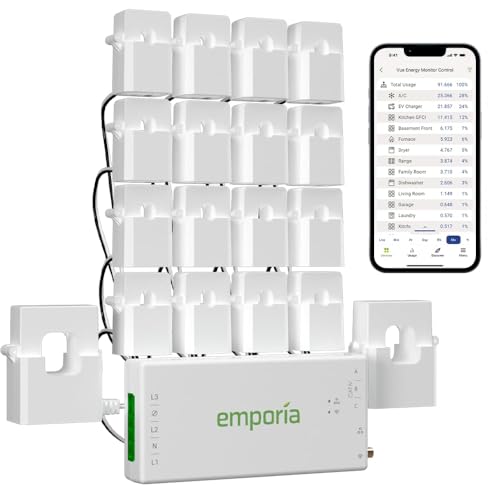
The Emporia Vue 3 Energy Monitor combines robust safety with comprehensive real-time energy data. It is UL Listed, meaning it meets stringent safety standards for electrical devices in the United States and Canada, reducing risks such as overheating or short circuits. The system installs in the circuit panel using clamp-on sensors and supports various configurations: single phase, single-split phase, and 2-wire systems; 3-wire systems; and 3-phase, 4-wire Wye systems. For more complex electrical layouts, a 200A sensor (sold separately) enables full three-phase coverage. Real-time monitoring lets you manage power usage, optimize appliance operation, and track solar net metering. A 1-year warranty provides basic assurance against manufacturing defects. Features are designed to help homeowners automate energy saving and monitor solar integration with daily insight into consumption patterns.
Fusion Energy Smart Monitor

This Smart Energy Monitor from Fusion Energy emphasizes broad circuit coverage with 16 50A sensors, making it suitable for both single-family homes and small multi-unit settings. It provides real-time power usage data and supports monitoring of solar generation and net metering, helping households balance grid consumption with on-site generation. The system is designed for straightforward installation in the circuit panel and includes a warranty period to address potential issues. It’s particularly useful for rental properties or shared apartments where precise circuit-level insight helps prevent misuse of high-energy appliances and supports energy budgeting across tenants or units. The flexible sensor approach helps monitor major energy users like air conditioning, heating, and water heating with clarity.
Meross Smart Energy Monitor

Meross offers an ETL-certified energy monitor with 18 circuit monitoring capability and no subscription requirements. The clamp-on design makes installation quick in common US panel configurations, including single-phase, single-split phase, and 3-phase Wye systems. The device records voltage, current, power, and power factor with claimed accuracy within a tight margin, enabling precise tracking of energy use. The app supports real-time monitoring, alerts, and historical data spanning multiple timeframes, which can help identify energy hogs and validate efficiency improvements. A two-year warranty provides additional assurance. This monitor is particularly appealing for homeowners seeking a cost-effective solution with straightforward data visualization and Home Assistant compatibility options via app integrations.
Home Assistant Green Hub

The Home Assistant Green hub is official hardware designed to accelerate smart home automation, integrating with the Home Assistant ecosystem for robust automation and device control. It comes as a compact, fanless unit with a quad-core processor, ample storage, and sufficient RAM to support local automation, scene control, and device integrations without relying on cloud-dependent processing. The emphasis is on reliability, security, and a low-noise footprint for home installations. This hub works best for users who want enhanced control over automations, routines, and advanced home integrations in a dedicated, mission-critical device designed by the Home Assistant project team. It is ideal for those who value privacy and local control in their energy and appliance automation strategies.
Emporia Vue 3 Energy Monitor II
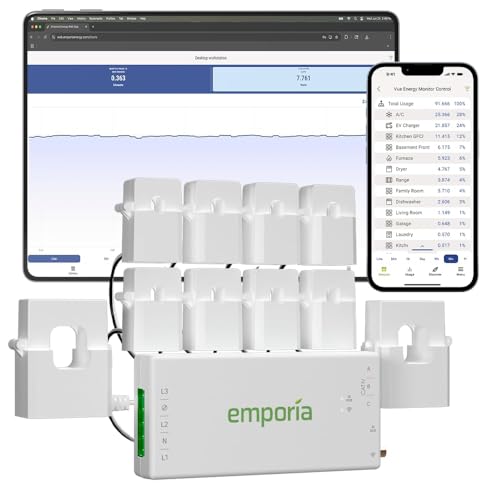
The Emporia Vue 3 Energy Monitor II poses as a refined variant designed for UL certification and in-panel installation with clamp-on sensors. It supports multi-phase configurations and earthed neutral connections, including options for 3-phase, 4-wire systems with additional sensor accessories. The device continues Emporia’s emphasis on continuous energy management and monitoring—allowing remote management of the home’s real power and solar/net metering data. Its warranty coverage helps provide long-term assurance. Homeowners can leverage the Vue 3 ecosystem for automated energy-saving routines, solar optimization, and a clearer view of consumption across circuits, promoting more informed energy usage decisions.
Buying Guide: Key Considerations For Selecting A Home Energy Monitor
- Safety certifications: Look for UL/ETL listings to ensure electrical safety and compliance with national standards.
- Panel compatibility: Confirm panel type (single-phase, 3-phase, Wye or Delta) and sensor needs. Some systems require additional sensors for full 3-phase coverage.
- Sensor count and granularity: More sensors enable circuit-level monitoring, which is valuable for pinpointing energy hogs in major appliances.
- Solar and net metering support: If you have solar panels, choose a monitor that can track production and net metering in real time.
- Data access and privacy: Consider whether data is stored locally or in the cloud, and what integrations exist (Home Assistant, etc.).
- Warranty and support: A longer warranty and responsive support reduce risk for long-term use in a home setting.
- Automation compatibility: If you use Home Assistant, open ecosystems and official integrations can simplify automation workflows.
- Installation ease: Some devices are plug-and-play in the panel with clamp-on sensors, while others may require a more involved panel work.
In summary, these options provide a spectrum from highly certified, professional-grade monitoring to flexible, consumer-friendly hubs that integrate with popular automation platforms. Whether you prioritize safety, precise circuit-level insight, or seamless automation, the right energy monitor can help you understand usage patterns, optimize efficiency, and maintain safer, more reliable electrical systems in a modern smart home.