Best High-W Wattage Portable Generators for Severe Power Outages
When you need reliable, high-capacity portable power, a generator with ample wattage matters. This guide highlights top options that deliver substantial peak and running watts for whole-home backup, RV use, and job sites. Each model combines durability, fuel flexibility, and practical features to support American households during outages and emergencies.
The following table lists five high-wattage portable generators selected for their performance, fuel flexibility, and safety features. Use it as a quick reference to compare peak watts, running watts, and core capabilities.
| Product | Peak Watts | Running Watts (Gas) | Fuel Type | Key Features |
|---|---|---|---|---|
| Westinghouse 14500 Peak Watt Tri-Fuel | 14,500 | 11,500 | Gas / Propane / Natural Gas | Remote start, transfer switch ready, long runtime |
| Westinghouse 13500 Peak Watt Dual Fuel | 13,500 | 10,500 | Gas / Propane | Remote start, transfer switch ready, CO safety and digital metrics |
| DuroMax XP13000EH | 13,000 | 13,000 (Gas) / 9,800 (Propane approx) | Gas / Propane | Dual fuel versatility, electric start, whole-home readiness |
| Westinghouse 12500 EFI Dual Fuel | 12,500 | 9,500 (Gas) / 8,500 (Propane) | Gas / Propane | CO sensor, multiple outlets, transfer switch ready |
| Westinghouse 11000 Dual Fuel | 11,000 | 8,800 (Gas) / 8,100 (Propane) | Gas / Propane | Remote start, multiple outlets, LED data display |
Westinghouse 14500 Peak Watt Tri-Fuel

The Westinghouse 14500 Peak Watt Tri-Fuel generator offers peak outputs of 14,500 watts with running watts up to 11,500 on gasoline, 13,500 peak and 10,500 running on propane, and 12,000 peak with 9,500 running on natural gas. Powered by a heavy-duty 550cc 4-stroke OHV engine with a cast-iron sleeve, this unit is designed for long life and steady performance. It can run up to 19 hours on a 9.5-gallon tank and roughly 7 hours on a 20-pound propane cylinder, making it suitable for extended outages. Features include remote electric start, transfer switch readiness, and multiple fuel compatibility for flexibility in emergencies.
Westinghouse 13500 Peak Watt Dual Fuel

The Westinghouse 13500 Peak Watt Dual Fuel model delivers 13,500 peak watts and 10,500 running watts on gasoline, with 12,500 peak and 9,500 running watts on propane. It includes a key fob remote start, electric and recoil start options, and up to 19 hours of runtime on a 9.5-gallon tank with a fuel gauge. This unit provides two transfer-switch-ready outlets (L14-30 and 14–50) and an RV-ready 14–50R outlet, plus several standard outlets with rubber covers for safety. It also features an automatic low-oil shutoff and a CO sensor for enhanced protection.
DuroMax XP13000EH Dual Fuel

The DuroMax XP13000EH provides 13,000 watts of power with dual-fuel capability for either gasoline or propane. It is designed for whole-home backup and transfer switch readiness, making it suitable for storms and outages. The engine is built to deliver reliable performance, and the dual-fuel design offers flexibility when fuel availability is uncertain. This model is widely used for home, job site, and RV applications, ensuring robust power delivery in emergencies.
Westinghouse 12500 Peak Watt EFI Dual Fuel
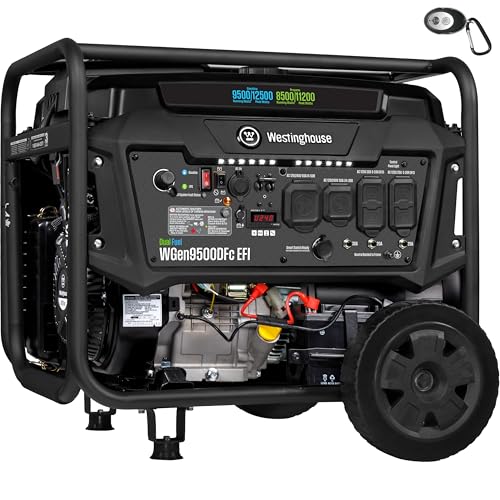
The Westinghouse 12500 EFI Dual Fuel offers 12,500 peak watts and 9,500 running watts on gasoline, with 11,200 peak and 8,500 running watts on propane. It runs up to 15 hours on a 6.6-gallon fuel tank and includes a remote start fob, multiple transfer-switch-ready outlets, and GFCI outlets with rubber covers. The engine features a cast-iron sleeve, automatic low oil shutdown, and a CO sensor for safety, making it a strong option for home backup and RV use.
Westinghouse 11000 Peak Watt Dual Fuel

The Westinghouse 11000 Dual Fuel provides 11,000 peak watts and up to 8,800 running watts on gasoline, with 10,000 peak and 8,100 running watts on propane. It features remote electric start, a user-friendly LED data center display, two GFCI outlets, and multiple transfer-switch-ready outlets. A CO sensor and digital hour meter assist with safety and maintenance tracking, while the parallel-capable design allows pairing with another unit for extra power needs.
WEN DF680iX Quiet 6800-Watt

Note: This model sits just below the top tier in wattage but remains a strong option for compact capacity with dual-fuel flexibility. It offers 6800 surge and 5100 running watts on gasoline, 6000 surge and 4500 running watts on propane. It includes a CO watchdog for safety, and its bonded-neutral 240V configuration supports Level 2 charging for electric vehicles. It is suitable for mid-sized power needs and backup scenarios where portability matters.
WEN DF5600X 5,600-Watt

The WEN DF5600X provides 5,600 surge watts and 4,500 running watts on gasoline, with a similar capability on propane. It includes CO shutdown features and an electric start option for quick power restoration. While not in the top wattage tier, it remains a practical option for smaller homes or as a supplementary power source during outages.
DuroStar DS13000MX 13,000-Watt

The DuroStar DS13000MX delivers 13,000 watts with dual-fuel capability for gasoline or propane, designed for whole-home backup and emergency readiness. It includes remote electric start and transfer switch compatibility, making it suitable for residential and RV use. The unit emphasizes safety with CO detection and robust construction, supporting dependable performance during outages.
Buying Guide: Key Purchase Considerations
When choosing a high-wattage portable generator, consider: peak vs. running watts for your essential loads; fuel flexibility (gasoline, propane, natural gas); starting method (remote, electric, recoil); transfer switch compatibility for safe home backup; safety features (CO sensor, automatic shutdown, CO watchdog); outlets and wiring (GFCI, RV, and 120/240V capabilities); run time on a full tank and fuel efficiency; noise level and portability; and warranty/support from reputable brands. Compare units on how quickly they can power essential devices, like refrigerators, heating systems, sump pumps, and lights, while accounting for fuel availability and maintenance requirements. Parallel operation options can offer scalable power for larger loads.
Also assess safety and compliance: look for CO sensors, automatic shutdown when CO is detected, and CARB-compliant models where applicable. For US homes, ensure the unit is suitable for transfer-switch installation and has protective features like rubber outlet covers and low-oil shutdown. Finally, verify availability of replacement parts and local service networks to ensure reliable long-term support.
In summary, for serious power needs during outages, prioritize higher peak watts with solid running watts, dual-fuel flexibility, reliable starting options, and robust safety systems. The models above provide strong options across different budgets and power requirements, helping households stay functional when the grid goes down.