Best High-Watt RV Solar Panels for Off-Grid Power
For RV owners chasing reliable, high-output solar solutions, selecting the right high-watt panels matters. This guide highlights top-performing options designed for RV rooftops, marine use, and off-grid setups. Each pick prioritizes efficiency, durability, and shading tolerance to keep appliances running on sunny days and cloudy ones alike. Below, you’ll find a concise buying table and five in-depth product sections to help you compare performance, installation fit, and long-term value.
| Product | Brand | Wattage | Key Feature |
|---|---|---|---|
| Renogy 400W ShadowFlux Kit | Renogy | 400 W | Anti-shading technology, 16BB N-Type cells |
| Callsun N-Type 16BB 400W | Callsun | 400 W | Bifacial, 16BB cells, dual 200W panels |
| Renogy 400W N-Type 24V Panels | Renogy | 400 W | Lightweight, 24V compatibility, high efficiency |
| Renogy 200W ShadowFlux N-Type | Renogy | 200 W | Compact, anti-shading, 16BB cells |
| Rvpozwer 400W 18BB N-Type | Rvpozwer | 400 W | 18BB cells, high efficiency, robust build |
Note: All selections are designed for RVs and off-grid systems, emphasizing efficiency, shading resilience, and long life. Images are provided from product listings for quick visual reference. Links lead to Amazon product pages for additional specifications and purchasing options.
Renogy 400W ShadowFlux Anti-Shading Kit

The Renogy 400W ShadowFlux solar panels use anti-shading technology to maintain power output when parts of the panel are shaded by trees or structures. Built with advanced N-Type cells and 16BB technology, these panels deliver up to 25% efficiency. The design is lightweight for rooftop installations and supports 24V system configurations, making it a strong option for RV roofs needing reliable power in varied light conditions. Designed to reduce hot spots and micro-cracks, this kit emphasizes durability for off-grid use.
Callsun N-Type 400W Bifacial Twin Panels

The Callsun 400W bifacial panels feature N-Type 16BB cells and a bifacial design that captures sunlight from the front and rear, potentially increasing total output by up to 30%. The two-panel (200W each) configuration suits RV roofs with moderate space, providing reliable daytime power while reducing hotspot risk with dual-module architecture. The kit emphasizes longevity in marine and off-grid environments, backed by resilient materials and balanced electrical design.
Renogy 400W N-Type Panels (24V)

Renogy’s 400W N-Type panels are designed for Class B vans and other compact RV installations. They’re 7.5% smaller and 11.7% lighter than prior models, focusing on space-saving without sacrificing output. The 25% cell efficiency from 16BB N-Type cells helps reduce microcracks and hot spots, improving longevity in heat and sun exposure. Compatible with 12V and 24V battery systems, these panels offer flexible deployment for varied RV electrical setups.
Renogy 200W ShadowFlux N-Type Panel

This 200W Renogy panel features ShadowFlux anti-shading technology and 16BB N-Type cells, delivering up to 25% cell efficiency. It’s designed to be compact and lightweight, making installation on RV rooftops easier while maintaining strong output in shaded conditions. The panel’s reduced footprint supports flexible mounting and easier storage during travel or in garages, ideal for smaller RVs or multi-panel configurations.
Rvpozwer 400W 18BB N-Type Panel
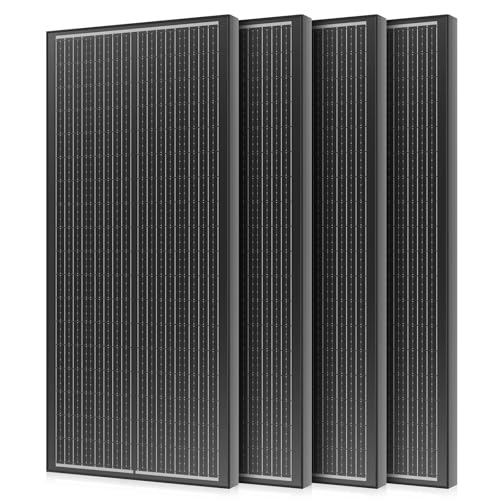
Rvpozwer’s 400W kit uses 18BB N-Type cells designed to deliver high power with enhanced durability. The 18BB configuration helps increase conversion efficiency while mitigating hot spots, promoting longer panel life in varied RV environments. The kit is suitable for larger RV roofs or stacked arrays, offering robust performance in off-grid setups, including marine and rooftop applications. The build emphasizes corrosion resistance and wind/snow loading tolerance for rugged outdoor use.
Buying Guide
Key purchase considerations for high-watt RV solar panels include panel type, efficiency, shading tolerance, system voltage, and installation footprint.
- Cell technology and efficiency: N-Type with 16BB or 18BB buses typically offer higher efficiency and lower hotspots than older P-Type designs. Look for panels that advertise 25% efficiency or higher for more daily energy in limited sun.
- Shading resilience: Anti-shading or ShadowFlux/bifacial designs help maintain output when RV roofs have obstructions or partial shade. This is crucial for trees, overhead branches, or nearby structures.
- System voltage compatibility: Ensure the panel’s voltage matches your battery bank (12V vs 24V) and your charge controller. Higher-watt, multi-panel arrays often pair best with 24V configurations for efficiency.
- Durability and mounting: RV installations require lightweight, weather-resistant panels with robust frames and corrosion resistance. Consider panels designed for mobile mounting and wind loading tolerance.
- Portability vs. capacity: Larger 400W panels deliver more energy but require more roof space. For smaller RVs, a mix of 200W panels with efficient shading tech can be a practical compromise.
- Longevity and warranty: Look for long-term warranties and EL testing or quality assurances. Panels with durable builds and comprehensive warranties reduce total cost of ownership over time.
- Maintenance and serviceability: Flat, easy-to-clean surfaces and accessible terminals simplify upkeep on the road or at remote campsites.
In practice, a typical RV off-grid setup often benefits from a 400W to 800W array when paired with a capable charge controller and a 12V or 24V battery system. For tight RV roof spaces, prioritize weight and footprint with high-efficiency, anti-shading panels. For larger roofs or marine environments, bifacial or dual-panel configurations can maximize output while maintaining reliability.