Best 12V Battery With Highest Amp Hours for Reliable Off-Grid Power
Finding a 12V battery with the highest amp-hour rating helps power RVs, boats, cabins, and off-grid setups longer between charges. This guide highlights five top choices that maximize capacity while maintaining safety and maintenance considerations. Each option is evaluated for suitability across recreational, solar, marine, and lawn-care applications.
| Product | Brand | Voltage | Ah Rating | Best For | Battery Type |
|---|---|---|---|---|---|
| Renogy Deep Cycle AGM | Renogy | 12V | 100Ah | RV, Camping, Off-Grid | AGM |
| Weize Deep Cycle AGM | WEIZE | 12V | 100Ah | Solar, Marine, Trolling | AGM |
| Weize Platinum AGM Battery | WEIZE | 12V | 80Ah | Automotive/Heavy Use | AGM |
| UPLUS U1 Riding Lawn Mower Battery | UPLUS NEW TECHNOLOGY BATTERY | 12V | 26Ah | Riding Mowers | AGM |
| CYCLENBATT 12V LiFePO4 | CYCLENBATT | 12V | 10Ah | Portable Power, Solar | LiFePO4 |
Note: The list focuses on 12-volt bank options with the highest amp-hour (Ah) ratings available in the provided catalog, balancing capacity with safety and maintenance considerations for typical American setups.
Product Comparisons At A Glance
- Highest capacity: 100Ah options from Renogy and WEIZE.
- Best maintenance profile: AGM systems with low self-discharge.
- Versatility: 26Ah and 10Ah LiFePO4 options for space-limited or lighter-duty needs.
Renogy Deep Cycle AGM 12V 100Ah Battery

Brand: Renogy
Type: AGM sealed lead-acid, maintenance-free. Capacity: 100Ah. Discharge current: up to 1100A max, with a 3% self-discharge rate. Compatible with series and parallel configurations (up to four in parallel). Noted for safety and minimal troubleshooting needs compared to some lithium alternatives.
Key specifications and implications:
– Safe, maintenance-free operation with a sealed design.
– Flexible compatibility in series or parallel connections for larger systems.
– Strong line for off-grid RVs, camping, cabins, and marine applications.
WEIZE Deep Cycle AGM 12V 100Ah Battery
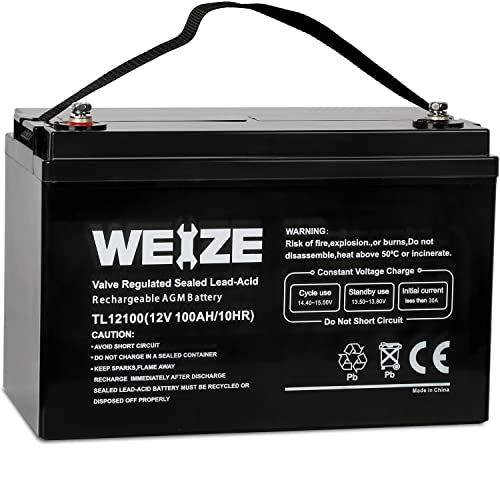
Brand: WEIZE
Type: AGM sealed lead-acid, maintenance-free. Capacity: 100Ah. Max discharge current: 1150A, self-discharge around 1-3% per month. Dimensions: 12.99 x 6.73 x 8.43 inches. Suitable for RVs, solar setups, trolling motors, wind systems, marine, camping, and off-grid use.
Notes:
– Low self-discharge supports longer storage without frequent recharge.
– Broad operating temperatures for outdoor environments.
– Good balance of capacity and practical sizing for common builds.
WEIZE Platinum AGM Battery 12V 80Ah

Brand: WEIZE
Type: AGM. Capacity: 80Ah. CCA: 850A. Compact 12V automotive/industrial battery with attention to fitment compatibility. Includes guidance on terminal orientation and fitment for vehicles and power systems.
Highlights:
– Slightly smaller capacity than the 100Ah models, but often a better fit for tighter spaces.
– Strong cycle performance and reliable discharge characteristics.
UPLUS U1 Riding Lawn Mower Battery

Brand: UPLUS NEW TECHNOLOGY BATTERY
Type: AGM sealed lead-acid. Capacity: 26Ah. 360A CCA. One of the common repeater formats for lawn tractors and garden tractors. Maintenance-free with a focus on long life and safety considerations.
Notes:
– Maintains a robust power profile for mowers and compatible outdoor equipment.
– Widely compatible with John Deere, Cub Cadet, Husqvarna, Craftsman, and similar brands.
CYCLENBATT 12V 10Ah LiFePO4 Battery

Brand: CYCLENBATT
Type: LiFePO4 with built-in 10A BMS. Capacity: 10Ah. Notable for high cycle life (theoretical 5000+ cycles) and space-saving form factor. Suited for power wheels, small solar setups, fish finders, UPS, and light portable power needs.
Key considerations:
– Significantly lighter than lead-acid options with a long cycle life.
– Higher upfront cost but lower total cost of ownership due to longevity.
– Requires proper BMS awareness and compatible charging profiles.
Buying Guide: Key Purchase considerations
Capacity vs. Space and Weight
Higher Ah ratings deliver longer run times, but they also increase size and weight. For RVs, boats, or cabins where space is at a premium, a high-quality 80–100Ah AGM might be the sweet spot. LiFePO4 options can offer similar capacity with substantially lower weight but require compatible charging and BMS awareness.
Chemistry and Maintenance
AGM batteries provide maintenance-free operation and better spill resistance than flooded lead-acid. They are a strong all-around choice for off-grid and mobile use. LiFePO4 cells (like CYCLENBATT) offer very long cycle life and light weight but need appropriate charging storms and BMS compatibility. Consider whether you need the reliability of maintenance-free AGM or the longevity and weight savings of LiFePO4.
Discharge Current and Peak Demands
100Ah AGM packs typically support high peak discharge for short durations (e.g., starting or heavy loads). If your system includes high-drain equipment, verify max discharge current (A) ratings. For lawn systems and moderate loads, 26Ah or 80Ah packs can be adequate when sized properly within the overall system design.
Temperature Range and Storage
Operating temperature affects performance and lifespan. AGM batteries generally tolerate a broad range, but very cold or hot environments can reduce capacity temporarily. LiFePO4 cells tolerate wide temperature bands and have higher cycle life, but charging electronics must be compatible with LiFePO4 chemistry.
Interconnectivity and System Design
When using multiple batteries in series or parallel, ensure compatibility with your charger and inverter. Some AGM models advertise compatibility with parallel configurations up to a certain number. Always follow manufacturer guidance for safe connection practices and venting considerations.
Cost of Ownership and Warranty
Higher Ah ratings in AGM formats often provide better total energy storage for the price. LiFePO4 options can reduce weight and extend service life, potentially offsetting higher initial costs. Review warranties, especially for long-term off-grid or marine applications.