Best High Voltage Rescue Hook for Safe Live-Line Rescues
Finding the right high voltage rescue hook depends on insulation rating, reach, and portability. This guide highlights five top options, noting who each tool is best for and why. Use these concise comparisons to pick the tool that fits your emergency response needs, whether you’re a utility worker, firefighter, or safety trainer.
Table: Quick comparison of selected products
| Product | Insulation Voltage | Reach / Length | Detachable Hook | Best For |
|---|---|---|---|---|
| UL-Certified Insulated Rescue Hook | 40 KV/mm dielectric, 1000V-35KV rated | 7.6 ft | Yes, detachable | Live-line rescue with high safety margin |
| 220kV Insulated Rescue Hook (Yellow) | 220kV insulation | 7.6 ft | Yes, detachable hook | Substation rescue and power line work |
| High-Voltage Insulated Rescue Hook, 35kV | 35kV insulation | 5.6 ft | Yes, detachable head | Electricians and firefighters needing compact reach |
| 110kV High Voltage Insulated Rescue Hook | 110kV insulation | 6.5 ft | Yes, detachable | Substation and fire/rescue operations |
UL-Certified Insulated Rescue Hook

The product uses UL 746C and ASTM F711 compliance, with a 40 KV/mm dielectric strength and 200V CTI rating. It includes a two-section, twist-lock fiberglass pole that extends to 7.6 ft and a removable 18-inch steel hook. The bright orange finish improves visibility in emergency scenes. Best for live-line rescue scenarios where the safety margin exceeds common high-voltage ranges.
- Best for utilities performing live-line evacuations and safety audits.
- Includes documented safety compliance for audits.
- Limitations: Data notes a broad application range; verify your exact duty environment to ensure compatibility.
220kV Insulated Rescue Hook (Yellow)

Designed for substation rescue and power line maintenance, this 220kV-rated model features reinforced glass epoxy insulation and a compact storage bag. It offers quick 1-second assembly through threaded shaft joints and a fully detachable design. The epoxy resin insulating rod and diamond-textured grip help handle wet or oily conditions. Best for field responders needing rapid setup and high-voltage capability.
- Better for high-voltage environments with frequent storage in tight spaces.
- Note: The kit emphasizes quick deployment; ensure the specific pole sections fit your team’s workflow.
High-Voltage Insulated Rescue Hook, 35kV

This 5.6-foot telescopic pole provides a compact, heavy-duty option with an 18-inch detachable hook. It uses a dual-insulation structure, combining a non-conductive core with closed-cell foam and a diamond-textured grip for secure handling. Best for electricians and firefighters who need a robust tool that stores easily in a vehicle or equipment room.
- Choose this if you require a balance of reach and strong insulation at a mid-range voltage level.
- Limitation: As a mid-range option, verify it meets your maximum anticipated system voltage.
Professional Insulated Rescue Hook, 220kV

This 9.8-foot three-section telescopic model emphasizes high voltage protection with reinforced fiberglass-epoxy insulation and a detachable 18-inch hook. It includes a dry bag for storage and a fast, modular assembly. Best for line crews performing extensive reach tasks and requires easy relocation in trucks or depots.
- Best for long-reach rescues and frequent transport between sites.
- Limitation: Heavier design may be less ideal for rapid deployment in tight spaces.
110kV High Voltage Insulated Rescue Hook

This model uses reinforced fiberglass-epoxy insulation with 110kV protection, featuring a quick-connect modular design and a dual insulation system. The 6.5-foot pole is fully detachable for compact storage. Best for responders requiring a mid-length, high-insulation tool with straightforward assembly.
- Choose this if you need reliable, compact storage with adequate voltage protection.
- Limitation: Not the longest reach among the listed options; plan accordingly for distant rescues.
Portable High Voltage Insulated Rescue Hook, 66kV
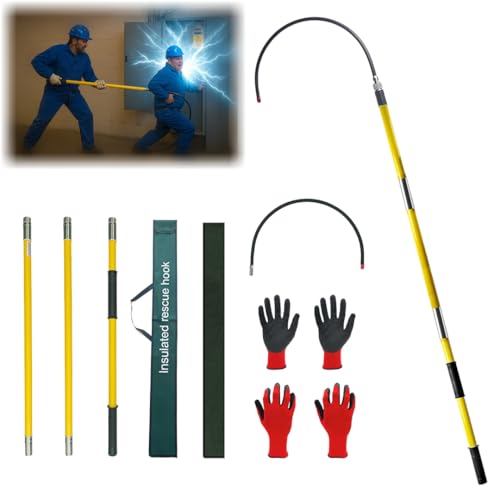
This tool extends to 10.8 ft and includes an 18-inch detachable hook head with a storage bag. It targets emergency responders needing extended reach while maintaining portability and rapid deployment. Best for emergency drills and field operations with variable rescue distances.
- Better for extended reach without bulky equipment
- Limitation: Heavier telescoping systems may be harder to manage single-handedly in tight spaces
220kV High Voltage Insulated Rescue Hook (Red)

Engineered for 220kV safety protection with robust insulation and a detachable 18-inch hook. Like other high-voltage tools, it features a quick-assembly modular design and dual insulation using a non-conductive core plus closed-cell foam. Best for crews needing high-voltage readiness in critical incidents.
- Choose this if your operations routinely reach 220kV environments.
- Limitation: Higher voltage capability may come with added weight and required training.
Buying Guide: Key Purchase Considerations
- Voltage rating: Choose a model aligning with your typical system voltages and safety standards.
- Reach: Consider pole length and whether detachable hooks faster for your response protocol.
- Insulation construction: Look for fiberglass-epoxy or epoxy resin insulation with a proven CTI rating and heat resistance.
- Hook design: Detachable hooks offer flexibility; ensure the hook head size matches common gear and harnesses you encounter.
- Portability: Evaluate weight, storage cases, and vehicle compatibility for rapid deployment.
- Compliance: Verify UL/ASTM certifications and any agency-specific safety requirements your team must meet.
Frequently Asked Questions
- What voltage rating do I need for rescue hooks?
- How important is a detachable hook?
- Can these tools be used in wet conditions?
- What maintenance is required for high-voltage rescue hooks?
- Are longer poles always better?
- Do these tools require special training?
Buying decisions should consider the typical rescue scenarios your team faces, including the necessary reach, containment of live-line risks, and ease of transport. The listed models provide a spectrum from compact, mid-range options to long-reach, high-voltage-capable tools suitable for utilities, fire departments, and industrial safety teams. Always align product choice with operational protocols and local safety regulations.