Best High Voltage Proximity Detectors for Safe Electrical Work
If you work around energized equipment, a reliable high voltage proximity detector is essential for safety. This guide highlights five top notches in non-contact voltage detection, explaining who each device suits best and why. It’s designed for electricians, maintenance staff, and facility technicians who need fast, clear voltage alerts in challenging environments. The recommendations balance broad voltage ranges, rugged design, and practical features like audible and visual alarms, self-tests, and wearable alerts.
| Product | Best For |
|---|---|
| Amprobe TIC 300 PRO / 3467441 | General electrical work, testing high voltage lines |
| AEMC 275HVD | Wide-range detection from 240V to 275kV |
| EITAI1860 Wearable | Personal safety with wearable alarm, field work |
| Triplett HVD132 | Dual-range detection for both high and low voltages |
| FLIR VP54 | Multi-sensory alerts in noisy sites, robust flashlight |
Amprobe TIC 300 PRO High Voltage Detector

The Amprobe TIC 300 PRO offers non-contact AC voltage detection from 30 VAC up to 122,000 VAC (122 kV) with both visual and audible indicators. A built-in self-test verifies the tester is functioning properly. This model is best for technicians who frequently encounter high-energy lines and need a straightforward, reliable alert in a compact form. It suits fieldwork where quick confirmation of live status matters more than a long feature list.
Best for: general high-voltage maintenance and on-site inspections where a clear, audible-visual alert is essential. Caution: reliance on a single detection method means be mindful of environments with strong electromagnetic interference that could affect sensitivity.
AEMC 275HVD Non-Contact High Voltage Detector

The AEMC 275HVD covers an impressive range from 240V to 275 kV, providing a single instrument for diverse applications. It is powered by three standard alkaline C cells and features a non-contact voltage detector design. This model is ideal for technicians who work across a broad spectrum of voltages—from building-level to utility-scale components. Its wide range reduces the need for multiple detectors in a kit.
Best for: professionals who need a single instrument that spans low to very high voltages. Limitation: battery life and replacement may require routine checks in remote sites, so carry spare cells.
EITAI1860 Wearable High Voltage Alarm Detector
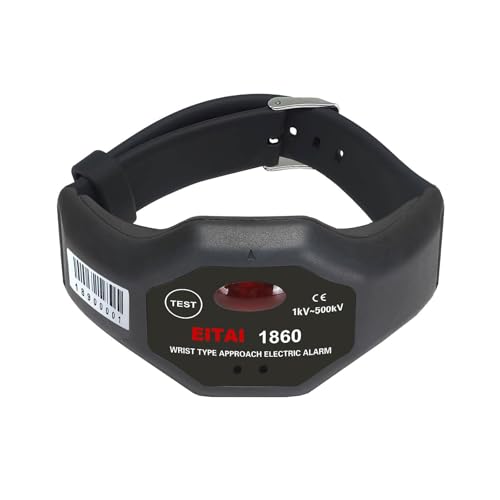
The EITAI1860 is a wearable high voltage alarm detector designed to provide early safety alerts when approaching voltage sources from 0.4 kV to 500 kV. Its non-contact induction technology delivers reliable detection without direct contact, making it suitable for workers who must maintain safe distances while moving around energized equipment. The product emphasizes user support with English-language service and technical help.
Best for: personal protection on job sites with elevated voltage exposure. Caution: wearable devices may require regular checks to ensure sensors remain properly oriented to the user.
Triplett HVD132 Non-Contact Dual Range Detector

The Triplett HVD132 provides two voltage ranges: a high-range up to 132 kV and a low-range starting at 50 V. This dual-range capability lets electricians quickly switch between modes to identify live high-voltage lines and to verify the presence of lower voltage circuits without swapping tools. A circuit test function ensures the detector itself is working before testing live wires.
Best for: technicians who handle both high-voltage transmission lines and residential or commercial low-voltage circuits. Limitation: may require practice to use efficiently in tight spaces where switch toggling is frequent.
FLIR VP54 Triple Alarm Non-Contact Detector

The FLIR VP54 combines multi-sensory alarms—tactile vibration, loud audible alert, and flashing LEDs—to alert users in noisy environments. It features dual sensitivity modes (standard 90-1000 V and high-sensitivity 24-1000 V) for tracing both high-voltage lines and lower voltage systems. The device is pocket-sized, rugged, and designed to survive a 3-meter drop, making it suitable for demanding job sites.
Best for: electricians and technicians in noisy environments who require reliable, multimodal alerts and a compact, durable form. Caution: in extremely bright settings, visual LEDs might be less noticeable at a distance; rely on the audible or vibration alerts as primary cues.
Buying Guide
Key considerations help you choose a high voltage proximity detector that fits your work style and site conditions:
- Voltage range: Select a detector that covers your typical working voltages. A wider range reduces the need for multiple tools.
- Detection method: Non-contact sensors are standard, but some models add wearable alarms or tactile feedback for repeatable alerts in noisy sites.
- Alerts and visibility: Visual LEDs, audible beeps, and vibrations improve safety in different environments. Choose multi-sensory options if noise or lighting is a challenge.
- Durability: Look for rugged bodies, drop resistance, and compact form factors for confined spaces.
- Power and maintenance: Check battery types, life, and ease of replacement. Instruments with self-tests help ensure reliability before use.
- Portability vs. range: Wearables prioritize personal safety and mobility; handheld detectors often offer broader range and easier sharing across a crew.
- Ease of use: Dual-range or circuit-test features can save time by confirming function before contact with live circuits.
What to consider for different work environments
- Field service and maintenance yards: prioritize wide voltage range, rugged builds, and reliable self-test features.
- Industrial facilities: consider detectors with strong visibility in bright or cluttered settings and multi-sensor alerts for loud environments.
- Residential and low-voltage tasks: dual-range detectors help identify both high and low voltages without extra tools.
FAQ
- What is a high voltage proximity detector used for? It detects the presence of AC voltage near equipment to prevent accidental contact and shocks.
- Do these detectors require training? Basic operation is straightforward, but reading ranges and using different alert modes benefit from practical instruction.
- Can I rely on a single detector for all voltage levels? A wide-range model can cover many scenarios, but specialized tasks may benefit from a dedicated low-voltage detector or a wearable alarm.
- Are wearables safer than handheld units? Wearables add personal safety by keeping alerts close to the user, especially on moving or elevated tasks.
- What if I work in a noisy environment? Choose detectors with vibration or audible alerts combined with visual indicators for reliable cues.