Best High Voltage Hot Stick Tools for Field Linemen and Substations
Find the right high voltage hot stick for safe live-line work. This guide highlights five purpose-built insulated poles that help linemen, substation crews, and field technicians perform switching, fuse handling, and rescue operations with reduced risk. Each product is evaluated for who benefits most, practical limitations, and how its design supports reliability in harsh conditions.
| Product | Best For | Key Benefit |
|---|---|---|
| PRO-Grade 20FT Telescopic Hot Stick & Utility Hook | Lineman crews needing long reach | 4-section, triangular no-twist design for control |
| PRO-Grade 13.1FT Telescopic Hot Stick & Utility Hook | Substation maintenance with compact reach | 4 adjustable sections, glove-friendly operation |
| 16.4FT Telescopic Hot Stick & Insulated Hook (Mounleve) 220kV | High-voltage outdoor work with extended reach | Epoxy resin fiberglass, 220kV rating, 26.2ft option |
| Spliceable Hot Stick, 110kV 13.1ft | Versatile 110kV live-line tasks | Spliceable universal head, epoxy resin fiberglass |
| Telescopic Hot Stick, 220kV 26.2ft | Heavy-duty live-line operations at long reach | 2mm fiberglass, moisture-resistant coating |
Note: This introduction focuses on tools designed for high-voltage live-line work. Each item below is presented with a concise justification for its fit, a practical caveat, and who should consider it most.
PRO-Grade 20FT Telescopic Hot Stick & Utility Hook
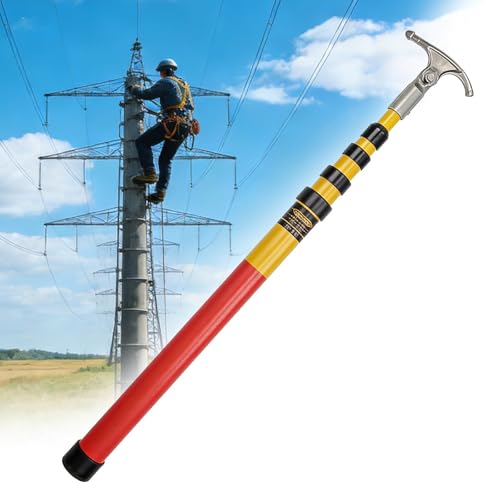
Brand: Rjdjbflc
Features: ASTM F711 COMPLIANT & ULTIMATE DIELECTRIC SAFETY: Foam-filled fiberglass (FRP) rod with closed-cell core resists moisture. OSHA 1926.957 compliant for protection in live-line work.
Best for: Linemen needing maximum reach with high dielectric safety for switching and fuse handling at substations or field sites.
Caution: The long 20ft length requires careful handling in tight spaces; store retracted to its compact form when driving to a site.
PRO-Grade 13.1FT Telescopic Hot Stick & Utility Hook

Brand: Rjdjbflc
Features: ASTM F711 COMPLIANT, triangular no-twist design for precision control, 4 adjustable sections, glove-friendly operation with high-visibility locking buttons.
Best for: Substation technicians or field crews needing manageable length with reliable torque control and glove-friendly handling.
Caution: Reduced length compared to the 20ft model may require closer approach to switches and fuses in dense installations.
Telescopic Hot Stick & Insulated Hook — 220kV 26.2ft

Brand: Rjdjbflc
Features: Broad 10kV–220kV range, epoxy resin fiberglass construction, moisture-resistant coating, heavy-duty 80 kg (176 lb) load-bearing capacity, designed for high-torque live-line work.
Best for: Operators requiring extended reach with robust insulation for long-span, energized line tasks in substations or outdoors.
Caution: Heavy-duty build adds weight; consider operator strength and transport ergonomics when selecting length.
Spliceable Hot Stick, 110kV 13.1ft

Brand: Rjdjbflc
Features: 10kV–110kV rating, epoxy resin fiberglass with heavy-duty construction, 80 kg load-bearing capacity, spliceable universal head for live-line tasks.
Best for: Teams performing fuse pulling and switching at mid-range voltages with a need for a modular head configuration.
Caution: The 110kV rating, while strong, is lower than the 220kV models; verify conductor voltage before deployment.
Telescopic Hot Stick, 220kV 26.2ft (Rjdjbflc)
Brand: Rjdjbflc
Features: 10kV–220kV isolation range, epoxy resin fiberglass, moisture-resistant coating, 80 kg load-bearing capacity for high-torque operations.
Best for: Utilities performing long-reach live-line work with maximum dielectric safety and robust construction.
Caution: Heavier tool; ensure operator readiness and vehicle storage capacity for transport.
Buying Guide: Key Considerations For High Voltage Hot Sticks
- Voltage rating and insulation: Choose models with explicit kV ratings that align with your typical operating voltages. Higher KV models provide greater dielectric protection for energized lines.
- Length and reach: Consider your work environment. Longer sticks offer more reach but add weight and storage considerations. Shorter sticks are easier to maneuver in confined spaces.
- Construction and durability: Look for epoxy resin fiberglass builds and moisture-resistant coatings to prevent water tracking and maintain insulation in wet conditions.
- Head design and compatibility: Spliceable or universal heads offer flexibility for various tasks, including switching, fuse handling, and hooks. Ensure compatibility with common live-line tools.
- Ergonomics and gloves: Triangular or non-slip designs can improve control when wearing insulating gloves. Locking mechanisms should be easy to operate with Class 4 gloves.
- Weight and portability: Heavy-duty models provide robust performance but require strong handling and proper transport solutions. Consider truck bed and storage space.
- Maintenance: Inspect rods for cracks, moisture ingress, or coating damage. Proper storage and re-tests per safety standards are essential for ongoing reliability.
FAQ
- What is a high voltage hot stick used for?
Hot sticks are insulating poles used to operate live electrical components like switches and fuses without direct contact, reducing arc flash and shock risks.
- Which voltage rating should I choose for general line work?
For typical field and substation tasks, models rated at 110kV to 220kV cover most scenarios, but verify the voltage levels you encounter most often.
- Are spliceable heads necessary?
Spliceable heads offer adaptability for multiple tasks and can simplify tool configurations in the field.
- How important is glove compatibility?
High-visibility locking and glove-friendly operation reduce risk and improve efficiency when wearing Class 4 insulating gloves.
- What maintenance steps keep hot sticks safe?
Regular inspection for moisture intrusion, cracks, and coating wear; proper storage; and periodic compliance checks against applicable standards.