Best High Voltage Differential Probes for Oscilloscopes: 5 Top Picks
High voltage differential probes enable safe, accurate measurements of floating signals in demanding test environments. The following five models from leading brands provide robust isolation, wide bandwidth, and versatile attenuation options to fit a range of scopes and applications. Each entry includes a quick overview of key features to help you compare performance and safety considerations.
| Product | Brand | Attenuation | Bandwidth |
|---|---|---|---|
| HDP50 | Goupchn | 50X / 500X | 100 MHz |
| DP10013 | Micsig | 50X / 500X | 100 MHz |
| DP10007 | SainSmart | 10X / 100X | 100 MHz |
| HT8100 | Hantek | — | 100 MHz |
| RP1050D | Rigol | X100 | 50 MHz |
Goupchn HDP50 High Voltage Differential Probe
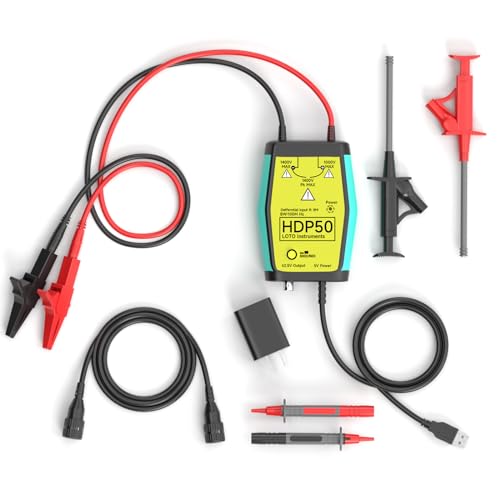
The HDP50 differential probe is engineered for high-frequency, high-voltage measurements. It supports a 100 MHz bandwidth and a 1400 V range. Two attenuation options—50X (up to 140 V) and 500X (up to 1400 V)—address different measurement needs. A 5 V DC adapter eliminates the need for batteries, with additional power options from USB, power packs, or charging devices. Compatible with most oscilloscopes that use standard BNC connectors. Designed for floating, differential measurements with a portable black storage case for transport and storage.
Micsig DP10013 High Voltage Differential Probe
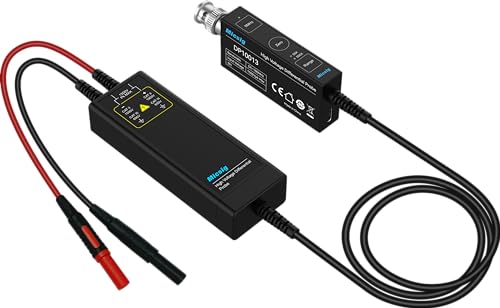
The DP10013 is a high-voltage differential probe rated up to 1300 V with 100 MHz bandwidth and 3.5 ns rise time. It features 50X/500X attenuation for floating measurements, emphasizing portability and ease of use. A USB DC 5 V power supply supports operation when the oscilloscope offers USB connectivity, making it a compact choice for field and lab use where battery-free operation is preferred.
SainSmart DP10007 700 V Differential Probe Kit
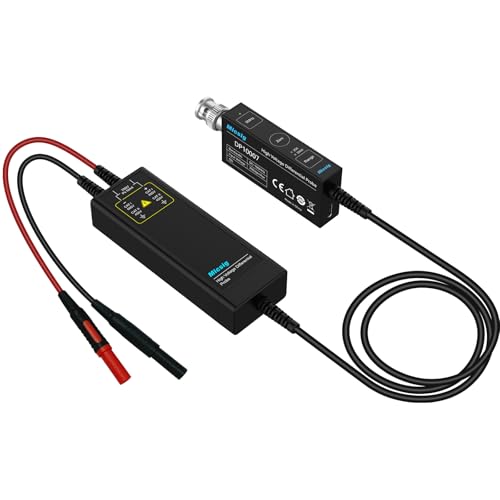
The DP10007 offers 10X/100X attenuation with a maximum differential test voltage of 70 V (10X) and 700 V (100X), enabling safe measurement of floating voltages up to 700 V while supporting up to 100 MHz bandwidth. It uses a USB 5 V power supply for portability and compatibility with scopes that provide USB power or interfaces, emphasizing protective isolation and user safety during high-voltage testing.
Hantek HT8100 High Voltage Oscilloscope Probe

The HT8100 provides a compact, high-voltage differential probing solution with an over-range alarm indicator (red LED) for easier monitoring. It is designed for stability, reliability, and precision across measurements, with emphasis on safe handling of floating high-voltage signals. The small form factor makes it suitable for portable test setups and bench work that require consistent performance and clear visual status cues.
Rigol RP1050D Passive Differential Probe

The Rigol RP1050D is a passive high-voltage differential probe rated up to 50 MHz bandwidth with a X100 attenuation ratio. It supports differential measurements up to approximately 700 V peak-to-peak for DC plus AC signals, offering robust compatibility with a range of oscilloscopes. The device is designed for stable operation, with a focus on accuracy and ease of use for professionals working with high-voltage signals in test environments.
Buying Guide
Key purchase considerations when selecting a high voltage differential probe include attenuation range, bandwidth, isolation safety, and compatibility with your oscilloscope. Attenuation options such as 10X/100X, 50X/500X, or X100/X200/X500 cover different voltage ranges and measurement needs. Bandwidth should match or exceed the oscilloscope’s bandwidth to avoid signal distortion. Safety features like over-range alarms, isolation ratings, and robust probe construction reduce risk when working with floating high-voltage signals. Ensure the probe uses standard BNC interfaces and is compatible with your scope’s connection type. Portability and power options (USB, AC adapters, battery-free operation) can be important for fieldwork or lab setups where mobility is essential. Consider the availability of accessories, case storage, and warranty coverage to support long-term reliability.
Different use cases may influence the choice: for high-frequency measurements and floating signals, higher bandwidth and multiple attenuation settings are advantageous; for simple bench tests, a compact, easy-to-use probe with clear safety indicators may suffice. When evaluating brands, note the protection standards, rise time, and compatibility with a wide range of oscilloscopes to maximize flexibility across instruments. Reading user reviews and manufacturer datasheets can provide deeper insight into long-term performance, noise floor, and calibration requirements, helping buyers select a probe that best fits their testing scenarios.