Best High-Voltage Charge Controller for 48V Solar Systems
Choosing a high-voltage MPPT charge controller can significantly reduce energy losses in long cable runs and enable larger battery banks for 48V solar setups. This guide highlights five top MPPT controllers with high-voltage input capabilities, wide voltage ranges, and robust protection features. The selected models balance current capacity, efficiency, and compatibility with sealed lead-acid, lithium, and other storage chemistries. Use this overview to compare specifications, monitor displays, and installation considerations for reliable, long-term off-grid power management.
| Product | Brand | Max PV Input | Battery Voltage Range |
|---|---|---|---|
| 48V 140A MPPT Solar Charge Controller | Temank | 500V | 48V Lead-Acid / Lithium |
| Y&H 140A MPPT Solar Charge Controller | Y&H | 500V | Up to 48V (High-Voltage capable) |
| PROSOLI 120A MPPT Solar Charge Controller | PROSOLI | 230V | 12-96V (multi-battery support) |
| EcoSolLi 120A MPPT Solar Charge Controller | EcoSolLi | 230V | 12-96V |
| EARNMee 60A MPPT Solar Charge Controller | EARNMee | 230V | 12-96V |
Temank 48V 140A MPPT Solar Controller

The Temank 48V 140A MPPT Solar Charge Controller supports up to 500V open-circuit PV input and up to 6500W of charging power. It offers a broad MPPT range from 60V to 450V DC and allows user-configurable charging currents from 10A to 140A. This model is designed for efficient energy transfer over long distances, accommodating high-capacity storage batteries and minimizing transmission losses. It includes a large LCD for real-time monitoring of PV voltage, PV current, PV power, battery voltage, charge current, date, power generation, error codes, and version information. Ideal for large solar arrays feeding 100Ah+ storage systems.
Y&H 140A MPPT Solar Charge Controller

This Y&H 140A MPPT solar controller is designed for 48V DC systems with a maximum PV input of 500V. It features a large LCD display that shows PV voltages, PV current, PV power, battery voltage, charge current, date, power generation, error codes, and firmware version. The controller is built to support energy storage batteries and provides high-voltage transmission efficiency, making it suitable for extended off-grid setups and longer PV-to-battery runs.
PROSOLI 120A MPPT Solar Charge Controller

The PROSOLI 120A MPPT controller delivers high-efficiency MPPT tracking with up to 99% efficiency and supports 12V through 96V battery configurations. It is compatible with lithium-ion and lead-acid chemistries and provides multiple protections, including PV over-current, battery overvoltage/discharge, load overcurrent, temperature safeguards, and a lithium activation feature. It’s designed for high-power solar systems where stable charging and battery protection are essential.
EcoSolLi 120A MPPT Solar Charge Controller
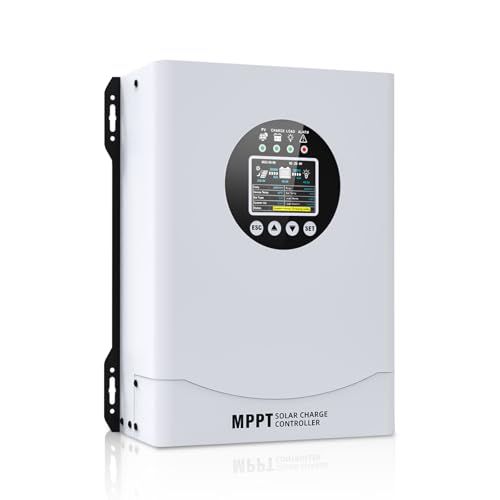
The EcoSolLi 120A MPPT controller is designed for a wide range of battery voltages (12V to 96V). It advertises MPPT efficiency with high tracking performance (no less than 99%) and a peak conversion efficiency up to 98%. It offers multiple protections: PV over-current, battery overvoltage, discharge protection, load overload, low-temperature charging, and an option to activate lithium batteries. The unit supports heavy-duty solar systems and helps maximize energy capture from large arrays feeding storage banks.
EARNMee 60A MPPT Solar Charge Controller

The EARNMee 60A MPPT controller features automatic system voltage detection across 12V to 96V ranges, with PV input up to 230V. It supports multiple battery types, including GEL, LiFePO4, Li-ion, and user-defined configurations. The device emphasizes a full-power input mode for stable operation in high-demand scenarios and provides MPPT tracking that aims to maximize energy harvest while ensuring reliability in diverse installation environments.
Buying Guide: Key Considerations For High-Voltage MPPT Controllers
- Voltage and power range: Match the controller’s max PV input voltage and max charging current to your array size and battery bank. Higher voltage input reduces current and transmission losses but requires appropriate cabling and safety measures.
- Battery compatibility: Ensure support for your chosen chemistries (lead-acid, AGM, GEL, LiFePO4, Li-ion, etc.) and verify automatic voltage detection if you have mixed or changing systems.
- MPPT efficiency and tracking: Look for trackers with 99%+ tracking efficiency and high peak conversion efficiency to maximize energy harvest, especially in marginal sunlight conditions.
- Protections and safety: Evaluate protections such as overcurrent, overvoltage, thermal, load disconnection, and lithium activation features to protect both panels and batteries.
- Display and monitoring: A clear LCD or LED interface helps monitor PV voltage/current, battery status, and system errors. Consider remote monitoring if available.
- Voltage regulation and output options: Confirm adjustable output voltages (12V/24V/48V) and whether the controller supports gradual load switching or timed control for appliances.
- Installation environment: Check enclosure temperature ratings, cooling requirements, and whether the unit is designed for outdoor or cabinet installation.
- Wiring and mounting: Pay attention to wiring port sizes and recommended conductor gauges for high-voltage setups. Adequate spacing and mounting hardware improve cooling and longevity.
- Expansion and compatibility: If planning future growth, select controllers offering higher current ratings or modules that can interface with additional battery banks or hybrid energy sources.
- Warranty and support: A robust warranty and accessible customer support can reduce downtime in critical off-grid applications.