Best High Voltage MPPT Solar Charge Controllers for Large Battery Arrays
These high-voltage MPPT solar charge controllers are designed to optimize energy harvest for 12V to 96V battery systems, enabling efficient charging for RVs, off-grid homes, and large solar setups. The following selections cover a range of voltages, protection features, and monitoring capabilities to suit different applications and battery types.
- Best overall for flexibility: EcoSolLi 120A MPPT Solar Charge Controller
- Better for high-voltage, long-distance systems: Temank 48V 140A MPPT
- Strong all-around performer: POWLAND 120A MPPT Solar Charge Controller
- Good balance of protection and ease of use: PROSOLI 120A MPPT Solar Charge Controller
- Reliable option with robust features: Y&H 120A MPPT Solar Charger Controller
EcoSolLi 120A MPPT Solar Charge Controller
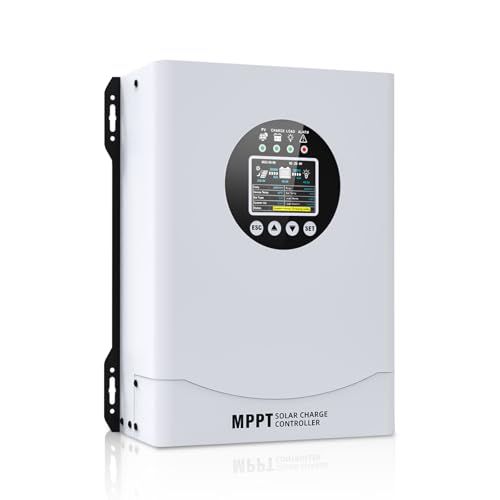
Best for large, flexible setups requiring broad voltage support. This controller documents automatic 12V–96V recognition and supports a wide array of battery types, including LiFePO4, SLD, and AGM. It claims high MPPT tracking with up to 99% efficiency and peak conversion near 98%, enabling more energy capture from sizable panels. Protection includes PV over-current, battery overvoltage, discharge, load overload, and temperature safeguards. It is well-suited for off-grid homes and mobile applications that use large solar arrays.
Who this is for: buyers needing a single, versatile controller for 12V to 96V systems with strong protection and lithium activation. Caution: ensure compatible wiring and proper heat management in high-current conditions.
Temank 48V 140A MPPT Solar Charge Controller

Best for high-voltage systems with long-distance energy transfer. This controller handles up to 500V PV input and 6500W of charging power, with a broad MPPT range (60V–450V) and adjustable charging currents (10–140A). It is designed for energy transfer over longer distances and supports high-capacity batteries. The large LCD provides detailed system monitoring, including PV and battery metrics. Limited information on warranty or ratings is not provided here, so verify compatibility before purchase.
Who this is for: users needing a high-voltage MPPT solution for long-distance solar transmission and large battery banks. Caution: ensure correct panel wiring in series and verify voltage limits for your battery type.
POWLAND 120A MPPT Solar Charge Controller

Best for universal voltage and battery compatibility. This controller auto-detects 12V–96V and supports high charging currents up to 120A. It emphasizes 98% MPPT efficiency and 30% more energy capture than PWM controllers, suitable for RV solar setups and off-grid homes. It claims robust protection for reverse polarity, overloads, and temperature. It’s especially useful where multiple battery chemistries (LiFePO4, AGM, GEL) are used. Limitation: the description notes general performance claims; confirm panel configuration and wire gauge for your system.
Who this is for: buyers seeking a single unit that adapts to many voltages and battery types with strong efficiency. Caution: verify wire sizing and series configuration for high-current installations.
PROSOLI 120A MPPT Solar Charge Controller

Best for wide battery compatibility and advanced protection. This controller supports 12V–96V systems with 120A charging and 99% tracking efficiency (peak 98%). It is compatible with LiFePO4, AGM, GEL, and other lead-acid types across 12–96V. Features include PV over-current, battery overvoltage, discharge, overload, and temperature safeguards, plus lithium activation capability. It suits multi-battery arrangements and mobile installations. Limitation: specific battery chemistry tuning options may require manual configuration on some setups.
Who this is for: buyers prioritizing broad battery compatibility and comprehensive protection. Choose this if you need reliable lithium activation support. Avoid if you require ultra-compact form factors.
Y&H 120A MPPT Solar Charger Controller

Best for universal battery recognition and safety features. This model supports 24–96V auto-detection and is compatible with Gel, Flooded Lead-Acid, and LiFePO4/Lithium batteries. It emphasizes high efficiency in harvesting and includes built-in over-temperature protection, temperature compensation, fault diagnosis, and short-circuit prevention. It is a practical choice for off-grid and remote installations where diverse battery types are used. Limitation: some users may require advanced monitoring beyond basic status indicators.
Who this is for: buyers needing automatic voltage recognition and reliable safety features. Pick this if you operate mixed battery chemistries. Avoid if you require ultra-detailed, real-time data logs beyond standard indicators.
Buying Guide
What to consider when choosing a high-voltage MPPT solar charge controller:
- Voltage range and auto-detection: Look for controllers that support 12V–96V (or higher) with automatic sensing to simplify system setup and reduce manual configuration.
- Maximum PV input and charging current: Match the controller’s PV open-circuit voltage and current rating to your solar array, ensuring it can handle peak panel outputs without triggering protections.
- MPPT efficiency: Prioritize models with high maximum efficiency (generally 95–98%+) to maximize energy capture, especially in partially shaded or variable conditions.
- Battery compatibility: Confirm support for LiFePO4, GEL, AGM, and flooded lead-acid batteries. Ensure the controller’s charging algorithm suits your battery chemistry.
- Protection features: Essential safeguards include over-current, overvoltage, short-circuit, reverse polarity, and high/low-temperature protection. Lithium activation is a plus for Li-ion systems.
- Monitoring and interface: A clear LCD or app-based monitoring helps track PV voltage, current, battery voltage, and charging status. Consider ease of use and available diagnostics.
- Wiring and installation: Check recommended wire gauges, connector types, and whether the device supports series or parallel panel configurations for your array.
- Physical considerations: Size, cooling requirements, and enclosure compatibility matter for space-constrained or outdoor installations.
FAQ
- What is an MPPT solar charge controller?
An MPPT controller optimizes the voltage and current from solar panels to maximize battery charging efficiency by tracking the maximum power point of the array.
- Can I use a high-voltage MPPT controller with all battery types?
Most models support multiple battery chemistries, including LiFePO4, GEL, AGM, and flooded lead-acid. Check the manufacturer’s compatibility list for your exact battery type.
- Why is MPPT efficiency important?
Higher efficiency means more energy captured from the same solar array, which is especially beneficial in partial shade or limited sunlight.
- What should I watch for when wiring panels to a high-voltage controller?
Follow recommended panel configurations (series or parallel) and wire gauges to handle the anticipated current and voltage safely.
- Are lithium activation features necessary?
Lithium activation helps optimize charging for LiFePO4 and other lithium batteries, but verify that your battery type is supported and properly configured.
- Do these controllers require special warranties or certifications?
Warranty and certifications vary by brand. Always review product documentation and seller terms for specifics.