Best High Voltage Cable Stripper Tools for Precise Insulation Removal
Yes. For professionals and DIYers handling high‑voltage or heavy‑gauge cables, a dedicated high voltage cable stripper speeds up insulation removal, reduces damage, and improves accuracy. The top tools below are suited for electricians, technicians, and electrical installers who work with thick jackets, rugged insulation, or 1000 V class tasks. The buyer’s guide and quick reference table help you compare options at a glance.
| Product | Best For | Key Benefit |
|---|---|---|
| Ktsxxops 1000V Cable Stripper | Live-work environments | IEC60900 insulation and quick stripping with anti-slip handle |
| Greenlee 1903 Pocket Cable Stripper | Medium to large jacket insulation | Triple action cuts and adjustable blade height |
| Jonard CST-1900 Round Cable Stripper | Flexible jacket materials | Spiral, linear, and circular cuts for versatile stripping |
| Klein Tools 21050 Large Cable Stripper | Very large conductors | Clover design for multiple wire sizes; twist to strip cleanly |
| Klein Tools 11046 Wire Stripper | Small to mid gauges | Compact, precise stripping holes in tight workspaces |
Ktsxxops 1000V Cable Stripper

The Ktsxxops 1000V Cable Stripper is designed for live‑work environments and general electrical tasks. It uses IEC60900 compliant insulation and a robust insulated handle to support safe stripping up to 1000 V. This tool is best for electricians who need a reliable knife-style stripper for versatile cables and quick insulation removal. A potential limitation is that it relies on a single blade geometry, which may be less adaptable for very unusual jacket constructions.
Best for: Electricians performing live work or dealing with various everyday high‑voltage cables. Choose this if you prioritize insulation safety and a compact, ergonomic design for frequent stripping tasks.
Caution: Use proper PPE and follow live‑work safety standards; inspect the blade for wear before use.
Greenlee 1903 Pocket Cable Stripper

The Greenlee 1903 is a compact, pocket‑sized stripper with a high‑carbon steel blade and adjustable blade height. It supports a range of jacket sizes and materials, offering three stripping actions: rotary, linear, and spiral. It is well suited for technicians who need precise control in confined spaces and frequent field use. The main limitation is that pocket size may limit blade exchange options or leverage for very thick insulation.
Best for: Technicians who work in tight spaces and need precise, multi‑mode stripping on common utility cables. Choose this if you value portability and blade programmability.
Caution: Ensure compatible blade adjustments for the insulation thickness to avoid nicks on conductors.
Jonard CST-1900 Round Cable Stripper
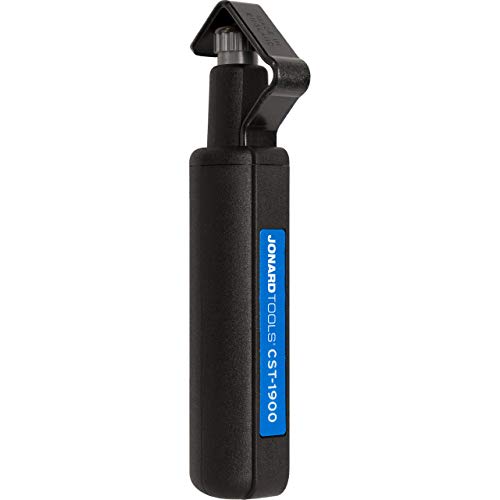
The Jonard CST-1900 uses a patented spiral stripping mechanism to remove tough insulation efficiently. It supports a range of jacket materials, including PVC, rubber, and PE, and offers multiple cutting modes for end, mid‑span, and jacket removal. This makes it a strong choice for installers handling varied cable types. A potential limitation is that the tool is specialized for jacket removal and may not replace a dedicated wire cutter for some tasks.
Best for: Professionals who frequently encounter mixed insulation types and need a versatile strip-and-ring capability. Choose this if you require robust stripping across diverse jackets.
Caution: Avoid forcing cuts on very thick insulation; use appropriate blade settings to prevent jacket damage.
Klein Tools 21050 Large Cable Stripper

The Klein Tools 21050 is designed for very large conductors, removing insulation on 750 MCM to 2/0 copper. Its Clover design consolidates four wire sizes into one tool, enabling quick, precise cuts with a simple twist. This tool is best for electricians dealing with large power cables, feeders, or heavy gauge conductors. A limitation is that large handles may be harder to maneuver in tight spaces.
Best for: Projects requiring stripping of very large cables or multiple large gauges with a single tool. Choose this if you handle 250 MCM and up consistently.
Caution: Use the correct stripping size for the cable to prevent insulation damage or knife binding.
Klein Tools 11046 Wire Stripper

The Klein Tools 11046 is a compact, lightweight stripper and cutter designed for 16‑26 AWG stranded wire. It features a narrow nose for confined spaces and self‑opening, spring‑loaded operation with precision stripping holes. While not a heavy‑duty heavy‑gauge tool, it’s a solid choice for smaller high‑voltage tasks or intricate wiring in restricted areas. The trade‑off is that it may not handle very large conductors as efficiently as larger models.
Best for: Installers who need a precise, compact stripper for small to mid gauges and tight enclosures. Choose this if you regularly work in cramped spaces or prefer a one‑hand operation tool.
Buying Guide
What should you consider when selecting a high voltage cable stripper?
- Voltage suitability: Look for IEC60900 or equivalent certification if you will work near live circuits or require higher insulation resistance.
- Conductor size range: Ensure the tool supports the gauge ranges you encounter most often, from small wires to large feeders.
- Cutting modes: Rotary, spiral, and linear cuts offer flexibility for different jacket materials and insulation thickness.
- Ergonomics and safety: An insulated handle, non-slip grip, and compact design reduce fatigue and risk during long tasks.
- Blade and material quality: High‑carbon steel blades and robust housings resist wear in demanding environments.
- Portability vs. capacity: Pocket models are portable; larger models handle heavier cables but may be less maneuverable in tight spaces.
Which type is right for you?
- Live-work professionals: Prioritize IEC60900 certification, insulated handles, and a compact form factor for site versatility.
- Field technicians: Favor tools with multiple stripping modes and adjustable blade height to adapt to jacket thickness.
- Industrial electricians: Choose large, heavy‑duty strippers with wide gauge ranges and robust leverage for large conductors.
Usage tips
- Inspect insulation thickness before stripping to select the correct setting and avoid conductor damage.
- Test a small sample on a scrap wire to calibrate force and depth of cut.
- Regularly clean blades and lubricate hinge points to extend tool life.
FAQ
- What gauge range should I expect from a “1000V” stripper? – It depends on model; many are designed for broader high‑voltage applications but verify the specific gauge range in the product details.
- Is an insulated handle enough for safety? – An insulated handle helps, but you should also follow proper live‑work safety protocols and wear PPE.
- Can I strip jackets of all materials with one tool? – Some tools support multiple jacket types (PVC, rubber, PE), but check the listed materials to confirm compatibility.
- Are pocket strippers less capable than bench models? – Pocket tools offer portability and convenience; bench or larger models may provide greater leverage and cutting depth for thick insulation.
- How do I avoid nicking conductors? – Use the correct stripping setting for the insulation thickness and test on scrap wire before final use.
- Should I choose a tool with multiple sizes in one? – Tools with a Clover or multi-size design reduce the need to switch tools when dealing with different gauges.