Best High Temperature Refrigerated Air Dryers for Industrial Use
Answering the need for reliable, high-temperature air drying, this guide highlights refrigerated air dryers designed to handle elevated inlet temperatures while delivering dry, oil-free air. These models are best for workshops, automotive shops, spraying, CNC environments, and industrial setups where heat tolerance and moisture removal are critical. The top picks below are selected for compatibility with mid- to high-horsepower compressors, ease of use, and efficient moisture removal. See the quick comparison table and stay aware of each unit’s temperature and pressure specifications to choose the right fit.
Quick comparison table of selected products:
| Product | Flow (CFM) | Best For | Notes |
|---|---|---|---|
| VEVOR 85 CFM Refrigerated Dryer | 85 | Mid-size industrial lines with 15–20 HP compressors | Color screen control, automatic drainage |
| VEVOR 125 CFM Refrigerated Dryer | 125 | Higher-demand industrial setups | R410a refrigerant, larger evaporator area |
| Schulz 50 CFM High Temp Dryer | 50 | 7.5–15 HP systems needing 180°F inlet tolerance | Non-cycling, needs pre-filter for moisture |
| HPDAVV 35 CFM Refrigerated Dryer | 35 | Workshops and garages with 7.5–10 HP compressors | R134a cooling, compact footprint |
| TECHTONGDA 53 CFM High Temp Dryer | 53 | Systems with high inlet temperatures up to 80°C | Includes three filters |
VEVOR Compressed Air Dryer, 85 CFM

The VEVOR 85 CFM refrigerated air dryer is designed for 15 HP and 20 HP compressors, offering a dew point in the 35.6–50°F range. With a color screen control panel and automatic drainage, this unit emphasizes ease of use and continuous moisture removal in demanding environments. Best for mid-sized production lines where stable, dry air improves tool life and performance. Inlet air can tolerate typical shop temperatures up to 149°F, making it suitable for relatively hot workshop conditions. A potential limitation is that performance depends on properly sized post-filters and regular maintenance of the drainage system.
Who it’s best for: shops needing a compact, high-efficiency solution for mid-to-large compressors without complex control requirements. Why selected: strong balance of flow, dew point control, and user-friendly interface for continuous operation.
Important note: Ensure compatible connections (RC 3/4″) and verify your compressor’s output to avoid undersizing the dryer for your airflow needs.
VEVOR Compressed Air Dryer, 125 CFM
The 125 CFM VEVOR dryer is built for higher-demand settings and is compatible with 20 HP, 25 HP, and 30 HP compressors. It uses R410a refrigerant and features a large evaporator area for efficient moisture removal and heat exchange. This model targets manufacturers and workshops that require robust, continuous drying at higher airflow rates. A caveat is that higher airflow can increase energy use; ensure your system layout minimizes pressure drop and that electrical supply matches the unit’s requirements.
Who it’s best for: facilities with larger air requirements or expanding production lines. Why selected: higher CFM capacity paired with reliable refrigeration and a user-friendly control panel.
Important note: Check the RC connections (RC 1″) and plan for adequate space around the unit for airflow and service access.
Schulz 50 CFM High Temperature Dryer

Schulz offers a 50 CFM high-temperature refrigerated dryer designed for 10 HP–15 HP compressors. It features an inlet temperature tolerance up to 180°F with a maximum ambient of 113°F, and a dew point around 41°F at 100 PSI. The unit uses R134a refrigerant and includes a recommended pre-filter to protect the moisture-removal stages. Best for: shops needing dependable high-temperature drying with straightforward operation. Caution: data emphasizes a moisture-removal filter is essential for optimal performance; pre-filters are strongly advised.
Who it’s best for: smaller industrial applications or retrofits where a compact, reliable dryer is needed. Why selected: explicit high-temperature tolerance and robust dew-point performance for challenging environments.
HPDAVV Industrial Refrigerated Dryer, 35 CFM
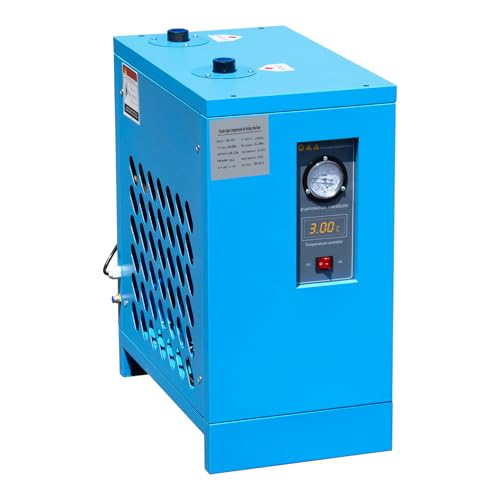
HPDAVV’s 35 CFM refrigerated dryer is designed for 7.5 HP to 10 HP compressors. It utilizes an energy-efficient R134a cooling system and offers compact dimensions ideal for tighter shop spaces. It delivers clean, dry air suitable for pneumatic tools and spray applications. Best for: small to medium workshops needing reliable drying without space for larger units. Limitation: 35 CFM may be insufficient for high-demand lines; consider this model for limited throughput needs or as a secondary dryer stage in larger systems.
Who it’s best for: garage or small shop environments where space is at a premium. Why selected: practical balance of cooling efficiency and compact footprint with straightforward installation.
TECHTONGDA High Temperature Dryer with Filters, 53 CFM
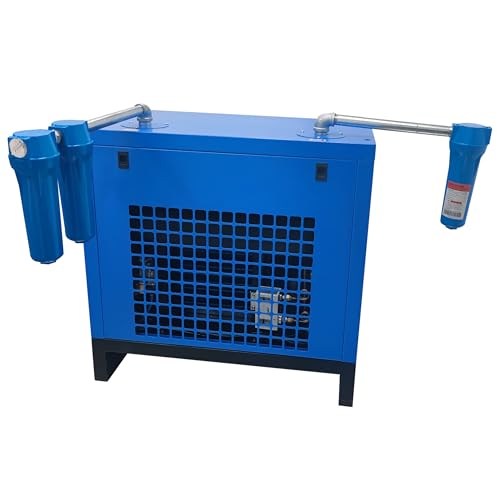
TECHTONGDA’s 53 CFM high-temperature refrigerated dryer is designed for air systems that tolerate up to 80°C inlet temperatures. It includes three filters—two on the outlet and one on the inlet—making it a ready-to-install option for eliminating moisture, oil, and particles. Best for: users needing a high-temperature solution with integrated filtration for cleaner output. Caution: ensure proper piping and filter connections as specified, and confirm your system’s required dew point is within the dryer’s capabilities.
Who it’s best for: operations that require pre- and post-filtration in a single package. Why selected: the included filter set simplifies installation and maintenance for moisture and oil control.
Buying Guide: Key Considerations for High Temperature Refrigerated Dryers
- Inlet temperature tolerance: Match the dryer’s maximum inlet temperature with your exhaust or ambient conditions to prevent performance loss.
- Airflow needs (CFM): Choose a unit with adequate CFM for your compressor size and peak demand. Oversizing reduces pressure drop, while undersizing reduces dryness.
- Dew point performance: A lower dew point means drier air. Consider applications such as spray painting or CNC machining that benefit from tighter moisture control.
- Refrigerant type and efficiency: Common refrigerants like R134a and R410a affect cooling efficiency and running costs. Verify compatibility with your facility’s maintenance capabilities.
- Pressure range: Ensure the dryer supports your system’s operating pressures, including any surge scenarios.
- Maintenance needs: Look for units with accessible drains and clear service intervals. Pre-filters and coalescing filters extend dryer life.
- Footprint and installation: Evaluate space, ventilation, and electrical requirements. Some models include compact footprints and simple plug-and-play options.
- Warranty and support: Consider brands with clear documentation, parts availability, and service support for industrial environments.
FAQ
- What is a high-temperature refrigerated air dryer? It is an air dryer designed to operate with elevated inlet air temperatures, cooling the air to remove moisture and oil to produce dry air for pneumatic tools and processes.
- Why is dew point important in an industrial dryer? Dew point indicates the dryness level of the output air; lower dew points prevent moisture-related damage and corrosion in downstream equipment.
- Can I mix dryers for larger systems?
- How often should I replace pre-filters or moisture filters? Follow the manufacturer’s maintenance schedule and inspect filters during routine service for optimal performance.
- Is a higher CFM dryer always better? Not necessarily; match CFM to your peak demand and consider pressure losses in piping to avoid undersizing or oversizing.
- Do these dryers require special electrical wiring? Some units run on standard 110–120V circuits, while larger models may need dedicated wiring or higher voltage. Check each product’s electrical specs.