Best High Power Dummy Load Options for RF Testing
Find the right high power dummy load for RF testing, ham radio work, or lab bench use. This guide highlights five top options, explains who each product is best for, and compares power rating, impedance, and frequency range. Whether you’re a hobbyist, professional, or field technician, these picks help you safely terminate signals without reflections.
Quick buying snapshot
- BECEN 200Watt PL259: Best for compact bench setups and general 50-ohm testing
- XRDS -RF 200W 4.3-10: Best for 0–3 GHz testing with compact Mini DIN interface
- PALSTAR DL1500: Best for high-power bench and antenna work up to 30 MHz
- XRDS -RF 50W 4.3-10: Best for low-to-mid power RF work in 0–3 GHz
- Pro Trucker 1000W Can Dummy Load: Best for extreme power handling at wide ranges
Best 200W 50Ω PL259 Dummy Load
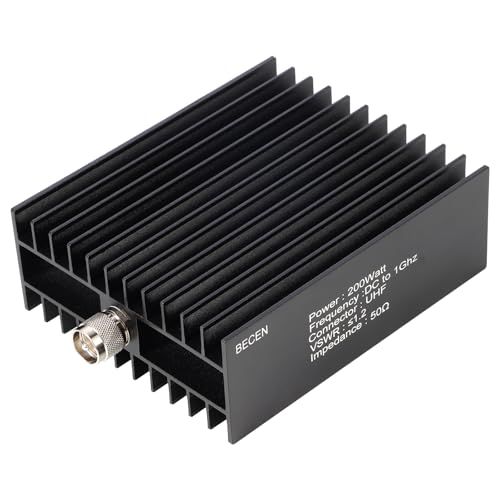
The BECEN 200Watt PL259 Dummy Load is a 50-ohm, DC to 1.0 GHz load rated for continuous average power. It is designed for bench testing, RF experiments, and field work where solid impedance matching is required. Best for hobbyists and technicians who need a reliable, compact 200W option for general RF testing.
- Best for compact benches and routine 50 Ω RF work
- Limitations: DC to 1 GHz range suits many tests, but higher frequency work may demand broader coverage
Pro Trucker 1000W 50Ω Can Dummy Load

The Pro Trucker 1000 watt can dummy load is a robust option intended for higher power testing in the 0–30 MHz range with low SWR. It is best for users who need very high power handling and are working with low to mid-band RF systems. Note that the can is designed for use with oil to improve thermal performance, and oil is not included.
- Best for high-power, low-frequency work (0–30 MHz)
- Limitation: Oil-filled can requires maintenance and additional setup
XRDS-RF 200W 4.3-10 Dummy Load

The XRDS-RF 200W dummy load offers a fixed 50 Ω impedance with a 4.3-10 Mini DIN connector. It supports up to 200W continuous power and is suitable for telecom and antenna testing across a wide 0–3 GHz range. Best for testers needing a compact, 4.3-10 DIN interface with solid high-power performance.
- Best for compact setups needing a DIN interface
- Limitations: 4.3-10 DIN compatibility may restrict use with some equipment
PALSTAR DL1500 1500W Dummy Load

The PALSTAR DL1500 delivers up to 1500 watts and spans 0–30 MHz with a hyperbolic tuning cone and an SO-329 coax input. This model is best for serious high-power bench and antenna work where broad low-frequency coverage is essential. It is well-suited for lab environments and field testing that demands robust power handling.
- Best for high-power, low-frequency RF work
- Limitation: Lower frequency range compared to some modern wideband loads
XRDS-RF 200W 4.3-10 (Alternative)
This XRDS-RF 200W 4.3-10 variant provides another high-power option with the same 50 Ω impedance and 0–3 GHz range. It is best for users who want redundancy or a separate unit for different lab stations. Considerations include DIN interface compatibility with existing gear.
- Best for multi-station testing needs
- Limitation: Similar specs to the other XRDS 200W model; choose based on connector compatibility
Buying Guide: How to Choose the Right High Power Dummy Load
What power rating do you actually need?
Match the load to the maximum signal power you plan to terminate. For bench work where frequent testing occurs, a rating around 200W–1000W provides headroom. Higher power ratings reduce the risk of overheating during prolonged tests.
Which impedance and frequency range matter?
The standard is 50 ohms for most RF systems. Ensure the chosen model maintains a stable 50 Ω across your test frequency. If you work primarily in low bands (below 30 MHz), prioritize loads with wider low-frequency support. For modern telecom testing up to a few GHz, look for models rated for 0–3 GHz or higher.
Connector type and compatibility
Variants include PL259, 4.3-10 Mini DIN, and other interfaces. Choose a unit whose connector matches your test equipment or has compatible adapters. Some high-power models use DIN or specific coax inputs; verify compatibility before purchase.
Thermal performance and setup considerations
High-power loads generate heat. Oil-filled cans or air-cooled designs affect installation. Consider the thermal path and whether you need additional cooling or a heat sink for continuous operation. Oil-filled options require handling awareness and spill precautions.
Physical footprint and portability
If you test in the field, compact and rugged designs are advantageous. In a home or lab bench, larger models with robust connectors may be preferred for long-term stability.
Price-to-performance and maintenance
Balance upfront cost with durability, especially for high-current applications. Some models require periodic oil maintenance or connector checks to prevent impedance drift.
Use-case guidance at a glance
- General RF testing and bench work: 200W–500W, 50 Ω, up to 1 GHz
- High-power, low-frequency needs: 1000W–1500W, robust cooling, 0–30 MHz
- Compact lab setups needing DIN interfaces: 200W–200W with 4.3-10 DIN
FAQ
- What is a dummy load used for? A dummy load terminates RF signals to prevent reflections, enabling safe testing and calibration of transmitters and antennas.
- Do I need oil-filled dummy loads? Oil-filled designs can improve heat handling for high-power, long-duration tests, but require proper handling and maintenance.
- Can I mix different dummy loads in a test setup? Yes, but ensure impedance, power rating, and connector compatibility match your test equipment to avoid reflections or damage.
- What frequency range is typical for most 50 Ω loads? Many are 0–3 GHz, with some designed for DC–1 GHz or 0–30 MHz depending on the model and application.
- How do I determine the right wattage? Estimate the highest RF power you expect to terminate in your tests and choose a load rated above that value for reliability and safety.
- Are there safety considerations with high-power RF testing? Yes—keep clear of live RF paths during testing, use proper shielding, and follow manufacturer guidelines for cooling and handling.