Best Helium Gas Leak Detectors for Precision Detection and Purity Testing
When choose a helium gas leak detector, you want accurate readings, quick responses, and a design suited to your environment—whether you’re in a lab, field service, or industrial setting. This guide highlights five top options that balance precision, portability, and ease of use. It’s ideal for professionals working with helium purity testing, leak localization, or mixed-gas environments. The top picks cover specialized helium analyzers, versatile multi-gas detectors, and rugged handheld units suited for tight spaces and varied conditions. See the quick product table below for a concise comparison.
| Product | Best For | Key Strength | Notable Limitation |
|---|---|---|---|
| Helium Gas Analyzer | Purity and Leak Detection | Laboratories and field technicians needing precise helium readings | 0-100% range, 0.1ppm resolution, built-in pump | Specialized tool; may require calibration familiarity |
| PT520A Natural Gas Detector (TOPTES) | Indoor/outdoor leak localization | 17-inch gooseneck, quick 0.5s response | Gas types vary; designed for broader natural gas detection |
| Amprobe-ULD-410 Ultrasonic Leak Detector | General leak detection across various gases | Broad frequency range (20–90 kHz), filters for noisy environments | Ultrasonic method—not a direct gas concentration readout |
| Klein Tools ET120 Gas Leak Detector | Wide ppm range detection with simple alerts | 50–10,000 ppm, adjustable sensitivity | Limited to combustible gases; not a pure helium analyzer |
| PT199 Natural Gas Leak Detector | Portable, quick detection at home and job sites | Fast audible/visual alarms, batteries included | General combustible gas sensing; not helium-specific |
Helium Gas Analyzer | Purity and Leak Detection

The Helium Gas Analyzer provides a 0-100% helium range with 0.1% resolution, making it suitable for purity testing and leak localization in controlled environments. It features a built-in pump and a color display for quick interpretation of results. It is best for labs and field technicians who need precise helium measurements and consolidated operation in one handheld unit. A built-in zero and span calibration option supports ongoing accuracy maintenance. Use this when helium purity and leak rate are the primary concerns, particularly in research or calibration tasks. A potential limitation is that it is specialized for helium and may be less versatile for other gas types unless paired with complementary detectors.
Best for: Lab technicians and field specialists focused on helium purity and leak verification. Why selected: It combines a wide helium range, fine resolution, and an integrated pump for convenience in tight spaces. Caution: Calibration requires familiarity with helium sensing and may need periodic attention to maintain accuracy.
PT520A Natural Gas Detector

The PT520A is designed to locate natural gas leaks with a 17-inch gooseneck probe for hard-to-reach areas. It detects methane, propane, natural gas, LPG, and butane, making it suitable for homes, RVs, and industrial settings where long reach helps pinpoint leaks quickly. A visible 7-bar indicator and a 75 dB alarm provide clear cues, and the device offers a rapid 0.5-second response. Best for: Environments requiring access to tight spaces and quick localization. Caution: Detection data covers multiple gases beyond helium, so ensure the device’s readings are interpreted within the correct gas context.
Amprobe-ULD-410 Ultrasonic Leak Detector

The Amprobe ULD-410 uses ultrasonic technology to detect leaks by picking up sound frequencies generated by escaping gases. It covers a broad range of gases and is beneficial in noisy environments where visual indicators may be insufficient. It includes multiple filters and a 2.5-inch LCD with a bargraph for quick interpretation. Best for: Technicians who need a versatile detector that works in varied environments. Caution: It does not provide direct gas concentration numbers, so it complements, rather than replaces, gas-specific detectors.
Klein Tools ET120 Gas Leak Detector

The Klein Tools ET120 offers a wide detection range from roughly 50 to 10,000 ppm and adjustable sensitivity, plus five red LED indicators and an 85 dB alarm that escalates with gas concentration. It’s compact and pocket-friendly, ideal for quick screening in homes, workshops, or small facilities. Best for: technicians needing a portable, easy-to-use detector for routine checks. Caution: It targets combustible gases and may require supplemental helium-specific methods for precise helium readings.
PT199 Natural Gas Leak Detector
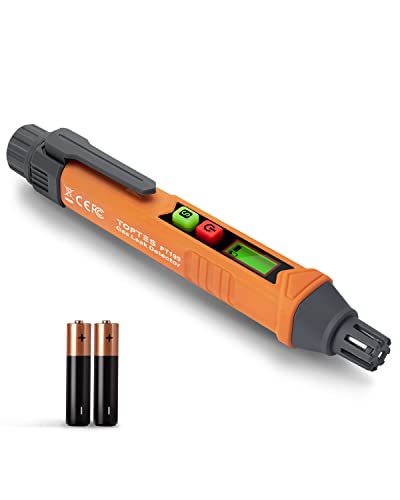
The PT199 is a portable sniffer for natural gas detection, featuring audible and visual alarms that activate within half a second of gas exposure. It includes two AA batteries and a compact design for on-the-go use. The LCD turns red as gas levels rise, providing a clear visual cue. Best for: home and small-site safety checks where quick alerts are critical. Caution: It is geared toward broader combustible gas detection, not solely helium-specific measurements.
Buying Guide: Helium Detector Essentials
- Purpose and gas type: Choose a device that aligns with helium purity testing or helium leak localization, or pick a multi-gas detector for broader use cases.
- Detection range and resolution: For helium, look for devices with wide ranges and high resolution to catch small leaks and purity variations.
- Response time: Fast alarms (sub-second) help prevent exposure and mitigate risk in critical environments.
- Probe design and reach: Long goosenecks or flexible probes aid access to tight spaces and equipment connections.
- Calibration and maintenance: Instruments with easy zero/span calibration and clear maintenance guidance improve long-term accuracy.
- Alerts and user interface: Visual indicators, color displays, and audible alarms should be clear in loud or dim settings.
- Portability and power: Battery life and ergonomic design matter for field work and portable testing.
- Compatibility: If you require helium-specific readings, ensure the detector’s gas library or sensing element is appropriate for helium.
FAQ: Helium Gas Leaks And Detectors
- What is the best detector for helium purity testing? – A helium-focused analyzer with a broad 0-100% range and fine resolution is typically best, especially when paired with a built-in pump for ease of use.
- Can multi-gas detectors detect helium leaks? – Some multi-gas detectors can detect combustible or inert gasses including helium, but accuracy for helium-specific readings may vary; verify sensor specifications.
- What indicates a rapid helium leak on these devices? – Look for a rapid shift in readings, a high-contrast color display, and an audible alarm tied to a threshold that matches the gas concentration.
- How often should calibration be performed? – Calibration frequency depends on usage and manufacturer guidance; regular zero/span checks maintain accuracy.
- Are helium detectors portable enough for fieldwork? – Yes, several compact handheld units are designed for field use with long battery life and integrated pumps or probes.
- Do these devices require special handling for safety? – Yes, follow standard gas safety practices, including ventilation, PPE as needed, and proper storage of detectors when not in use.