Best Heavy Duty Welding Cables for Tough Power Needs
Finding the right welding cable means choosing the balance of flexibility, insulation, and current capacity for demanding environments. This guide focuses on heavy‑duty cables suitable for automotive, solar, generators, and marine use. The top five products below are selected for their size variety, construction quality, and practical usage notes. Each entry explains who it’s best for and why it was chosen, along with a brief caveat to help you decide confidently.
| Product | Gauge / Length | Best For | |
|---|---|---|---|
| TEMCo 2 Gauge + 25 ft Red & 25 ft Black | 2 AWG, 50 ft total | Heavy-duty battery work, solar, inverter setups | High amp capacity with dual-conductor flexibility |
| POWGRN 10 Gauge 50 ft | 10 AWG, 50 ft | Welder extension with most 50 A tools | ETL listed, weatherproof, long reach |
| Shirbly 2 Gauge 10 ft + 10 ft | 2 AWG, 20 ft total | Automotive, battery banks, small solar setups | Pure copper, versatile bendability |
| TEMCo 4 Gauge + 25 ft Red & 25 ft Black | 4 AWG, 50 ft total | Medium‑duty power wiring, portable welders | Solid copper with flexible jacket |
| Shirbly 1/0 Gauge 20 ft + 20 ft | 1/0 AWG, 40 ft total | Large automotive, solar arrays, generators | High conductivity and versatile length |
TEMCo 2 Gauge + 25 ft Red & 25 ft Black Heavy Duty Cable

Best for: Users needing a compact, dual-conductor setup for powerful battery work in vehicles, solar arrays, or inverters. The cable uses an annealed OFC conductor and TEMCo Easy-Flex EPDM jacket for flexibility in tight spaces.
- Max current: 205 amps (up to 50 feet)
- Rated up to 600 volts
- Temperature range: -58°F to +221°F (-50°C to +105°C)
- Nominal outer diameter: 0.413 inches
Caution: The dual 2 AWG conductors add bulk; routing may require careful fitment in cramped compartments or panels.
POWGRN 50 Foot 10 Gauge Welder Extension Cord

Best for: Welders needing a long, reliable extension with broad compatibility. This 10 AWG cable is rated for up to 250V and 7,500 watts, with ETL listing and a weatherproof jacket for outdoor use.
- 50 ft length improves mobility around large work areas
- Weatherproof, high-temperature resistant jacket
- ETL listed for safety and reliability
Caution: This cord is designed for 50 A capacity; avoid overloading with higher current equipment beyond its rating.
Shirbly 2 Gauge Battery Cable 10 ft + 10 ft

Best for: Diesel, automotive, and solar setups needing a compact yet robust 2 AWG option. It uses a pure copper OFC core with EPDM insulation for outdoor resilience.
- Pure copper, 1070 strands for flexibility
- Voltage rating up to 600 volts; wide operating temp range
- Epdm insulation provides moisture and chemical resistance
Caution: The 2 AWG length is shorter; plan a layout that minimizes excessive bending radii to maintain conductor integrity.
TEMCo 4 Gauge + 25 ft Red & 25 ft Black Cable

Best for: Medium‑duty power wiring, portable welders, and automotive projects requiring sturdier conductors than light-duty cables. The 4 AWG setup is dual-conductor with a flexible EPDM jacket.
- Max current: 150 amps (up to 50 feet)
- Rated up to 600 volts
- Operating range: -58°F to +221°F (-50°C to +105°C)
Caution: Heavier gauge increases stiffness; plan routing to minimize sharp bends and ensure long-term flexibility.
TKDMR 2/0 Gauge 10 ft + 10 ft + 20 ft Sleeving
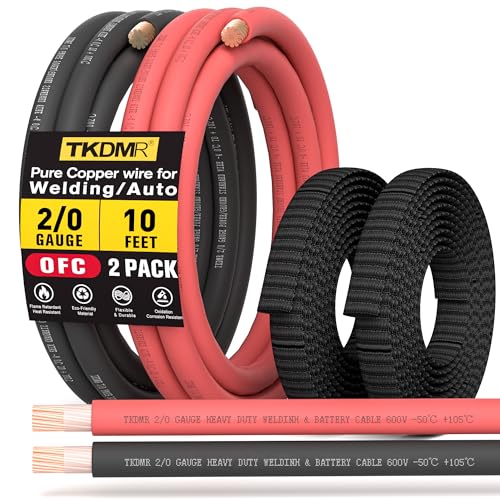
Best for: Applications requiring high current capacity in larger electrical systems, such as heavy equipment or solar installations, with added braided sleeving for protection and organization.
- 2/0 AWG copper conductor
- Resistance to solvents, heat, and abrasion
- Includes braided sleeving for wire protection
Caution: The additional sleeving adds bulk; ensure compatibility with existing conduits and cable guides.
Buying Guide: How To Choose The Right Welding Cable
What gauge do I need? The gauge determines current capacity and voltage drop. For heavy automotive or solar setups, 2–6 AWG is common; lighter tasks can use 10–4 AWG. Consider both the maximum amperage required and the length of run.
How important is insulation and jacket material? EPDM insulation provides excellent heat resistance, weather resistance, and flexibility. A rugged jacket is essential for outdoor, marine, or welding in dusty environments. Ensure the jacket is resistant to oil, solvents, and UV exposure if your work is outdoors.
Should I prefer single conductor or dual conductor? Dual-conductor cables with separate red/black leads simplify wiring and reduce confusion. However, single-conductor runs can be cleaner in tight spaces but may require separate heat‑shrink sleeving for color coding.
Is length a critical factor? Yes. Longer runs increase resistance and voltage drop. If you must extend power farther than 25–50 feet, choose heavier gauge to compensate for the added length.
What about flexibility and ease of handling? Look for annealed OFC conductors and EPDM insulation described as “Easy-Flex” or similar terms. This helps with tight routing, bend radii, and handling around heavy equipment.
What safety and compliance should I check? Look for ETL listings or similar safety certifications when purchasing cords for portable welders and tools. Ensure the jacket is flame retardant and rated for the operating environment you expect.
FAQ
- What does AWG stand for and why does it matter?
– AWG stands for American Wire Gauge. A lower number means a thicker wire, capable of carrying more current with less voltage drop over distance. - Can I mix different gauge cables for a single project?
– It’s possible but not ideal. Use a consistent gauge where possible to maintain predictable current capacity and reduce voltage drop. - Is weatherproofing essential for welding cables?
– For outdoor or shop environments, yes. A weatherproof jacket protects against moisture, oils, and UV exposure, extending cable life. - When should I choose 2/0 AWG over 2 AWG?
– Choose 2/0 AWG for higher current demands or longer runs to minimize voltage drop; 2 AWG is suitable for many typical automotive or portable weld setups. - What is the benefit of dual-conductor cables?
– Dual leads simplify polarity identification and reduce the need for additional color coding in complex installations. - Are these cables compatible with all welders?
– Compatibility depends on voltage, amperage, and connector types. Check your welder’s cord rating and plug type before purchase.
This selection provides a practical mix of gauge sizes, lengths, and insulation styles to match common heavy-duty welding tasks. Each product is selected for clarity around best use cases, with notes on potential constraints to help you decide confidently.