Best Heaters for Small Ponds: Safe, Efficient De-Icers for Winter
Winter ponds benefit from a reliable heater that prevents ice from sealing off the water’s surface while keeping fish safe and accessible to oxygen. The following selections cover a range of pond sizes, temperatures, and power needs, with safety features and durable construction in mind. Each option is suitable for small outdoor ponds and stock tanks, providing automatic operation and straightforward installation.
Summary of Selected Products
| Product | Brand | Power | Key Feature |
|---|---|---|---|
| Engtesy 500W Pond Heater | Engtesy | 500W | Non-conductive casing for safety; submersible design |
| HITOP Outdoor Pond Heater 600W | HITOP | 600W | Floating, fast heating, intelligent temp control |
| Farm Innovators 1250W Pond De-Icer | Farm Innovators | 1250W | Thermostatic control; aluminum float for durability |
| HITOP 300W Outdoor Pond Heater | HITOP | 300W | Compact, floats, quick ice-hole formation |
| TURBRO Pond De-icer 400W | TURBRO | 400W | Full stainless steel, IP68, GFCI protection |
Engtesy 500W Pond Heater

The Engtesy pond heater features a non-conductive casing designed to reduce electric shock risk, making it suitable for ponds and stock tanks where animals may drink from the water. Its durable, weather-resistant construction resists rust and corrosion, ensuring long-term reliability in outdoor environments. Installation is straightforward: submerge the unit, plug in, and rely on a 10-foot cord for flexible placement. The unit is positioned as a safe, low-maintenance option, capable of functioning as a submersible heater when paired with compatible setups.
HITOP Outdoor Pond Heater 600W

This 600W HITOP model is designed to keep a hole in the ice by melting channels in the water around the heater. It heats a limited area quickly, suitable for small-to-medium outdoor ponds. The device floats on the water with upgraded foam to prevent contact with pond mud, helping protect the heater and the pond substrate. It includes an intelligent constant-temperature feature that maintains water near 68–72°F and automatically starts or stops as needed, reducing energy use while keeping an open breathing hole for fish.
Farm Innovators 1250W Pond De Icer

Designed to float on top of ponds and create a protected breathing space under winter ice, this aluminum-bodied heater focuses on efficiency and longevity. The floatation and aluminum construction suit harsher outdoor conditions, and the built-in thermostatic control ensures operation only when needed, optimizing energy use while reducing ice formation. Its robust build supports reliability through repeated freeze-thaw cycles common in colder climates.
HITOP 300W Outdoor Pond Heater

The 300W HITOP model provides a compact option for smaller ponds or bird baths. It adheres to a similar floating design and offers fast heating in its target zone, sufficient to create a melt hole for fish to access oxygen. The device uses an intelligent constant-temperature control, maintaining water around 68–72°F with automatic operation. Its smaller form factor makes it a practical choice where space or power is limited.
Laguna PowerHeat 315-Watt Floating Heater

This Laguna PowerHeat model is a reliable 315-watt floating de-icer designed for outdoor ponds with fish. It features a highly visible LED indicator to show when the unit is active and an integrated thermostat that shuts off the heater if temperatures rise too high, protecting the device and aquatic life. The compact size makes it suitable for smaller ponds while offering smart safety features.
SoulBay 1000W Pond Heater
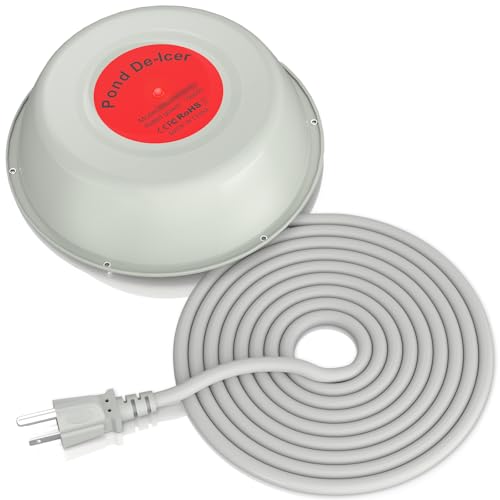
The SoulBay 1000W model is designed for larger small ponds or bird baths that require more robust heating. It offers thermostatic control to maintain temperatures above freezing and avoid excessive heating. The higher wattage supports faster de-icing in chilly conditions, helping maintain water accessibility for wildlife throughout the winter.
TURBRO 400W Floating De-Icer

The TURBRO 400W de-icer uses full stainless steel casing with IP68 water resistance and GFCI protection for electrical safety. It includes a UL-approved cord and leakage protection plug, prioritizing safety in outdoor installations. With SCR technology for precise temperature management and a long 32.8 ft cord, it offers flexible placement and reliable performance in various pond layouts.
Buying Guide: How to Choose The Best Small Pond Heater
- Cold-weather needs: Determine pond size, typical winter temperatures, and how much open water you need to maintain for fish to breathe. For very small ponds, a 300–600W unit often suffices; larger small ponds may require 800–1250W.
- Safety features: Look for non-conductive casings, thermostatic controls, LED indicators, GFCI protection, and overheat shutoffs. These reduce risk to animals and water users.
- Submersion and floating design: Floating de-icers work well for ponds with irregular shapes. Submersible units may be easier to install in stock tanks or narrow areas but require secure placement to avoid tangling cords.
- Power cord length and placement: A longer cord (20–40 ft) provides flexibility to position the heater away from intake or wildlife areas. Consider weather exposure and the risk of freezing at the cord entry.
- Durability and materials: Stainless steel and aluminum housings resist corrosion in wet environments. Weather-resistant, rust-proof builds extend the device’s lifespan in outdoor settings.
- Temperature range and control: Consistent 68–72°F targets are common; some units allow automatic cycling to prevent over-heating or excessive ice melt, which conserves energy.
- Ice-hole strategy: Most pond heaters are designed to create a breathing hole rather than heat the entire water. This approach preserves oxygen exchange for fish while keeping the overall pond cooler.
- Compatibility with existing setups: If you have a stock tank or a particular pond shape, verify mounting methods, submersion depth, and whether the heater requires a specific water type or tank.
- Maintenance and reliability: Choose models with simple maintenance and robust seals. Look for features like visible indicator lights and accessible plug connections for easier inspection.
- Budget and efficiency: Higher wattage units may heat more quickly but consume more power. Evaluate the cost-to-benefit for your climate and pond size, and favor models with thermostatic control to avoid wasteful cycling.