Best Heat Vent With Fan for Balanced Comfort in Any Room
The best heat vent with a fan helps push warm or cool air where you need it most, improving comfort in bedrooms, living spaces, and nurseries. This guide highlights five top options that fit 4″ x 10″ vents, explaining who each product is best for and why. Use this overview to choose a solution that aligns with your HVAC setup, noise tolerance, and temperature control needs.
Top picks at a glance. The following table compares key points to help you decide quickly.
| Product | Best For | Why It Stands Out | Limitations |
|---|---|---|---|
| BIOWIND Quiet Register Booster Fan | Small to mid-sized homes seeking quiet operation | 10-speed control, thermostat and LED temperature sensing for auto on/off | Requires 4″ x 10″ vent compatibility; remote control dependent on battery |
| MOTCTQVD Smart Register Booster Fan | Tech-enabled homes needing precise control | Dual intelligent control via panel and remote; 10 speeds | Smart features may require setup; remote use adds one more accessory |
| KHEOED Built-in Register Booster Fan | Quiet operation lovers and smart-control fans | Ultra-quiet operation with 10 speeds and precise temperature sensing | Some users may prefer larger airflow options for bigger rooms |
| Hisummer Register Booster Fan | Sleep-focused spaces and upstairs rooms | Up to 150 CFM, low noise as low as 17 dBA, precise temperature sensing | Specific to 4×10 openings; higher airflow may be overkill in small rooms |
All five products target 4″ x 10″ vent openings and aim to reduce temperature variances between rooms. Each option offers remote or smart control features, with varying emphasis on quiet operation, airflow, and automatic temperature-based adjustments. When selecting, consider room size, desired noise level, and how actively you want the system to adjust to changing temperatures.
BIOWIND Quiet Register Booster Fan

The BIOWIND model is designed for smoother airflow and quieter operation. It uses a dynamic fan balance, motor start-up verification, and noise screening to improve long-term reliability. Best for: homes where a quiet, unobtrusive vent boost is valued, such as bedrooms or living rooms. Why selected: combines a premium frame with electronic temperature sensing that can automatically regulate airflow. Limitation: relies on a remote control and LED controller, which require occasional battery changes and setup attention.
MOTCTQVD Smart Register Booster Fan

This smart fan supports 10-speed control and offers dual intelligent operation through a control panel and remote. Best for: tech-forward homes that want precise climate control with configurable timers and modes. Why selected: it balances cooling and heating modes with an emphasis on optimized airflow, helping maintain even temperatures. Limitation: the full feature set may require initial setup and familiarity with remote controls.
KHEOED Built-in Register Booster Fan

The KHEOED model emphasizes ultra-quiet operation with 10 speeds and smart temperature sensing. Best for: users who want a stealthy vent boost that quietly supports heating or cooling in bedrooms or living areas. Why selected: smart control with precise sensing helps tailor airflow to room conditions. Limitation: may be less effective in very large spaces if duct size or layout limits airflow.
Hisummer Register Booster Fan
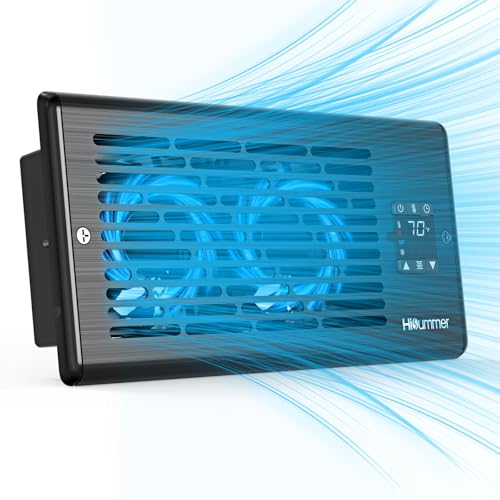
The Hisummer model is designed for up to 150 CFM airflow with a focus on upstairs and bedroom use. Best for: quiet environments where distractions by vent noise must be minimized, including nurseries or children’s rooms. Why selected: a high-precision NTC temperature sensor enables automatic speed adjustments for consistent comfort. Limitation: specifically fits 4×10 openings; larger rooms may require additional units for full coverage.
Buying Guide: How To Choose The Right Vent Booster
- Vent size and compatibility: Ensure the 4″ x 10″ opening is compatible with the chosen model and that mounting space allows installation without modifying the ductwork.
- Noise level: If quiet operation is critical, prioritize models advertising low dBA ratings or PWM-driven quieting systems.
- Control mechanism: Decide between remote control, digital thermostat-based auto mode, or fully manual speed settings based on your daily routine.
- Airflow and room size: Higher CFM is better for larger spaces or rooms with poor insulation; smaller rooms may be best served by quieter, lower-speed models.
- Smart features: Look for automatic temperature sensing and programmable timers if you want hands-off operation and consistent comfort.
FAQ
- What is a heat vent booster fan good for? It improves airflow from central HVAC vents, helping balance temperatures across rooms and reducing hot or cold spots.
- Do these fans require professional installation? Most 4″ x 10″ vent boosters are designed for straightforward DIY replacement, but ensure proper wiring and mounting if you’re not comfortable with electrical work.
- Will a booster fan affect energy bills? They are typically modest in energy use, but higher speed settings and continuous operation can increase consumption slightly.
- Is it better to choose a smart or a basic model? Smart models offer automatic control and timers, which can provide steady comfort with less manual adjustment, though they may be pricier.
- How do I determine the right speed? Start with lower speeds and observe how evenly rooms adjust to temperature changes; raise speed if you notice persistent cold or hot spots.
- Can these be used in any room? They are ideal for bedrooms, living spaces, nurseries, and upstairs areas where air distribution is uneven or slow to reach.