Best Heat Tankless Water Heaters for Instant Hot Water
Answer: If you want on-demand hot water with no storage tank, a tankless heater—electric or gas—delivers continuous warmth as long as you have adequate power or fuel supply. The top picks below are best for different home sizes and use cases, helping you decide who benefits most from each option. Electric models are often ideal for apartments or point-of-use needs, while gas models suit whole-home households with higher flow requirements.
The following table lists five strong options, highlighting who they are best for and the key trade-offs to consider when choosing a heat tankless water heater. Use this as a quick reference when comparing sizes, energy use, and installation needs.
| Product | Best For | Key Considerations |
|---|---|---|
| EcoSmart ECO 11 | Compact homes or point-of-use installs | 13 kW max, wall-mountable, highly space-efficient |
| Rheem 18kW 240V Tankless Electric (Gray) | Medium households needing higher flow | Self-modulating, up to 4.4 GPM |
| Rheem RTEX-24 24kW 240V | Whole-home applications with higher demand | High power, multiple breakers, adjustable temp |
| Rinnai RX199iN Condensing | Indoor/outdoor versatility, propane or natural gas | High efficiency, up to 11.1 GPM |
| CAMPLUX 6kW Point-Of-Use | Under-sink or small spaces | Compact, energy-saving with self-modulating tech |
EcoSmart ECO 11 Electric Tankless Water Heater

The EcoSmart ECO 11 offers self-modulating technology and a compact footprint. It’s designed for endless on-demand hot water with continuous monitoring of water temperature and controlled flow. With a power draw of 54 amps and a density-focused design, it fits smaller spaces while delivering reliable performance. Best for: apartments, studios, or point-of-use setups where space and energy efficiency matter. Caution: suitability depends on existing electrical service—verify panel capacity before installation.
Rheem 18kW 240V Tankless Electric Water Heater
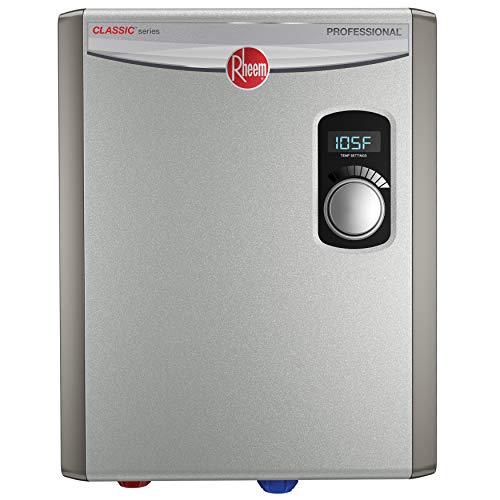
This model features an external digital thermostat with LED display and self-modulating power to match hot-water demand. With durable copper immersion elements and field-serviceable components, it’s well-suited for mid-sized households needing higher flow, up to 4.4 GPM. Best for: homes with 1–2 bathrooms or smaller families that require more than basic hot water. Limitation: electric-only design requires appropriate wiring and breakers in the panel.
Rheem RTEX-24 24kW 240V Electric Tankless
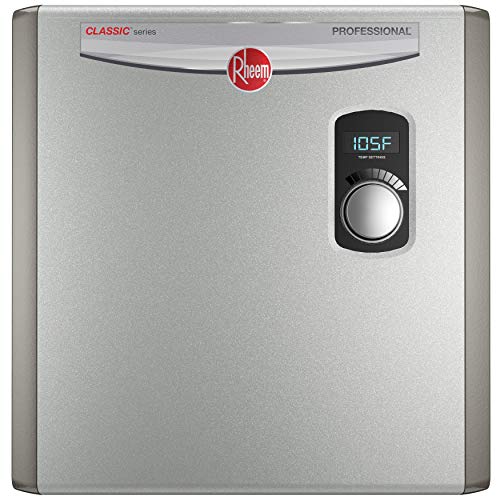
Designed for whole-home use, the RTEX-24 provides substantial hot water capacity with 24 kW of power and a digital temperature display for precise control. It requires robust electrical service and multiple breakers, making it better for homes with available electrical capacity and higher hot-water demand. Best for: larger households needing reliable simultaneous hot water across multiple fixtures. Caution: installation must align with electrical panel capacity (100A model suitability).
Rinnai RX199iN Condensing Tankless Water Heater

This model offers indoor or outdoor installation with versatile fuel options (propane or natural gas). It delivers up to 11.1 GPM, boasting high efficiency and advanced control features. Best for: homes needing strong flow and gas-fueled efficiency across multiple fixtures. Limitation: gas line and venting requirements can complicate installation and may influence total cost.
CAMPLUX Tankless Water Heater 6kW

The CAMPLUX 6kW unit is a point-of-use electric heater designed for small spaces and under-sink installation. It uses self-modulating technology to optimize energy use and is ideal for hot water at a single tap or quick-fill scenarios in compact settings. Best for: apartments, office kitchens, or small bathrooms where space is at a premium. Caution: lower flow rates mean it may not support simultaneous use of multiple fixtures.
Buying Guide
What’s the right size for your home?
Consider your peak simultaneous hot-water use. A household with two bathrooms typically benefits from higher GPM ratings, while a single-toilet setup may be satisfied with a compact unit. For gas models, review venting and installation constraints; for electric models, confirm panel capacity and available amperage.
Electric vs. gas—how to decide?
Electric tankless heaters are generally easier to install where gas lines are not available, especially for point-of-use needs. Gas models often provide higher flow at a lower temperature rise and are more suitable for whole-home applications with several fixtures in use at once. Budget for electrical work or venting when choosing electric or gas systems.
Flow rate and temperature rise matter.
GPM ratings determine how many fixtures can run simultaneously. Temperature rise requirements depend on incoming water temperature in your climate. If you live in colder regions, you’ll need more powerful units to achieve the same temperature at higher flow rates.
Electrical and space considerations.
Electrically powered units require adequate breaker capacity and space for installation. Wall-mounted models save floor space and are suitable for apartments or closets. For gas models, ensure proper venting and outdoor-friendly placement if needed.
Durability and maintenance.
Look for units with durable heating elements and accessible service options. Self-modulating technology helps reduce standby energy use. Field-serviceable parts can simplify maintenance over time.
FAQ
- What is a tankless water heater?
- Do tankless heaters require professional installation?
- What’s the best option for a small apartment?
- How do I estimate needed GPM?
- Are there maintenance needs for tankless units?
- Can tankless heaters save energy?
A tankless water heater heats water on demand without storing hot water in a tank, reducing standby energy use and delivering hot water as you need it.
Many do, especially gas models or electric units requiring electrical upgrades. Review local code requirements and consult a licensed installer for safe, compliant setup.
Electric point-of-use models are often ideal due to easier installation and space savings, though verify electrical service capacity and panel space.
Estimate based on peak usage: the number of fixtures running at once and the water temperature rise needed. Higher GPM capacity provides more simultaneous flow.
Some models require periodic flushing to prevent mineral buildup, especially in hard-water areas. Follow manufacturer maintenance guidelines to sustain efficiency and lifespan.
Yes. They heat water only when called, reducing standby heat losses compared with traditional storage tanks, particularly when paired with self-modulating technology.