Best Heat Carbon Monoxide Detectors for Home Safety and Travel
If you’re shopping for a reliable heat carbon monoxide detector, this guide highlights five strong options and explains who each is best for. These detectors offer a mix of built‑in sensors, long battery life, and interconnection features that help alert you quickly. Ideal buyers include homeowners seeking continuous protection, renters needing portable or plug‑in options, seniors who benefit from remote or easy-to-reach alarms, and travelers who want compact, travelable CO alerts.
| Product | |
|---|---|
| X-Sense SC07 | Standalone, 10-year sealed battery |
| X-Sense XP0H-WN | Wireless interconnected, 10-year battery |
| Kidde 3rd Edition AA Battery Powered | Battery powered, portable |
| Kidde Plug-In with Battery Backup | Plug-in with 2 AA backups |
| TOPTES CT-580 | Portable CO detector with display |
X‑Sense SC07: 10‑Year Battery Combination Alarm

The SC07 is a basic standalone detector combining a photoelectric smoke sensor with an electrochemical CO sensor. It is UL 217 and UL 2034 certified and uses a sealed 10‑year lithium battery. This model is best for buyers who want simple, long‑lasting CO and smoke detection without interconnection or smart features. A key limitation is that it cannot interconnect with other alarms or use a base station.
X‑Sense XP0H‑WN: Wireless Interconnection

The XP0H‑WN is a wireless interconnection model that coordinates alarms across multiple devices. It does not include Wi‑Fi. All interconnected alarms sound together for rapid evacuation awareness, and a remote (sold separately) lets you test or silence alarms without climbing. This option is best for larger homes or multi‑level residences that want synchronized alerts; a limitation is the lack of Wi‑Fi connectivity for remote monitoring.
Kidde Carbon Monoxide Detector: Battery Powered (3rd Edition)
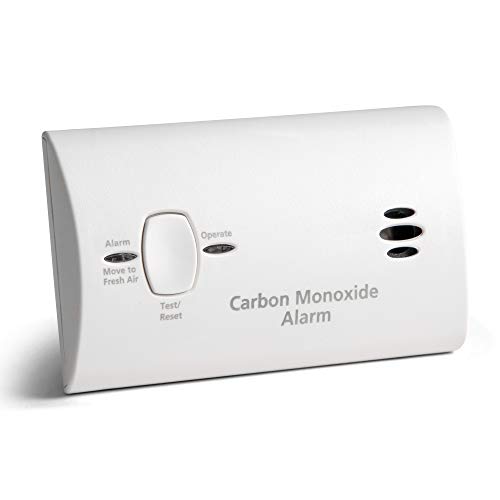
This Kidde model runs on two AA batteries and includes an easy installation option with either wall mounting or tabletop placement. It features an electrochemical sensor, an 85 dB alarm, and green/red LED indicators to show power status and CO presence. It’s best for renters or travelers who want a simple, battery‑powered option that works during power outages. A limitation is battery reliance and non‑interconnect capability.
Kidde Plug‑In CO Detector With Battery Backup

This plug‑in Kidde model uses 120V AC with two AA batteries backup for outages. It includes a rotating plug and a backlit display for CO readings, plus a test/hush function for quick checks. It’s best for home use where wall outlets are convenient and a continuous power source is preferred. A potential limitation is reliance on wall outlets; you might need to relocate if outlets are scarce or crowded.
TOPTES CT‑580 Portable CO Detector

The TOPTES CT‑580 is a handheld CO detector with a TFT color display and three alarm modes (indicator light, audible alarm, and vibration). It detects CO from 0 to 1000 PPM with rapid response in about 0.3 seconds. This model suits travelers, campers, or professionals who need a portable CO screening tool. The caveat is that it’s a manual inspector device rather than a room‑based fixed detector, so it’s less suited for continuous home protection.
Buying Guide: Key Purchase Considerations
- Power source: Choose between sealed 10‑year batteries, disposable batteries, or plug‑in with battery backup based on your reliability needs and maintenance preference.
- Interconnection: If you live in a multi‑level home, consider wireless interconnection to ensure simultaneous alarms across all devices. Evaluate whether a base station or remote control is desired.
- Sensor type: For smoke and CO, a combination detector saves space and provides unified alerts. For CO‑only use, a dedicated detector may be a lighter option.
- Display and alerts: Backlit or large LCD displays improve readability of CO levels. Visual LED indicators help confirm unit status at a glance.
- Portability vs. fixed placement: Portable detectors are ideal for travel or temporary setups, while wall‑mounted models give continuous protection at home.
- Certifications: Look for UL 217 (smoke) and UL 2034 (CO) certifications to ensure compliance with safety standards.
Frequently Asked Questions
- What is the difference between a standalone and wireless interconnected CO detector?
Standalone units operate independently; wireless interconnected detectors activate all units when one detects CO or smoke, improving safety in larger homes. - Do CO detectors require maintenance?
Standalone battery models may need battery replacement at the end of life; plug‑in models with battery backup require battery checks during outages. - Can I use a CO detector in rental units?
Yes, portable or battery‑powered detectors are suitable when wiring isn’t possible or allowed by the landlord. - Is it safe to rely on a CO detector for travel safety?
Portable detectors help monitor environments in hotels or rentals, but ensure the detector is calibrated and within its recommended usage period. - Should I buy a combination smoke/CO detector or separate units?
A combination unit saves space and simplifies monitoring but ensure both sensors meet your needs and the device is compliant with UL standards. - What indicates a detector’s life is ending?
Most sealed‑battery detectors are designed for long life (up to 10 years). If the unit stops alarming reliably or shows LED faults, replace it.