Best Heat Cables for Ice Dams: Effective Roof De-Icing Solutions
Ice dams can cause costly roof damage and water leaks. This guide examines top heat cable options designed to prevent ice dams, clear gutters, and protect pipes during freezing conditions. Each product is evaluated on safety, self-regulating performance, installation ease, and durability. Use this overview to compare features and find a heat cable kit that fits your roof type and climate.
| Product | Brand | Key Features |
|---|---|---|
| Eastrexon 50FT Roof Snow De-Icing Kit | Eastrexon | 8 W/ft, self-regulating, 50 ft cable with 9.8 ft cord; 4-layer safety design; suitable for roofs and gutters |
| Heat Tape Pro | Radiant Solutions Company | GlowCap technology; 6 W/ft; 37 ft cable + 10 ft cord; 10-year warranty; UL listed |
| TOPDURE 240 ft Kit | TOPDURE | 5 W/ft, ETL & CSA certified; pre-assembled 6 ft lead; durable insulation |
| H&G Lifestyles 8W/ft Kit | H&G Lifestyles | 8 W/ft self-regulating; 50 ft or 60 ft variants; durable construction |
| WarmlyYours Roof Snow De-Icing | WarmlyYours | 5 W/ft; 100 ft length; clips and spacers included; DIY-friendly installation |
Note: The table above highlights representative features. Always verify compatibility with your roof materials, gutter type, and local safety standards before installation.
Eastrexon 50FT Roof Snow De-Icing Kit

The Eastrexon heat tape uses a self-regulating design with a waterproof outer jacket, insulation, shielding, and a PTC layer. It is built with AL-MG alloy wire and a core of tinned copper, designed to adapt power output as temperatures change. The kit covers a 50-foot length and includes a 9.8-foot power cord, enabling installation along roofs, gutters, and downspouts to prevent ice buildup and ensure drainage.
Radiant Solutions Heat Tape Pro

Heat Tape Pro features GlowCap technology to verify operation from end to end. It is a commercial-grade, self-regulating heat cable designed for long-term ice dam and pipe protection. The system includes a 37-foot cable plus a 10-foot power cord, and it carries a best-in-industry 10-year warranty. UL listed and engineered to avoid shorts or burnout if overlapped, it suits flat roofs, metal roofs, asphalt, wood, and rubber surfaces.
TOPDURE 240 Ft Roof & Gutter Kit
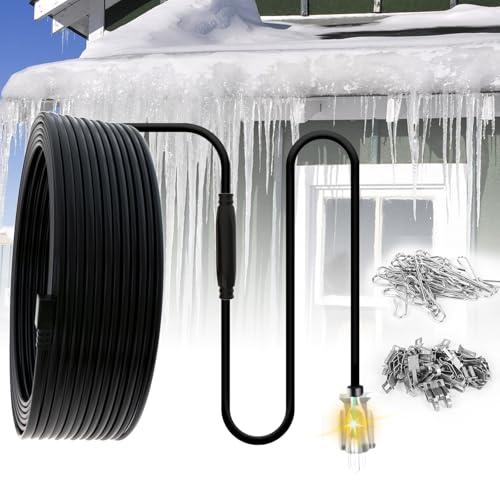
TOPDURE emphasizes safety with ETL and CSA certifications for the self-regulating cable. It ships with a 6-foot power lead and includes installation clips and spacers. The cable uses XLPE insulation and features aluminum foil shielding and a tinned copper braid for durability. A fully certified system emphasizes safe operation in diverse roof configurations while delivering reliable de-icing performance over a long run.
H&G Lifestyles 8W/FT Roof Heat Cable Kit

This 8 W/ft self-regulating heat cable is designed to automatically adjust output with ambient temperature, maintaining warmth to prevent ice dams. The kit uses a durable construction with polyolefin inner insulation, a protective layer, and a tinned copper core. It is engineered to remain effective in extreme cold and withstand winter conditions, providing consistent de-icing performance for roofs and gutters.
WarmlyYours Roof Snow De-Icing Cable

WarmlyYours offers a DIY-friendly 100-foot kit with 5 W/ft heat output. It includes clips and spacers tailored for metal or plastic gutters and various roof pitches. The system is designed to prevent ice dams and snow buildup, helping protect roofs and gutters from winter damage while being straightforward to install in advance of snow season.
Buying Guide: Key Considerations For Selecting Heat Cables
When choosing heat cables for ice dam prevention, consider roof type, climate, and installation constraints. Self-regulating cables adjust their power based on temperature, reducing energy use and preventing overheating, which is essential for safety and efficiency.
- Wattage per foot: Higher wattage (e.g., 8 W/ft) provides stronger heating, useful in very cold regions or steep roofs, but may cost more to run. Lower wattage (5 W/ft) can suffice in milder climates with proper insulation.
- Length and coverage: Ensure the total cable length covers the roof width and gutter length. Include a power lead long enough to reach an outlet without stretching the cord.
- Self-regulating vs fixed power: Self-regulating cables modulate heat, improving safety in use and preventing overheating at overlaps. Fixed-power cables maintain constant output and may be cheaper upfront.
- Certifications: Look for ETL/CSA certifications for safety, UL listing for electrical components, and warranty length to gauge durability and support.
- Ease of installation: Pre-assembled kits with clips, spacers, and clear instructions simplify mounting on varied roof types. Ready-to-connect kits reduce installation time.
- Durability and insulation: A robust outer jacket, insulation, shielding, and copper or aluminum cores improve performance in freezing conditions and resist weathering.
- Roof compatibility: Consider materials (metal, asphalt shingles, plastic gutters) and roof pitch. Some products are specifically recommended for certain surfaces.
- Overlapped cables: Modern designs minimize risk of shorts or burnout when laying the cable across roof sections or around fixtures.
For best results, pair heat cables with proper attic insulation, venting, and roof edge clearance to reduce ice dam formation. Regular inspections after heavy snowfall help ensure connections remain intact and that the system operates as intended.