Best Hand Dryers for Bathrooms of 2026: Quick, Quiet, and Efficient
Choosing the right hand dryer for a bathroom—whether in a commercial setting or at home—depends on speed, noise, energy use, and durability. The following selections prioritize fast drying times, solid build quality, and practical installation options. This guide highlights five top models, with direct links to their Amazon listings for quick comparison and decision-making.
| Product | Brand | Model | Key Benefit |
|---|---|---|---|
| AIKE AK2630 | AIKE | Silver | Compact, fast dry, simple outlet installation |
| AIKE AK2812 | AIKE | Brushed Stainless | High-speed air, elephant-style airflow, easy cord access |
| EnBath Hi-Speed | EnBath | Hi-Speed | Rapid 9-11 second dry, energy-saver mode |
| JETWELL 2Pack | JETWELL | UL Approved | Two-pack value, HEPA filtration, fast dry |
| Goetland 2Pack | Goetland | Stainless Steel | Dual-pack, modern look, efficient drying |
Across these options, most failures come from poor installation, excessive noise, or inconsistent airflow. The products chosen here aim to minimize those issues while delivering reliable performance in busy bathrooms. Read on to learn about each model, its installation approach, and what makes it stand out in a crowded market.
AIKE Air Wiper AK2630 — Compact Silver
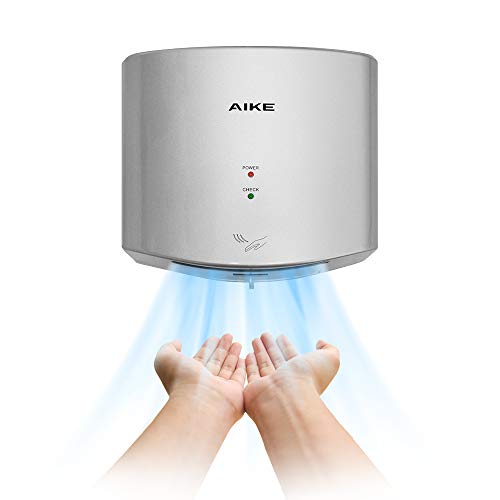
This AIKE model emphasizes a compact footprint suitable for limited spaces while maintaining strong airflow. It ships with a 60-inch power cord for straightforward plug-in installation and is designed for 100–130V input at 1400–1650W, with a typical dry time around 10–15 seconds. Noise levels sit around 67dB, and the unit offers an air volume of approximately 100.8 m³/h. Its sensing distance ranges from 110 to 130 mm, providing a responsive user experience without wandering hands hovering near the unit. Ideal for restrooms where space is at a premium, yet durability and commercial-grade performance are required.
Key considerations:
– Pros: Quick dry time, compact design, straightforward plug-in setup.
– Cons: Cord-only installation means it cannot be hard-wired, which may be a limitation for certain retrofit projects.
– Best for: Small bathrooms in offices, schools, or clinics needing reliable performance without remodeling.
AIKE Elephant AK2812 — High-Speed Auto Warm Wind

The AK2812 model features a larger airflow and a robust 1400–1650W power range, operating at AC100–130V. It’s designed for speed, drying hands in roughly 8–12 seconds, with a nozzled wind that delivers up to 145 MPH and a reported air volume around 115.2 m³/h. The dryer is mounted on the wall and ships with a 55-inch power cord plus a 3-pin plug, making it easy to plug into a standard outlet. Noise is listed at about 76dB, which is audible but typical for high-speed units in busy facilities. This is a solid choice for high-traffic bathrooms needing rapid turnover between users.
Key considerations:
– Pros: Notable dry speed, strong airflow, simple plug-in installation.
– Cons: Higher noise level than some ultra-quiet models.
– Best for: Restrooms with high user volume where fast hand drying is a priority.
EnBath Hi-Speed — Stainless Steel, Energy Saver

EnBath’s stainless steel design blends durability with a modern aesthetic. It delivers lightning-fast drying in 9–11 seconds thanks to a powerful motor and an impressive airspeed around 224 mph. The unit also offers an energy-saving mode: about 1350 watts for heated air or 500 watts for room-temperature air. This balance can reduce electricity use during slower periods while preserving quick drying when demand peaks. The stainless exterior is both hygienic and easy to clean, making it a sensible option for commercial bathrooms or high-traffic homes.
Key considerations:
– Pros: Very fast dry times, energy-saving option, durable finish.
– Cons: Higher initial power draw in full mode.
– Best for: Commercial spaces seeking fast turnover with energy-aware operation.
JETWELL 2Pack UL Approved — High Speed, HEPA

This Jetwell 2-pack brings value with two units designed for high-traffic spaces. Operating at AC100–130V with 1450W, these units provide airflow of about 140 m³/h and wind speeds up to 145 mph, enabling hands to dry within 7–10 seconds. They include a 55-inch cord with a plug for easy direct outlet connection, with the option to detach the cord for hard-wiring. The build features a one-piece stamped stainless steel shell for durability in busy environments, making them well-suited for schools, airports, and large offices. Noise is listed at 70 dB, placing it in a typical range for fast-drying models.
Key considerations:
– Pros: Two-pack value, strong performance, durable stainless shell.
– Cons: Slightly higher noise than ultra-quiet designs.
– Best for: High-traffic installations where multiple units are needed to minimize lines.
Goetland Stainless Steel — Dual Pack, 1800W

Goetland’s bundle emphasizes a modern stainless steel appearance with an 1800W heating option. The package includes two units designed for robust performance in busy bathrooms. The 1800W output supports efficient drying, with the system described as fast, efficient, and energy-conscious for its class. It’s positioned to be a practical upgrade for commercial restrooms or high-traffic home setups where a cohesive, matched look is desirable. The product notes also mention adjustable features to optimize humidity and airflow for different usage patterns.
Key considerations:
– Pros: Matched dual-pack, strong heating power, contemporary finish.
– Cons: May require more careful placement for optimal airflow.
– Best for: Businesses seeking a consistent, stylish, and high-capacity hand-drying solution.
Buying Guide: Key Considerations For Selecting A Bathroom Hand Dryer
Hand-dryer selection hinges on several core factors. First, dry time matters: faster units improve throughput and reduce lines in busy bathrooms. Look for models that achieve under 10–12 seconds for best efficiency. Noise is another consideration; some high-speed models produce louder operation, which may be unsuitable for restrooms in quiet settings or homes. Energy mode options help manage electricity costs, particularly in facilities with many units.
Installation and durability play major roles. Corded plug-in models offer quick retrofits, but hard-wiring may be preferred for permanent installations or in locations with strict safety standards. Stainless steel or IP-rated housings provide better durability against moisture and vandalism, especially in high-traffic venues. Consider the mounting method (surface mount vs. wall-mounted) and whether the unit ships with easy cord management to minimize tripping hazards.
Airflow and sensing performance influence user experience. Infrared sensors should activate instantly to avoid user frustration, while a wider sensing distance can reduce the need to hover hands precisely. Some models feature HEPA filtration or medical-grade filtration for environments requiring higher hygiene standards, such as clinics or hospitals. Energy-saving modes help reduce operating costs during off-peak hours while maintaining adequate airspeed for efficient drying during peak times.
Economic considerations include upfront price, maintenance costs, and the availability of bundled units versus single units. Two-pack options can offer savings for larger facilities, while individual units may be perfect for smaller offices or home bathrooms. Finally, warranty and service support are important for ensuring long-term reliability in commercial settings.
In summary, the best pick depends on bathroom size, user volume, and retrofit goals. For compact spaces, AIKE AK2630 provides solid performance in a minimal footprint. For ultra-fast results in busy facilities, AIKE AK2812 and EnBath Hi-Speed are strong contenders, with Jetwell and Goetland offering good value in dual-pack configurations. Evaluate your installation constraints, noise tolerance, and energy preferences to select the model that best meets your needs.