Best Hand Crank Emergency Radio for Off-Grid Safety
When power outages and severe weather strike, a reliable hand crank emergency radio is essential. This guide highlights five sturdy options that deliver NOAA, AM/FM reception, multiple charging modes, and practical features for hikers, campers, home prep, and Bug-Out bag planners. Each select product is chosen for clarity, durability, and clear performance signals. Best for: home preppers, outdoor enthusiasts, or anyone needing dependable off-grid updates and power backup.
Buyer’s quick reference: a comparison snapshot of the selected models.
| Product | Best For | Key Strength | Notes |
|---|---|---|---|
| Midland ER310 | Home or campsite preppers | Three power sources plus weather alerts | Backup AA option; long run time |
| Mesqool Solar Radio Emergency Hand Crank 12000mAh | Off-grid campers | Large solar panel, fast crank charging | Dual outputs for devices |
| Weather Radios Portable AM FM NOAA Alert (Mesqool) | Emergency kits | Same feature set with big solar panel | Clear sound, robust panel |
| RunningSnail Emergency Crank Radio MD-090P | Hiking and outdoor safety | Most powerful lighting and reading lamp | Reading lamp and SOS |
| QAUYYW Hand Crank Emergency Radio | Serious survival scenarios | 37000mWh battery, strong lighting | Long run times, SOS siren |
Midland ER310 Emergency Crank Weather Radio

Best for: home preppers and outdoor riders who want multiple power sources in one rugged unit. The ER310 offers solar, hand crank, and a rechargeable battery, plus a 6-AA backup option. It also includes an emergency flashlight with Morse code signaling, and a NOAA weather scan with alert. The device is particularly suited for scenarios where continuous weather updates are critical. A potential limitation is the reliance on internal batteries for long-term outages; keep spares on hand.
Mesqool Solar Radio Emergency Hand Crank 12000mAh

Best for: off-grid campers and family bug-out kits that prioritize fast charging and device backup. This model emphasizes a large 8500mm² solar panel for quicker solar charging, a high-sensitivity signal chip for NOAA/AM/FM clarity, and an upgraded hand-crank generator that delivers faster charging to the radio or a phone. A caution: high-ambient light can affect solar performance; in low-light conditions expect slower recharge.
Mesqool Weather Radios Portable AM FM NOAA Alert
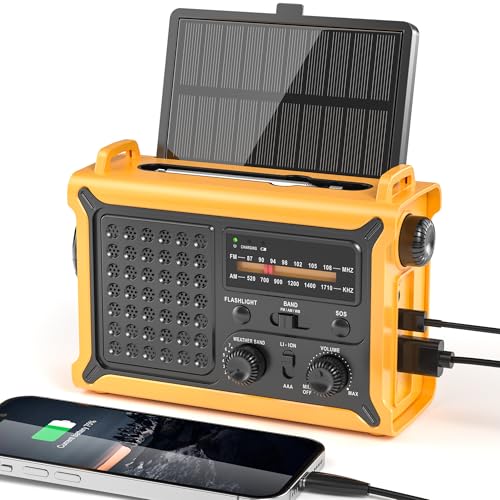
Best for: household safety kits and outdoor campers seeking a robust solar-hybrid radio. This unit mirrors Mesqool’s strong reception with a large solar panel and a dependable hand crank. It provides a clear NOAA/AM/FM experience and includes dual charging options for mobile devices. Limitation: as with other solar radios, performance depends on sun exposure and crank efficiency can vary with user technique.
QAUYYW Hand Crank Emergency Radio

Best for: serious survival scenarios and long-lasting power thanks to a 37000mWh battery. It includes a powerful 3W flashlight and LED reading light plus a loud SOS siren to attract attention quickly. The three-mode charging (solar, hand crank, USB-C) makes it flexible for varied environments. A limitation: the sheer battery capacity may come with a heavier unit and larger footprint than basic models.
RunningSnail Emergency Crank Radio MD-090P

Best for: hikers and outdoor families who need a strong emergency flashlight, a reading lamp, and reliable NOAA weather updates. The MD-090P emphasizes a long-lasting 14800mWh battery with multiple lighting modes and a robust hand crank. It’s a solid choice when lighting and weather alerts must coexist with device charging. Caution: solar charging capacity is supplementary; rely primarily on cranking or USB for fast power restoration.
Buying Guide: Key Purchase Considerations
- Power options: Look for models with at least two charging modes (hand crank and solar) and a rechargeable battery. Some units also support USB charging for phones.
- Reception and alerts: Prioritize NOAA weather scan and alert features, along with AM/FM reception for reliable updates in storms or outages.
- Battery capacity: Higher mWh or mAh translates to longer operation. Match capacity with your typical outage duration and device charging needs.
- Output options: If you need to charge devices, check the number and type of outputs (USB, USB-C, DC, etc.). Consider dual outputs for simultaneous device charging.
- Durability and portability: Assess build quality, weather resistance, and weight. For hiking, lighter units with solid cranking action win.
- Lighting and signaling: Many models include a built-in flashlight and SOS alarm. Decide how important signaling is for your safety plan.
- Storage and maintenance: Some radios store extra batteries or spares. Consider ease of use and replacement parts availability.
Frequently Asked Questions
- What is a hand crank emergency radio best used for? It provides weather updates and emergency communications when power is out and conventional radio or cellular networks may be down.
- Do these radios require sunlight to work? Solar charging reduces reliance on cranks, but many models also include a hand crank and internal battery for use indoors or during night hours.
- Will these radios charge my phone? Some models offer USB or USB-C outputs capable of charging smartphones during an outage.
- How many power sources should I prefer? A combination of solar, hand crank, and a rechargeable battery offers the best flexibility for varied emergency scenarios.
- Are larger battery capacities always better? Higher capacity increases run time, but it also adds weight and size. Choose based on your portability needs and typical use case.
- Is a built-in SOS alarm important? An SOS signal can attract attention quickly in remote or dangerous situations, making it a valuable feature for outdoor safety.