Best Group 25 Deep Cycle Batteries for RVs, Boats, and Off-Grid Use
Choosing the right 12V deep cycle battery involves balancing lifespan, weight, efficiency, and how you’ll use it. Below are five well-rounded options that suit RVs, marine setups, solar-powered cabins, and off-grid lifestyles. Each product has strong cycle life, reliability, and safety features, helping you keep power steady on the go. Use the buying guide at the end to compare key considerations across chemistries and use cases.
Summary Table of Chosen Products:
| Product | Brand | Type | Capacity | Best For |
|---|---|---|---|---|
| Weize Deep Cycle AGM 12V 100Ah | WEIZE | AGM | 100Ah | RV, Solar, Trolling Motor |
| ROSINLI 12V 100Ah LiFePO4 Group 24 | ROSINLI | LiFePO4 | 100Ah | Solar Homes, RV, Off-Grid |
| UPLUS 12V 92Ah Group 27M Dual Purpose | UPLUS NEW TECHNOLOGY BATTERY | AGM | 92Ah | Marine, RV, Trolling |
| VEMDIA 12V 100Ah LiFePO4 Group 31 | VEMDIA | LiFePO4 | 100Ah | RV, Solar, Marine |
| Dyness 12V 100Ah Mini TM LiFePO4 | Dyness | LiFePO4 | 100Ah | Compact Spaces, Trolling |
Weize Deep Cycle AGM 12V 100Ah Battery
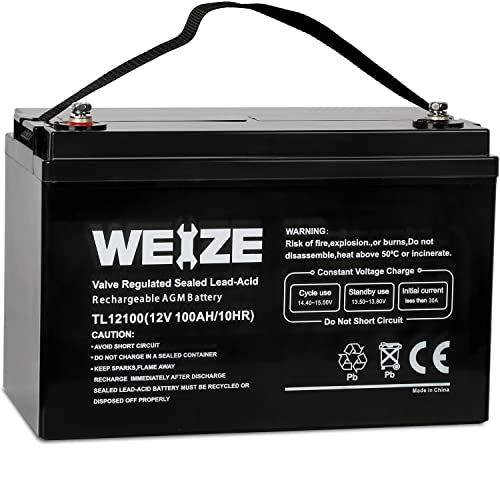
The Weize AGM battery delivers 12V with a 100Ah capacity and a low self-discharge rate, making it suitable for RVs, solar storage, trolling motors, and off-grid systems. Its AGM design minimizes maintenance and reduces the risk of acid leaks, while a robust 1100A max discharge current supports short-term high-demand use. Operating temperatures cover typical outdoor scenarios, and the battery is designed to hold charge longer between uses. Consider this option if you want a maintenance-free, leak-resistant power source with reliable deep-cycle performance.
ROSINLI 12V 100Ah LiFePO4 Group 24 Battery

This LiFePO4 battery uses automotive-grade cells and includes a built-in 100A BMS for protection against overcharge, over-discharge, over-current, and short circuits. It’s lighter than many lead-acid alternatives and offers significantly higher energy density, making it well-suited for solar storage, RVs, camping, and marine uses where longer cycle life and easier handling matter. The BMS helps safeguard performance in variable temperatures and long-term storage.
UPLUS 12V 92Ah Group 27M Dual Purpose Marine Battery
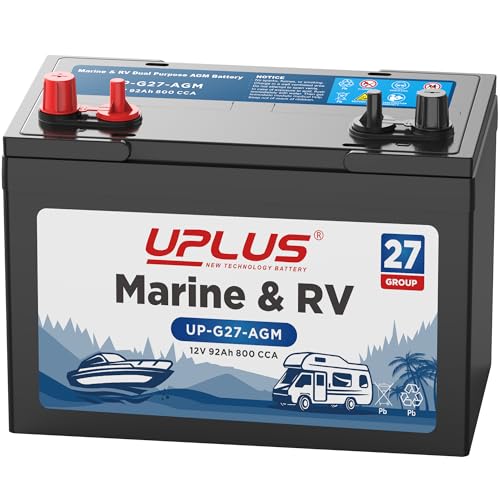
This dual-purpose AGM battery combines starting power with deep-cycle capability, offering 800CCA and 175RC for marine engines up to 350 horsepower. It helps simplify electrical systems on boats by combining starting and deep-cycle functions in one unit while resisting vibration and rough marine conditions. Its space-saving design supports layouts with limited mounting space, making it a practical choice for small to mid-size boats and RVs with marine applications.
VEMDIA 12V 100Ah LiFePO4 Group 31 Battery

VEMDIA’s Group 31 LiFePO4 battery offers a built-in 100A BMS and claims up to 15,000 deep cycles with a lifetime of around 10 years. It’s substantially lighter than lead-acid equivalents, featuring compact dimensions suitable for RVs, boats, and off-grid storage. The advanced BMS helps guard against overcharge, over-discharge, short circuits, and high temperatures, supporting safer long-term operation in varied environments.
Dyness 12V 100Ah Mini TM LiFePO4 Battery

Dyness Mini TM delivers 100Ah in a compact footprint, designed for trolling motors and space-constrained rv or marine setups. It uses LiFePO4 chemistry with a built-in smart BMS and low-temperature protection. The smaller size allows flexible configurations, including single or multi-unit installations, while maintaining reliable deep-cycle performance and compatibility with typical 12V systems.
Buying Guide: Key Purchase Considerations and Comparisons
- Chemistry and cycle life: AGM is maintenance-free and robust for starter-and-use scenarios, but LiFePO4 typically offers longer cycle life, lower weight, and higher safety margins. If you plan long-term usage with frequent deep discharges, LiFePO4 often provides better total cost of ownership.
- Capacity and discharge: 100Ah is common for these models, but total usable capacity depends on depth of discharge (DOD). LiFePO4 batteries commonly allow deeper DOD (often 80-100%), whereas AGM packs may benefit from shallower discharges to maximize longevity.
- Weight and mounting: LiFePO4 packs are usually lighter than AGM equivalents for the same capacity, easing installation and transport considerations on boats and RVs. Consider physical dimensions and mounting space for your setup.
- Built-in protections: A smart Battery Management System (BMS) in LiFePO4 batteries guards against overcharge, over-discharge, short circuits, and overheating. This is a critical feature for off-grid and remote installations.
- Temperature tolerance: Look at operating and storage temperatures; some models specify charging windows that optimize performance in cold or hot climates. In extreme environments, low-temperature charging protection is important.
- Maintenance and safety: AGM batteries are maintenance-free but can vent gases if abused; LiFePO4 are generally safer with less risk of thermal runaway and require minimal maintenance.
- Compatibility and expansion: If you plan to expand capacity, verify whether the battery family supports series/parallel configurations and the maximum number of units in a system without compromising safety or performance.
- Applications: Choose based on intended use—marine (vibration resistance, high CCA compatibility), RV and off-grid (deep-cycle longevity and lightweight design), or portable power (compact form factors and modularity).
- Warranty and support: Check manufacturer warranties, replacement policies, and availability of accessories such as compatible battery boxes or mounting hardware.