Best Grid-Tied Solar System Kit Solutions for Home Use
Answering the common question “Which grid-tied solar system kit should I choose for my home?” this guide highlights five practical kits for American households. Each kit is described with its best-use scenario, so you can compare installation needs, cost-efficiency, and longevity. This article targets buyers seeking reliable, easy-to-install grid-tie systems that connect to the utility grid without requiring battery storage. The selection includes compact kits for small homes and larger configurations for power-hungry households. Use the quick reference table below to compare key options at a glance.
| Product | System Size | Best For | |
|---|---|---|---|
| AUECOOR 1000W Grid Tie Solar System Kit | 1000W | Small homes or upgrades to existing systems | High efficiency panels; strong framing |
| AUECOOR 600W Home Grid Tie Solar System Kit | 600W | Compact installs, budgets | Solid warranty and outdoor durability |
| 1200W Solar Panel Kit Grid Tie System (AUECOOR) | 1200W | Moderate home energy needs | Comprehensive kit with PV combiner box |
| 1080W Solar Panel Kit Home Grid Tie System (Giosolar) | 1080W | Mid-size homes, easy expansion | Grid-tie with MPPT inverter |
| 1800W Home Grid Tie Solar Kit (POUR) | 1800W | Higher energy demand, larger homes | Higher output; best for bigger loads |
AUECOOR 1000W Grid Tie Solar System Kit
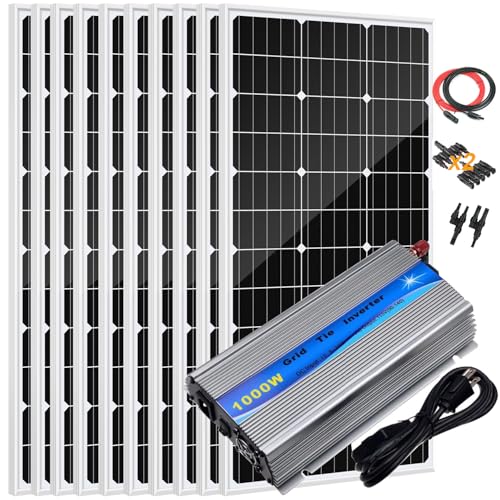
The 1000W kit uses 100W monocrystalline panels with a grid-tie inverter designed for home use. It emphasizes high efficiency (panel conversion up to 20.5%) and environmental resilience, including corrosion-resistant framing and robust wind/snow loading ratings. This option is best for small to medium homes looking to maximize solar output without battery storage. The inverter includes protections against overloads and voltage or polarity issues. A caution: ensure local grid requirements and permits are aligned before installation.
Best for: Small to mid-sized homes seeking a straightforward, roof-morne grid-tie setup with solid efficiency and outdoor durability.
AUECOOR 600W Home Grid Tie Solar System Kit

This 600W kit focuses on compact installations with a reliable inverter. It includes a 6-year material warranty and a 25-year power output transfer warranty, making it a practical choice for tighter budgets or smaller roofs. The system is designed to withstand outdoor conditions with a corrosion-resistant frame. A limitation to note: the total output is lower than larger kits, which may suit smaller energy needs or incremental upgrades.
Best for: Homes with limited roof space or budgets seeking a dependable starter grid-tie system.
1200W Solar Panel Kit Grid Tie System (AUECOOR)

This all-in-one 1200W kit bundles 12 panels with a 1200W MPPT grid-tie inverter, a PV combiner box, and suitable cabling. The pre-attached cables ease installation, and the wide input range (18-60V) helps with flexible panel string configurations. This option is better for households needing more power than a 600W kit but not yet at 2000W capacity. A potential limitation is the kit’s complexity for first-time installers; ensure proper wiring and safety practices.
Best for: Homes expanding solar capacity beyond starter kits, with a need for a complete, plug-and-play package.
1080W Solar Panel Kit Grid Tie System (Giosolar)

This 1080W kit uses monocrystalline panels with a 120V AC grid-tie inverter and provides a practical middle-ground for mid-size homes. The unit is designed to be cost-conscious while delivering steady grid power without battery storage. It suits households that want reliable daytime generation to offset electricity use and potentially reduce utility dependence. A caution: monitor local interconnection standards to ensure compatibility with your utility program.
Best for: Mid-to-large homes seeking a balance between size, cost, and grid-tie efficiency with MPPT control.
1800W Home Grid Tie Solar Kit (POUR)

The POUR 1800W kit targets higher energy demands, offering a larger array of 120W panels and a 200W MPPT inverter. This configuration is best for bigger homes or users who expect significant daytime solar production to cover most daytime loads. It emphasizes grid-fed operation with efficient conversion and protection features. A limitation: larger installations may require more space and professional electrical work to ensure safe, compliant operation.
Best for: Bigger homes or users aiming for substantial daytime solar contribution with a higher potential bill offset.
Buying Guide: Key Purchase Considerations
- System size vs. home load: Match kit wattage to your average daytime electricity use to maximize solar offset without oversizing.
- Inverter type and compatibility: Look for MPPT inverters for higher efficiency and stable grid interaction.
- Roof space and mounting durability: Choose kits with corrosion-resistant frames and robust wind/snow ratings for your climate.
- Wiring and safety: Ensure pre-attached cables or PV combiner boxes simplify installation and meet local codes.
- Interconnection rules: Verify net-metering and grid connection requirements with your utility before purchase.
- Expansion options: If future power needs grow, consider modular kits that allow easy scaling.
- Warranty and service: Favor systems with multi-year warranties and accessible support for maintenance.
How to choose among these kits?
- Small homes or roof constraints: AUECOOR 600W or 1000W kits can fit tighter spaces while delivering meaningful output.
- Mid-sized homes with budget considerations: The 1080W Giosolar or 1200W AUECOOR kits balance cost and capacity.
- Higher energy usage or expansion goals: The 1800W POUR kit provides more headroom for daytime generation and larger loads.
Installation and safety tips
- Follow manufacturer wiring diagrams precisely and use proper PPE during installation.
- Ensure proper grounding and overcurrent protection as required by local electrical codes.
- Consult a licensed electrician if you are uncertain about grid interconnection requirements.
FAQ
- What is a grid-tied solar system kit? It connects solar panels to the utility grid and does not store energy in batteries. During sun, energy is fed to the grid and your home can draw from the grid at other times.
- Do these kits require batteries? No, grid-tied kits commonly do not include batteries, reducing upfront costs and maintenance.
- Can I install these kits myself? Some kits are designed for DIY installation, but local codes and interconnection rules often require professional wiring.
- Will I still have power when the grid goes down? Most grid-tied systems without batteries shut down during an outage for safety; add storage to supply critical loads when necessary.
- How do I choose the right kit size? Evaluate your peak daytime usage and available roof area; larger homes may benefit from 1000–1800W kits or more.
- Are these kits compatible with net metering? Many utilities support net metering, but confirm program specifics with your local provider.