Best Grid Solar Power Systems for Home and Backup
Grid-tied and off-grid solar power systems offer reliable energy for homes, cabins, RVs, and remote cabins. This guide highlights five top options that balance capacity, expandability, and safety. Best for homeowners seeking scalable, high-output kits; best for campers or remote setups needing portable battery support; best for RVs or boats requiring compact, efficient panels. Read on to compare system components, suitability, and potential limitations to help you choose a grid solar power system that matches your energy needs.
| Product | Typical Use | Estimated Capacity |
|---|---|---|
| ECO-WORTHY 10KW Off-Grid Kit | Home, shed, cabin backups | ~9.36 kWh/day (2340W panels, 10kW inverter) |
| ECO-WORTHY 10kW + 32kWh Storage Kit | Full home energy backup, scalable | Up to 39.36 kWh/day (10620W PV) |
| Renogy 400W Premium Kit | Small-to-midsize off-grid or RV setups | ~2–2.5 kWh/day (1000–2000W typical) |
| Renogy 200W RV Solar Kit | RVs, boats, trailers | ~0.8 kWh/day (800Wh typical) |
ECO-WORTHY 10KW Output Off-Grid Solar System Kit

The ECO-WORTHY set combines a 2340W solar panel array with a 10kW 120V/240V inverter and two 48V 100Ah lithium batteries. It targets daily output around 9.36 kWh under four hours of strong sun, making it suitable for powering essential home loads, a portable AC, refrigerator, and other 240V appliances. It supports parallel operation (up to 6 units) for higher output and includes a WiFi module for monitoring. The system uses UL-listed components and emphasizes safety and compliance with North American standards. Best for homeowners who want a scalable, grid-tied capable, high-output kit with remote monitoring.
- Best for: energy-forward homes needing substantial daily power and future expansion.
- Why selected: strong capacity, parallel expansion, and real-time monitoring.
- Limitations: requires space for multiple large panels and a suitable sun window for sustained daily output.
ECO-WORTHY 10000W Complete Off-Grid Kit

This all-in-one package offers a 10kW split-phase inverter and 18 × 590W solar panels (10620W PV), with two 48V 314Ah LiFePO4 batteries delivering 32.2 kWh of storage. Upgraded battery management and a 7-inch display enable real-time monitoring via Bluetooth, Wi-Fi, or PC connectivity. The design supports up to 15 units in parallel for increased capacity and features built-in wheels for mobility. Best for households needing robust, scalable energy storage and a capable inverter for continuous operation during outages.
- Best for: long-term home energy resilience and multi-unit parallel expansion.
- Why selected: high storage capacity and scalable architecture.
- Limitations: larger footprint and a higher initial setup complexity.
Renogy 400W Premium Kit

The Renogy Premium Kit includes four 100W panels, a 40A MPPT charge controller, mounting brackets, Z brackets, and ready-to-use wiring. It uses a 22.5% efficiency profile and a robust build to withstand high wind and snow loads. The MPPT controller offers high efficiency tracking and temperature-compensated charging. Best for buyers who want a proven, efficient off-grid setup with solid warranty support and straightforward installation.
- Best for: reliable, mid-sized off-grid power with easy assembly.
- Why selected: balanced efficiency, durable hardware, and easy setup.
- Limitations: total system capacity is lower than larger commercial kits; may require additional components for full home backup.
Renogy 200W RV Solar Kit
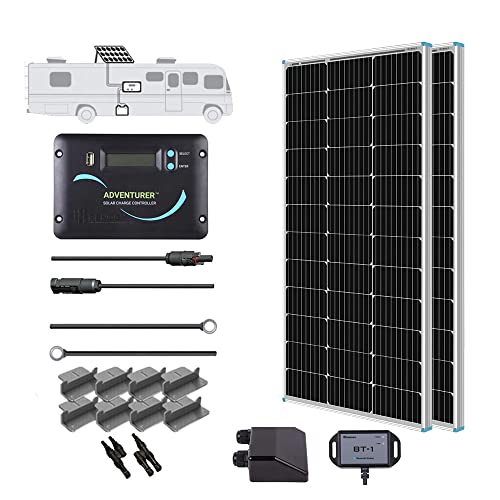
This RV-oriented kit provides about 800Wh daily output under four hours of sun, designed for smaller footprints and mobile applications. It includes 200W of solar panels, a 30A Adventurer PWM charge controller, and mounting hardware. Best for RVs, boats, and portable setups where space and weight are critical. A limitation is lower daily output compared with larger home kits, so use for lighter energy loads or supplemental charging.
- Best for: mobile lifestyles needing compact solar power on the go.
- Why selected: compact footprint and practical for travel environments.
- Limitations: limited daily energy; not ideal for full home backup.
Buying Guide
- What is your energy goal? Decide between full-home backup, partial power for essentials, or RV/mobile use. Larger kits provide more daily kWh and higher parallel capacity, but require more space and investment.
- How scalable should the system be? If you plan to expand, choose kits that support parallel units and offer clear BMS and communication options (RS485/ CAN, Wi-Fi, Bluetooth).
- What battery chemistry fits your needs? LiFePO4 offers safety and depth of discharge advantages but at higher upfront cost. Ensure the system supports the chosen batteries and has robust protection features.
- What climate and sun exposure apply? Panels and inverters perform best with consistent sun. Consider orientation, shading, and seasonal daylight when estimating daily kWh output.
- What are monitoring and maintenance considerations? Look for real-time monitoring, mobile apps, and clear service documentation. Maintenance should be straightforward with modular components for easy replacement.
- Is installation complexity a factor? All-in-one kits simplify setup; multi-component systems may require professional wiring and compliance checks for local codes.
Frequently Asked Questions
- What is the advantage of parallel-capable inverters? It lets you scale capacity by adding more inverters or batteries, increasing total power output and storage as needs grow.
- How much daily energy does a typical 10kW kit provide? Output depends on sun hours; under strong sun, a 10kW kit can produce several tens of kWh per day, but actual figures require site-specific sun exposure.
- Are lithium battery systems essential for off-grid kits? Lithium packs offer higher energy density and longer life than lead-acid, but they come with higher upfront cost. Evaluate total cost of ownership.
- Can these systems operate during a power outage? Off-grid and hybrid kits provide isolation from the grid, enabling continued operation for critical loads when grid power is unavailable.
- Do I need professional installation? Large systems with high voltages and parallel configurations may require licensed electrical work to comply with safety standards and codes.
- What maintenance is required? Regular inspections of wiring, connectors, fuses, and battery health help maintain performance and safety over time.