Best Generator Hook Up Kit Options for Safe Home Power During Outages
Answering the common question “which generator hook up kit is right for my home?” this guide highlights top 5 kits that balance safety, ease of use, and compatibility with common home panels. These kits are best for homeowners seeking a reliable, code-conscious way to power essential circuits during outages, and for contractors comparing setup options for fixed installation. The top picks cover 30- and 50-amp configurations to fit mid-size portable generators and load centers.
Buyer types at a glance:
– Best for 50-amp home circuits: CircleRiver, Ficstar, LANDNOR, and RVINGPRO 50A kits deliver robust power with pre-drilled inlet boxes for flexible installation.
– Best for balance of price and features: LiftCharger 30A is ideal for smaller loads and Square D Homeline panels.
– For general-purpose emergency power: All listed kits provide ETL/UL-listed safety features and durable copper conductors.
Summary of selected products
| Product | Amp Rating | Length | Key Benefit |
|---|---|---|---|
| CircleRiver 50 Amp Kit | 50A | 15 ft | Pre-drilled inlet box; sturdy STW 6/3+8/1 AWG |
| Ficstar 50 Amp Kit | 50A | 15 ft | UL/ETL listed; green indicator light |
| LANDNOR 50 Amp Kit | 50A | 25 ft | Larger pre-drilled box; easy wiring |
| RVINGPRO 50 Amp Kit | 50A | 15 ft | ETL listed; tough outdoor design |
| LiftCharger 30 Amp Kit | 30A | 15 ft | Interlock kit for Square D Homeline; circuit-selectivity |
CircleRiver 50 Amp Generator Cord and Inlet Box Combo

Best for heavy-duty, outdoor installations where a robust 50-amp connection is required. Features include ETL listing for both the generator cord and inlet box, a 15-foot length, and a NEMA 14-50P to SS2-50R configuration. The STW 6/3 + 8/1 AWG wiring supports up to 12,500 watts, making it suitable for running essential home circuits during outages. Caution: ensure the pre-drilled box aligns with your mounting space to avoid obstruction or panel interference.
RVINGPRO 30 Amp Generator Cord and Inlet Box Kit

Best for smaller loads or tighter spaces where 30-amp service suffices. This kit includes a 25-foot cord with NEMA 14-30P and L14-30R connectors, plus a pre-drilled inlet box designed for multiple directional connections. ETL listed for outdoor reliability. Caution: its max wattage is lower (about 7,500 watts), so avoid planning to power high-draw appliances simultaneously.
Ficstar 50 Amp Generator Cord and Inlet Box Kit
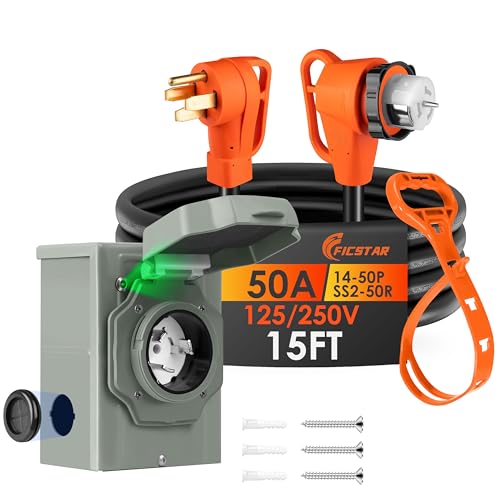
Best for users seeking a UL-listed cord with a clear power indication and sturdy construction. It offers a 15-foot cord with NEMA 14-50P to SS2-50R, and a pre-drilled inlet box with four-direction mounting for flexible installation. The kit is designed to handle up to 12,500 watts and emphasizes UV and heat resistance. Caution: ensure compatibility with your generator model’s plug type before purchase.
LANDNOR 50 Amp Generator Cord and Inlet Box

Best for convenient installation with extra space for wiring. The kit uses 25-foot length with STW 6/3 + 8/1 AWG copper wiring and a 50A NEMA 14-50P to SS2-50R configuration. Pre-drilled box accepts connections from all directions, simplifying routing to panels. Caution: larger inlet box footprint may require more mounting clearance in tight spaces.
RVINGPRO 50 Amp Generator Cord and Inlet Box Kit

Best for high-demand outages with durable ETL-listed components. This 50-amp kit uses a 15-foot cord and NEMA 14-50P to SS2-50R, providing robust connection for running essential circuits. The pre-drilled inlet box supports flexible installation. Caution: check outdoor clearance and ensure the panel can accept a SS2-50P inlet without obstruction.
LiftCharger 50 Amp to 30 Amp Generator Hook-up Kit

Best for those needing interlock protection and easy connection to Square D Homeline panels. The kit includes a 50-amp cord, a 50-amp inlet, interlock components, and a circuit breaker compatible with 150/200/225 Amp load centers. It enables targeted circuit energizing during outages. Caution: designed around specific load centers; confirm panel compatibility before purchase.
Buying Guide: Key Considerations for Generator Hook-Up Kits
- Maximum load and amperage: Choose a kit that matches your generator’s output and the essential circuits you intend to power. Higher amperage kits support more circuits but require larger inlets and panels.
- Inlet box size and mounting: Pre-drilled, multi-direction inlet boxes simplify installation and wiring routing. Ensure there is enough space behind the outlet box for cable management.
- Cord length and wire gauge: Longer cords reduce placement limits, but may introduce voltage drop. Look for STW or similar copper conductors and appropriate AWG for your amperage.
- Electrical safety certifications: ETL or UL listing indicates compliance with safety standards for outdoor use and electrical reliability in adverse conditions.
- Compatibility with load centers: Ensure the interlock or transfer-switch approach aligns with your home’s panel model (e.g., Square D Homeline) to avoid backfeeding risks.
- Weather resistance: Outdoor-rated cords and jackets help withstand sun, heat, rain, and cold. UV resistance and flame retardant materials are pluses for long-term durability.
- Ease of installation: Look for pre-drilled inlet boxes and simple mounting patterns to speed up installation or upgrades by a professional.
Frequently Asked Questions
- What is a generator hook-up kit?
A generator hook-up kit includes a power cord and a power inlet box designed to connect a portable generator to a home’s electrical system, often with pre-drilled mounting and safety features.
- Do I need a transfer switch with these kits?
Some kits use interlock mechanisms to prevent backfeeding, while others pair with a transfer switch. Choose based on your panel type and local electrical codes.
- What wattage should I expect from a 50-amp kit?
Most 50-amp kits support up to about 12,500 watts, depending on the specific cord and inlet box configuration.
- Is a 30-amp kit enough for essential circuits?
Yes, for smaller outages or fewer essential devices, a 30-amp kit can supply critical loads efficiently, though total wattage is lower.
- What maintenance is required for generator hook-up kits?
Regular inspection of cords, inlets, and connections; ensure weather seals remain intact; replace any frayed insulation or corroded contacts promptly.