Best 10000-Watt Gas Generators for Home or Jobsite
The top 10000-watt gas generators deliver reliable power for homes, job sites, and emergency backup. This guide highlights five solid options and explains who each is best for, based on their design, fuel type, and runtime characteristics. Whether you need portable power for construction lighting, or a sturdy home backup, these models offer durable, code-compliant performance suitable for American conditions. The buyer intent is clear: choose a generator that matches your load, fuel preferences, and runtime expectations.
| Product | Best For | Approximate Power |
|---|---|---|
| Honda EB10000 AN | Job sites and contractors needing durable, quiet operation | 10,000 watts continuous |
| Westinghouse 12500W Dual Fuel | Home backup with fuel flexibility | 12,500 peak / 9,500–8,500 running (gas/propane) |
| DuroStar DS13000MX | Whole-home power backup with dual-fuel choice | 13,000 watts |
| Westinghouse 14500W Dual Fuel | Large homes or remote builds needing high output | 14,500 peak / 11,500 running (gas) |
| Champion 10,000-Watt Electric Start | Quiet, residential backup with easy startup | 10,000 watts |
Honda EB10000 AN 10kW Gas Generator with Electric Start

Best for contractor use and industrial lighting on job sites. This Honda model pairs an electric start with a compact, install-friendly design. It’s built for rugged environments and long runtimes on typical workloads. The unit emphasizes stability with Honda’s Digital Automatic Voltage Regulator, keeping voltage within a narrow band for steady power delivery. It includes full GFCI protection, meeting OSHA expectations on job sites. A potential limitation is its noise level, though Honda notes a quiet operation relative to comparable industrial units.
Why chosen: Known for durability, reliable start, and consistent voltage. Best for professionals needing a robust, compliant contractor generator.
Westinghouse 12500W Dual Fuel Home Backup

Best for homeowners who want fuel flexibility and transfer-capable backup. This unit runs on gasoline or propane, with a remote start option and a multi-point fuel system. It includes a 6.6-gallon tank for extended runtimes and multiple outlets, including transfer switch readiness. The VFT display provides real-time voltage, frequency, and runtime data. A consideration is the larger footprint typical of dual-fuel, high-output models.
Why chosen: Ideal for reliable home backup with optional propane fueling, offering practical run-time and transfer readiness in one package.
DuroStar DS13000MX 13,000-Watt Dual Fuel

Best for users needing high power with dual-fuel versatility. The DS13000MX supports both gasoline and propane, allowing longer run times and cleaner emissions in emergency scenarios. It features remote electric start for convenient operation and is designed for whole-home backup or demanding job-site loads. A noted limitation is that dual-fuel systems can add maintenance considerations compared to single-fuel models.
Why chosen: Strong power output and fuel flexibility make it a solid choice for larger homes or job-sites requiring longer runtimes and easier fuel management.
Westinghouse 14500W Dual Fuel Backup

Best for larger homes or remote builds needing substantial power output. This model delivers a high peak wattage with strong running watts on gasoline and propane, supported by an extended running time on a sizable fuel tank and a fuel gauge. It includes transferable features for home backup and RV readiness. The higher output means more noise potential, so using in noise-constrained environments should be considered.
Why chosen: Excellent for situations where maximum throughput is required, with dual-fuel options to adapt to available fuel supplies.
Champion 10,000-Watt Electric Start Portable
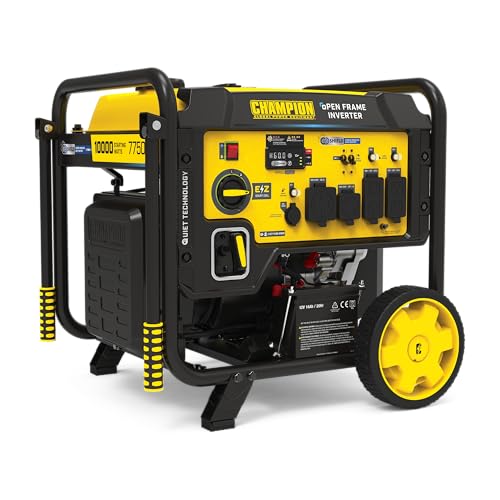
Best for quiet residential backup and outdoor activities where fewer disturbances are preferred. Champion’s model emphasizes quiet operation around 72 dB, with Clean Power technology to stabilize output for electronics like phones and EV chargers. It also offers EZ Start Dial and Cold Start capability for easier startup in cooler conditions. A limitation is that the single-fuel design may require closer fuel monitoring during longer outages.
Why chosen: A practical balance of quiet operation, clean power, and convenient startup for home users seeking dependable, low-noise backup power.
Buying Guide
- Power needs: Determine continuous running watts and peak watts. For homes, aim for a model with at least 9,000–11,500 running watts if you want to cover essential circuits during outages.
- Fuel type: Dual-fuel units offer flexibility (gasoline or propane) but can be heavier and more complex. Gas-only units are lighter and simpler.
- Starter and runtime: Electric start is convenient on larger models; consider fuel tank capacity for longer runtimes without refueling.
- Portability and noise: Job-site models may require wheels and handles; noise ratings around 70–75 dB are common for 10kW-class units, but quieter options exist.
- Safety and codes: Look for GFCI protection, EPA/CARB compliance where applicable, and transfer-switch readiness for safe home backup integration.
- Outlets and compatibility: Ensure available outlets match your equipment and that the unit supports essential circuits you plan to power during an outage.
- Maintenance: Dual-fuel systems need more routine upkeep; confirm oil management and user serviceability before purchase.
FAQ
- What is a typical 10000-watt generator able to power? It can run essential home circuits, sump pumps, furnaces, and several large appliances depending on the unit’s running watts.
- Is dual-fuel better than single-fuel? Dual-fuel offers fuel flexibility and longer availability during long outages, but adds weight and maintenance considerations.
- Do I need a transfer switch with these generators? A transfer switch is recommended for safe, automatic backup power to your home or business wiring.
- How loud are these generators? Many models target around 72–75 dB under load; quieter options exist but may cost more.
- Can I run a 10000-watt generator indoors? No. Always operate outdoors with proper ventilation and follow manufacturer safety guidelines.
- What maintenance is essential? Regular oil checks, air filter cleaning/replacement, spark plug checks, and fuel stabilization for prolonged storage.