Best Gas and Electric Tankless Water Heaters for Quick, On‑Demand Hot Water
When choosing a gas or electric tankless water heater, prioritize continuous hot water, installation location, and fuel type compatibility with your home. The top products below are chosen for reliability, efficiency, and suitability for different households—whether you need indoor or outdoor installation, natural gas or propane, or compact options for tighter spaces. This buyer’s guide highlights who each model is best for and why, plus clear caveats to consider before buying.
| Product | Best For | Key Benefit |
|---|---|---|
| Rheem RTG-70DVLN-3 | Small to medium homes with 2–3 bathrooms | Indoor, high efficiency, strong GPM |
| Rheem RTGH84DVLN | Mid-size homes needing higher flow | 8.4 GPM, strong BTU, indoor |
| Rheem RTG-70XLN-3 | Outdoor installation, similar capacity to indoor units | Outdoor, durable, 7.0 GPM |
| Rinnai RX199iN | Homes seeking flexible indoor/outdoor use | Condensing, high efficiency, 11.1 GPM |
| APUS 190,000 BTU Outdoor | Whole-home outdoor setups | 8.1 GPM, WiFi & remote |
Rheem RTG-70DVLN-3 Indoor Tankless Gas Water Heater

The Rheem RTG-70DVLN-3 is a high-efficiency indoor tankless gas unit delivering up to 7.0 GPM with about 160,000 BTU. Best for 2–3 bathroom homes with simultaneous hot water needs such as showers and laundry. This model emphasizes fast, reliable hot water during peak demand and is designed for indoor installation with a compact cabinet for wall mounting by a qualified installer.
- Best for: Indoor installation, 2–3 bathroom homes.
- Why selected: Strong flow at a compact size; reliable heat on demand.
- Caution: Indoor installation requires venting and professional hookup; actual performance varies with incoming water temperature.
Rheem RTGH84DVLN3701171 8.4 GPM Indoor Gas Tankless Heater
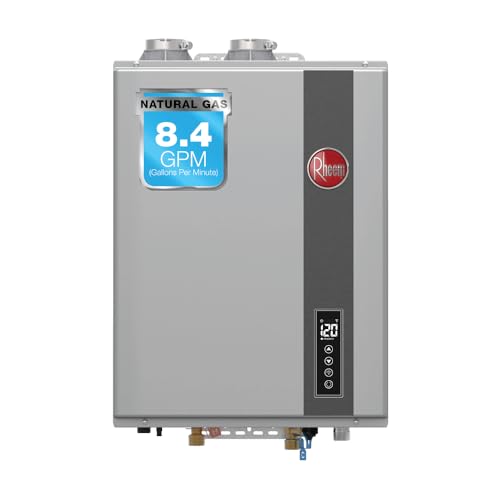
This model offers a higher flow rate of 8.4 GPM and 157,000 BTU, making it suitable for mid-size homes with multiple simultaneous hot water demands. It’s designed for indoor installation with electric ignition for convenient operation.
- Best for: Homes needing higher simultaneous hot water flow.
- Why selected: Higher GPM helps prevent cold water bursts when showers run together.
- Caution: Heavier BTU needs may affect venting and vent sizing requirements; verify installation clearance.
Rheem RTG-70XLN-3 Outdoor Tankless Gas Water Heater
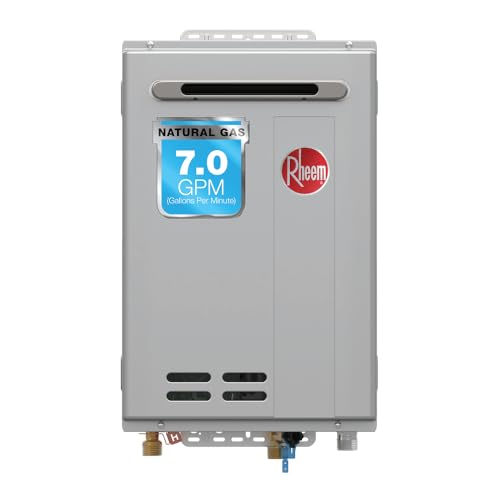
The RTG-70XLN-3 is the outdoor counterpart to the indoor unit, delivering 7.0 GPM with the same 160,000 BTU capability. It’s ideal for outdoor installation and still supports wall mounting by a qualified installer.
- Best for: Outdoor installations in homes with adequate venting and weather protection.
- Why selected: Similar performance to the indoor version in an outdoor-ready package.
- Caution: Outdoor units require weatherproofing considerations and protection from extreme temperatures.
Rinnai RX199iN Condensing Tankless Water Heater

The Rinnai RX199iN supports up to 11.1 GPM and operates with propane or natural gas, offering indoor or outdoor installation flexibility. It uses a Smart Sense gas control system and features a compact design for various household layouts.
- Best for: Homes needing high hot water capacity and flexible installation options.
- Why selected: High GPM with dual-fuel compatibility suits larger families or busy households.
- Caution: Condensing design can require careful venting and condensate management; check local codes.
APUS 190,000 BTU Outdoor 8.1 GPM Gas Tankless (WiFi)

APUS’s outdoor model delivers 8.1 GPM with 190,000 BTU and includes WiFi and a remote control. It is marketed for whole-house use and supports multiple outlets concurrently, with a 0.79 GPM minimum flow to ensure operation under low water pressure.
- Best for: Outdoor installations requiring remote control and multi-outlet support.
- Why selected: WiFi connectivity adds convenience for scheduling and monitoring.
- Caution: Outdoor units need weather protection and appropriate wiring for remote features; verify compatibility with existing gas line pressure.
Buying Guide — Key Considerations And Comparisons
- Flow needs: Measure your peak hot water demand (number of bathrooms, appliances, and simultaneous uses) to choose GPM in the 7–11 range for adequate performance.
- Fuel type: Decide between natural gas and propane. Propane units can be ideal in areas with limited natural gas service but may cost more to operate per BTU.
- Indoor vs outdoor: Indoor units require venting and a safe installation space; outdoor units must withstand weather and provide frost protection in cold climates.
- Venting and clearance: Gas models require proper venting, clearance from combustibles, and proper gas line sizing. Larger BTUs demand appropriate vent and gas line planning.
- Electric vs gas: Electric tankless heaters are common in some scenarios, but the products here are gas-based. If you’re considering electric options, look for unit efficiency, patchy flow under low pressure, and electrical service capacity.
- Installation: Many of these units require professional installation. Check local codes and homeowner association requirements for venting, gas line work, and electrical connections.
- Maintenance: Regular descaling and flushing help maintain efficiency, especially in hard-water areas. Condensing units require condensate management.
- Control features: Some models offer smart controls or remote apps for temperature and status monitoring. Consider whether you want WiFi integration and ease of adjustment from a phone or wall controller.
Frequently Asked Questions
- What size tankless water heater do I need for a 2–3 bathroom home?
– Look for a unit in the 7.0–9.5 GPM range, depending on simultaneous usage and incoming water temperature. - Can I install a gas tankless water heater indoors?
– Yes, but it requires proper venting, clearance, and professional installation to meet safety codes. - Is a condensing model more efficient than a non-condensing one?
– Generally, yes. Condensing models recover more heat from exhaust, improving efficiency, but may require more complex venting and condensate management. - Do these units support propane or natural gas?
– Several models support both or are designed for one fuel type; verify fuel compatibility before purchase. - Do tankless heaters require electric power?
– Some models use electric ignition or smart controls and may need a dedicated circuit; verify electrical requirements during planning. - What maintenance is needed for gas tankless heaters?
– Regular flushing to remove mineral buildup and routine venting inspections help maintain performance.