Best Natural Gas Garage Radiant Heaters for Warmer Workshops
Answering the key question: which natural gas garage radiant heater fits your space and budget? This guide highlights five reliable options designed for garages, workshops, or large sheds. Each selection targets common buyer needs: room size, venting requirements, and ease of installation. Suitable buyers include do-it-yourself homeowners, professional shop owners, and anyone upgrading a drafty garage to a comfortable workspace. The following table summarizes the five chosen products, including approximate heating capability and intended space.
| Product | BTU / Heating Area | Best For | Notes |
|---|---|---|---|
| Mr. Heater F272800 40,000 BTU Natural Gas Garage Heater | 40,000 BTU | Smaller garages with standard ceilings | Infrared heat, compact footprint |
| Mr. Heater F260550 Big Maxx MHU50NG | 50,000 BTU | Medium to large garages | Ceiling-mounted, flexible thermostat options |
| SunStar Infrared Ceramic Heater, Natural Gas 80,000 BTU | 80,000 BTU | Very large spaces | Angled mounting for radiant coverage |
| Mr. Heater 30,000 BTU Vent Free Radiant Natural Gas Heater | 30,000 BTU | Smaller or vent-free setups | Battery ignition, vent-free operation |
| Mr. Heater F260560 Big Maxx MHU80NG | 80,000 BTU | Large shops, industrial garages | Includes conversion kit for propane |
Mr. Heater F272800 40,000 BTU Natural Gas Garage Heater

This infrared heater is designed for garages with 12 to 15 ft ceilings, offering efficient, cost-effective warmth. It is best for small-to-medium garages where ceiling height aligns with its recommended clearances. The unit emphasizes infrared heat delivery, which can quickly raise perceived warmth without excessive energy use. Consider this option if your space is modest in size and you prefer a straightforward installation without complex ducting.
Best for: small to mid-size garages, users seeking direct infrared warmth. Caution: ensure proper top, side, back, and clearance clearances are met to avoid heat damage or fire risk.
Mr. Heater F260550 Big Maxx MHU50NG

The Big Maxx MHU50NG is a ceiling-mounted unit heater that turns garages, barns, and workshops into heated workspaces. With 50,000 BTUs, it is better for larger areas, roughly up to 1,667 sq ft, or about a three-car garage. It supports standard 24-volt thermostats and newer Wi-Fi-enabled models (sold separately). Choose this when you need more uniform heat distribution and a robust setup for bigger spaces.
Best for: medium-to-large garages needing higher output and thermostat flexibility. Limitation: may require professional installation for proper mounting and wiring.
SunStar Infrared Ceramic Heater Natural Gas 80,000 BTU

This infrared ceramic heater uses aluminized steel construction for corrosion resistance and long life. Aluminum reflectors maximize radiant efficiency, improving heat delivery across open spaces. It allows horizontal angle mounting up to 30 degrees, enabling targeted warmth toward work zones. Best suited for very large spaces or awkward layouts where radiant heat needs to reach multiple work areas.
Best for: large, open garages or workshops where radiant heat coverage is critical. Caution: ensure mounting can support angled installation and proper venting per local codes.
Mr. Heater 30,000 BTU Vent Free Radiant Natural Gas Heater

This vent-free design emits 30,000 BTU per hour and heats up to 1,000 square feet. It features a battery-operated electronic ignition for convenient startup. Best for smaller spaces or garages where venting is not practical. The vent-free setup means warmth is generated without ducting but requires proper clearance and ventilation considerations for indoor use.
Best for: small garages or sheds needing quick, vent-free heating. Limitation: ensure indoor air quality and venting guidelines are followed; may not be ideal for very tight or poorly ventilated spaces.
Mr. Heater F260560 Big Maxx MHU80NG Natural Gas Unit Heater
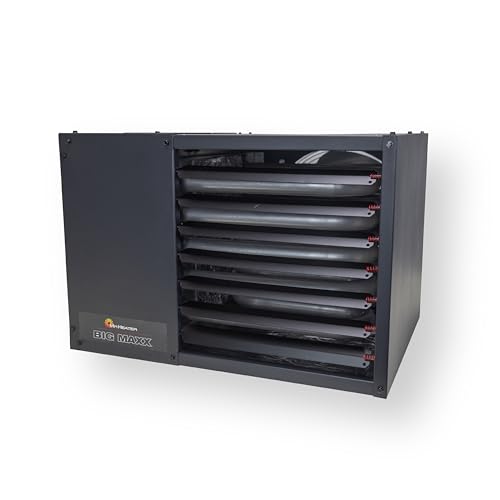
This 80,000 BTU unit heater is designed for large spaces and includes a natural gas to propane conversion kit, offering flexibility for different fuel setups. It is well-suited for sizable garages or industrial workshops where consistent heat output is required across a broad area. Best for: large commercial or residential garages needing robust heating with future fuel flexibility. Caution: installation may require professional service to ensure safe venting and gas connections.
Buying Guide
Key considerations when choosing a natural gas garage radiant heater:
- Space size and layout: Match BTU output to the garage area. For example, 30,000–40,000 BTU works for small garages; 50,000–80,000 BTU suits larger spaces.
- Ventilation and installation: Vent-free units require careful ventilation planning. Many units are ceiling-mounted; ensure studs, joists, and clearance rules are followed.
- Fuel flexibility: Some models include conversion kits to switch between natural gas and propane, offering future-proofing for fuel supply changes.
- Thermostat compatibility: Consider models that support standard 24-volt thermostats or Wi-Fi-enabled thermostats for easier climate control.
- Maintenance and durability: Look for corrosion-resistant construction and components designed for garage environments.
- Safety clearances: Always verify top, sides, back, and below clearance specs to prevent heat damage or fire risk.
FAQ
- What size garage heater do I need for a 2-car garage? Typically 40,000–60,000 BTU is suitable for a standard two-car garage, depending on insulation and climate.
- Is vent-free heat safe for a workshop? Vent-free units can be safe if used in well-ventilated spaces and installed according to instructions and local codes.
- Can I install a natural gas heater myself? Some models are designed for homeowner installation, but larger or vented units often require professional installation for gas connections and venting.
- Do these heaters support thermostats? Yes, several models support standard or Wi-Fi-enabled thermostats for automatic temperature control.
- What maintenance is needed? Regular inspection of gas lines, ignition systems, and venting (where applicable) helps maintain safe and efficient operation.
- Are there safety concerns with oversized heaters? An oversized heater may heat space too quickly or create uneven temperatures; select BTU output based on space size and insulation.