Best Full Spectrum Plant Lights for Indoor Growth and Health
Looking for full spectrum plant lights to boost indoor plant growth? This guide highlights five top options that deliver true full-spectrum coverage, adjustable brightness, and timers to fit different plant stages. Each option suits different buyers: hobbyists starting seedlings, apartment gardeners with limited space, or enthusiasts growing leafy greens and flowering plants year-round. Below, you’ll find concise specs, who each light is best for, and practical buying tips to compare quickly.
| Product | Brand | Key Benefit |
|---|---|---|
| Aokrean Plant Grow Light (3 Pack) | Aokrean | Versatile 3-spectrum options; adjustable height; auto timer |
| LEOTER Grow Light, 80 LEDs | LEOTER | Comprehensive spectrum with 3-mode light and 10 dimmable levels |
| Barrina T5 Grow Lights 4-Pack | Barrina | Low-watt, high PPFD with 4 separate fixtures |
| VIPARSPECTRA P700 Grow Light | VIPARSPECTRA | High output with balanced spectrum and efficient cooling |
| Yiyehu Full Spectrum Grow Lights (15–62 in) | Yiyehu | Extensible height range and detachable tripod for various setups |
Aokrean Plant Grow Light — Three Spectrums, Auto Timer

Best for: Small to medium indoor gardens needing variable spectrum options and a timer. This unit offers three lighting modes: white, warm white, and red, plus a mix option for flexible illumination. It supports 3/9/12-hour cycles, keeping lights on automatically each day. The stand design accommodates soil insertion or a base, making it suitable for pot-based setups and desktop gardens. A potential limitation is that the stand requires the pot to help stabilize, so placement should consider stability and height.
GooingTop Clip Grow Light — 6000K Full Spectrum

Best for: Clayton-style setups, small to medium plants needing a stable clip-on light with broad spectrum coverage. This lamp uses a 6000K white light with additional red LEDs, designed to approximate noonday sun for indoor plants. It includes a timer with 4/8/12-hour options and a flexible gooseneck with a clamp, allowing directional lighting. Limitation: the device relies on USB or plug power, so placement is restricted by available outlets and cable management.
LEOTER Grow Light — 80 LEDs, Full Spectrum
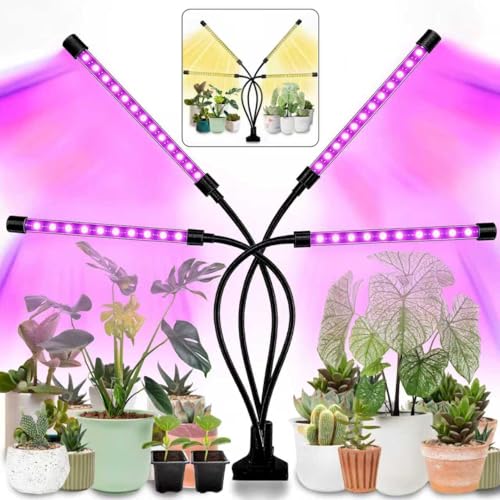
Best for: Plants in need of a high-coverage full spectrum with adjustable timing. This upgraded model includes 1) Full Spectrum (380–800 nm), 2) Red+Blue, and 3) Red+Blue+Full Spectrum modes, plus 10 dimming levels. It features a circular memory timer to automatically turn on/off daily, though the timer may require a reset after power-off. The gooseneck and compact footprint suit desktops, shelves, and plant stands. Use this for seedlings to vegetative stages to ensure steady growth.
VIPARSPECTRA P700 Grow Light — 70W

Best for: Seedlings and vegetative plants in compact grow tents and small spaces. The P700 offers a balanced full spectrum with 660 nm red and white light, paired with robust heat dissipation via large aluminum heat sinks. It provides high PAR with energy efficiency, delivering strong growth while maintaining a cooler operation. A caveat: as a 70W unit designed for 2×2 ft areas, larger plants may require additional fixtures for uniform coverage.
Yiyehu Full Spectrum Grow Lights — 15 to 62 Inches

Best for: taller, multi-size plants that require a tall stand. This model offers a detachable tripod and an extendable height range from 15 inches to 62 inches, making it adaptable for seedlings up to mature plants. It emphasizes true sun-like full spectrum (380–800 nm) to energize photosynthesis across growth stages. Limitation: the extension and tripod setup may be more complex to assemble and adjust than smaller clip-on options.
Buying Guide: Key Considerations For Full Spectrum Plant Lights
- Light Spectrum And Intensity — Look for full-spectrum options covering 380–800 nm, with dedicated red and blue channels for different growth stages. Higher PPFD is beneficial for larger plants, while seedling stages may prioritize even light distribution.
- Adjustability — Consider height, angle, and mounting options (clip, tripod, or stand) to fit different pot sizes and plant heights. An adjustable timer helps automate care during vacations or workdays.
- Power And Efficiency — Compare wattage to actual light output. Energy-efficient LEDs provide strong PAR with lower energy use, reducing long-term running costs.
- Coverage Area — Ensure the fixture covers the intended plant area. Multiple heads or longer arms often provide better uniformity for larger setups.
- Ease Of Use — Check mounting stability, ease of assembly, and whether the timer is memory-based or requires manual reset after power loss.
Frequently Asked Questions
- What is full-spectrum light for plants? — A light that covers wavelengths from about 380 nm to 800 nm, closely simulating natural sunlight to support all growth stages.
- Do I need a timer? — Timers help automate day-night cycles, promoting steady growth and freeing you from manual on/off routines.
- Which light height is best? — Place lights high enough to avoid hotspots but close enough to deliver adequate PAR; taller plants may need adjustable stands or tripods.
- Can I use these lights year-round? — Yes, indoor full-spectrum lights are designed for continuous use to supplement natural light in winter or low-light spaces.
- Are clip-on lights better than stands? — Clip-ons save space and are ideal for small setups; stands or tripods suit tall or larger plants with varied heights.
- How many lights should I use for a group of plants? — For a small collection, one multi-head unit or two evenly spaced fixtures typically suffice; larger setups benefit from multiple fixtures to ensure even coverage.