Best Front Door With Keypad for Modern Homes
Answering your search for a keypad front door lock, these options offer keyless entry, remote access, and smart features suited for different households. Best for busy families needing multiple codes, best for renters or frequent guests, and best for households prioritizing app control and integration with voice assistants. The following picks emphasize clear access options, auto-lock, and robust security, with notes on ideal use cases and potential limitations.
| Product | Brand | Why It Stands Out | Best For |
|---|---|---|---|
| Philips WiFi Keypad Door Lock | PHILIPS | Direct 2.4GHz WiFi, real-time app control, voice assistant ready | Homeowners wanting direct WiFi access without hubs |
| TEEHO TE001 Keyless Entry | TEEHO | 20 codes, one-time code, auto-lock features | Families with guests and frequent visitors |
| Zowill Keyless Entry | Zowill | Multiple unlock methods, ANSI Grade 3, auto-lock | Households needing flexible access for family and cleaners |
| Veise VE06-L With Lever | Veise | App control, 250+ codes, web portal, anti-peep | Owners managing rentals or multi-tenant properties |
| Veise VE027-K With Built-in WiFi | Veise | Integrated Wi-Fi, 8+ unlock methods, remote management | Tech-forward homes seeking robust remote monitoring |
Notes: This guide focuses on five options that balance ease of use, security features, and flexible access. Availability and exact specs may vary by seller and region. Always verify compatibility with your door and local smart home ecosystem before purchase.
PHILIPS WiFi Keypad Door Lock With Handle
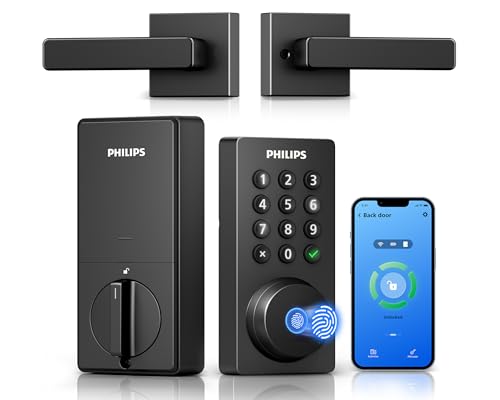
The Philips 4200 Series WiFi Door Lock Deadbolt includes built-in WiFi for direct home network access and remote app management. Best for homeowners who want to control lock status and access history from anywhere without a hub. It supports voice commands via Alexa or Google Assistant for hands-free locking and status checks. This model is particularly suitable for doors where a handle set is preferred. Caution: Some users may require stable 2.4GHz WiFi coverage for consistent performance.
TEEHO TE001 Keyless Entry Door Lock

The TE001 keypad lock offers 20 user codes plus a one-time code for guests. It features auto-locking with a selectable delay (10-99 seconds) and a quick 2-second one-touch auto-lock. Best for households with frequent visitors, contractors, or Airbnb-style needs. Limitation: Fewer advanced app or remote-control options compared with WiFi-enabled models.
Zowill Keyless Entry Door Lock With 2 Lever Handles

The Zowill lock provides multiple unlock methods: 20 user codes, one-time codes, and two backup keys. Auto-lock can be set to 10-99 seconds, and the lock carries ANSI Grade 3 certification. Best for homes needing flexible access for family, cleaners, and guests, with solid physical security. Caution: Some users may prefer a stronger integration with smart home apps over traditional codes.
Veise VE06-L Smart Lock With Lever

The Veise VE06-L combines a lever handle with a keypad and app control. It supports 250+ codes, two unlock methods via app and codes, and a web portal for management. Best for property owners and landlords who need remote access control and detailed logs. Limitation: Some users may find the feature set overwhelming for small apartments with simpler needs.
Veise VE027-K Built-in WiFi Smart Lock

The VE027-K integrates built-in WiFi for remote control without a hub and offers up to 8+ unlocking methods, including fingerprint, codes, IC cards, keys, and voice integration. Best for tech-forward homes needing versatile access for family, guests, and service providers. Caution: Ensure reliable WiFi coverage and power supply for uninterrupted remote operation.
Buying Guide
What unlock methods do you need?
Consider whether you want keypad codes, fingerprint, smartphone app control, or card/fob access. More options offer flexibility for guests and service providers, but may introduce complexity. If you value simplicity, prioritize codes and app control with clear admin options.
Do you require remote access or a hub?
Some locks connect directly to WiFi without a hub, while others require a bridge. Direct WiFi models simplify setup and reduce extra devices, but ensure your home WiFi is reliable. For larger homes, a hub-based system may provide more stable connectivity.
Security features to look for
Anti-peeping codes, auto-lock timing, and tamper alerts help enhance security. ANSI or equivalent certification indicates physical security standards. Review access logs to monitor who enters and when.
Installation and compatibility
Verify that the lock fits your door type and lever or knob configuration. Some models include easy installation steps and no-drill options, while others may require professional installation for best results. Consider whether you need lever handles or a traditional knob with a keypad.
Smart home integration
Check compatibility with voice assistants (Alexa, Google), and whether the lock can work with your existing smart home routines. App usability and remote management are important for real-time status checks and guest access sharing.
Cautions and limits to consider
Battery life and replacement logistics are practical concerns for smart locks. Some models may enter hard lockout modes after repeated incorrect attempts, so understand the lockout behavior. Always ensure you have a trusted backup entry method in case of power or WiFi outages.
FAQ
-
What is the benefit of a front door keypad lock?
A keypad lock provides keyless entry, guest access management, and the option to grant temporary codes, improving convenience and security compared with traditional keys.
-
Do these locks require a hub?
Some models connect directly to WiFi, while others use a hub or bridge. Direct WiFi models simplify setup, but verify coverage in your home.
-
Can I control these locks from my phone?
Yes. Most listed locks offer smartphone apps for remote control, access history, and code management, often with additional features like voice control.
-
Are keypad locks secure against hacking?
High-quality keypad locks use multi-factor access options and anti-peeping measures. Look for proven certifications and robust encryption used by the manufacturer.