Best Flush Mount Solar Panels for Off-Grid Power on Any Surface
Flush mount solar panels provide clean, discreet energy for RVs, boats, campers, and rooftops without protruding hardware. This guide highlights five well-suited options that balance efficiency, durability, and ease of installation. Whether you’re seeking lightweight flexibility, marine resilience, or sturdy rooftop mounting, these picks suit different buyers—from weekend campers to full-time off-grid setups. Read on to find which panel fits your surface, climate, and power needs. A quick summary table is included to compare key traits at a glance.
| Product | Best For | Key Benefit |
|---|---|---|
| Renogy 100W N-Type | RVers and boaters needing reliable 12V power | High efficiency with 25% cell efficiency and 16BB tech |
| Renogy Flexible 100W | Curved or uneven surfaces | Ultra-light, ultra-thin, bendable mounting |
| Callsun 100W Ultra-Thin | Compact, curved installations | 240° bendability for complex surfaces |
| ECO-WORTHY 200W Kit | Higher daily output on RVs or cabins | Integrated 30A PWM controller and robust frame |
| SOLPERK 20W Kit | Small, portable maintenance power | Smart MPPT controller and adjustable mount |
Buyer notes: Choose for your surface type first—rigid rooftop, curved RV roof, or marine hull. Consider desired power output, weight, and weather resistance. If you plan to expand later, a higher wattage kit with robust mounting hardware can simplify future upgrades. The following sections break down why each option may be the best fit for specific situations and how to avoid common pitfalls during installation.
Renogy 100W N-Type Solar Panel

Best for: RVs, marine vessels, and off-grid trailers needing steady 12V power. This panel uses grade A+ cells with 25% efficiency and a 16BB configuration to improve output and longevity. The design aims to reduce hot spots and extend service life, while a low temperature coefficient helps maintain performance in hot climates. This makes it a reliable workhorse for campers and boaters who prioritize consistent daytime charging in varying weather.
Why selected: The high-efficiency cells deliver more usable energy per square foot, especially on tight rooftop spaces. 16BB cells address common reliability concerns in rugged environments. It’s a solid, do-it-all choice for home bases or mobile setups with moderate to high energy needs.
Limitations: It’s a rigid panel; installation requires flat mounting space and adequate hardware to seal joints against the elements. If your surface is curved, you may prefer a flexible option.
Renogy Flexible Solar Panel 100W

Best for: Curved or uneven surfaces where rigid panels won’t fit, such as RVs, boats, or cabins with unconventional rooflines. This panel weighs about 70% less than rigid options, making transport and installation easier. It’s ideal for stealth installs where a barely-there profile matters.
Why selected: Ultra-lightweight construction and true bendability enable mounting on complex geometries, while the thin lamination profile leads to a near-invisible installation. It provides a practical compromise between portability and power for users who need a flexible fit.
Limitations: Flex panels can be more susceptible to micro-cracks over long-term flexing and may have slightly different aging characteristics than rigid panels. Verify your mounting surface curvature tolerance before purchase.
Callsun 100W Ultra-Thin Flexible Panel
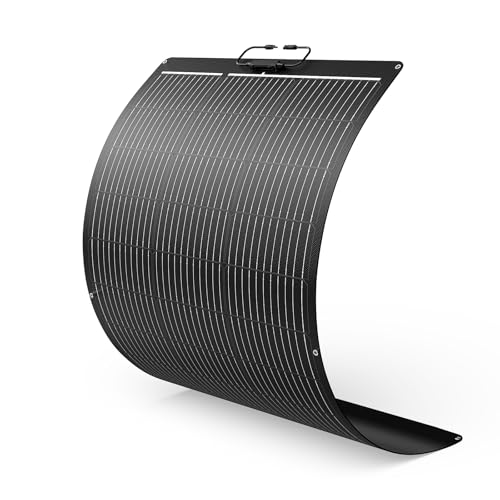
Best for: Solar generators, power stations, and vehicles requiring a slim, aerodynamic panel that hugs curved surfaces. The 240° bendable design is tailored for RVs, 5th wheels, vans, and boats where traditional panels won’t lay flat.
Why selected: The combination of ultra-thin profile and marine-grade resilience makes this panel a practical option for mobile users seeking a low-profile energy source. It plugs into many common solar generator systems with standard connectors, adding straightforward expandability.
Limitations: It’s designed for compatibility with certain power stations; verify connector types and mounting compatibility with your system before buying.
ECO-WORTHY 200W Kit

Best for: Off-grid campers and cabins needing higher daily energy. This kit includes two panels and a 30A PWM charge controller, offering a more complete system for medium-scale power needs while maintaining robust durability.
Why selected: The 200W total output suits higher daytime energy requirements, and the PWM controller provides stable regulation for a variety of 12V batteries. The corrosion-resistant frame and weather rating support long-term outdoor use in diverse climates.
Limitations: PWM controllers are generally less efficient than MPPT controllers in certain conditions; if you anticipate variable sun or higher battery voltage, consider a system with MPPT or plan for efficient charging strategies.
SOLPERK 20W Solar Panel Kit
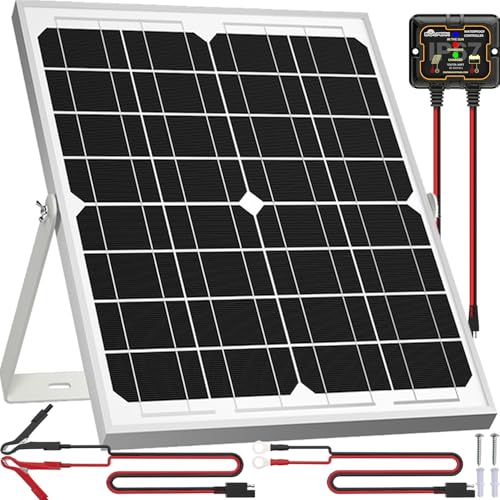
Best for: Maintenance charging for boats, trailers, and small vehicles where a compact, all-in-one kit is desired. The included MPPT controller helps maximize charging efficiency, even with modest panel power output.
Why selected: The combination of a small solar panel with an intelligent MPPT controller offers a practical way to maintain battery charge in portable or limited-space scenarios. The adjustable mounting bracket improves placement flexibility for different roofs or decks.
Limitations: With only 20W, this kit is best for maintaining, not fully charging, larger batteries or high-demand loads. It’s most effective as a supplementary power source rather than a primary energy source in larger setups.
Buying Guide
- Surface compatibility: Rigid roofs favor traditional panels with robust mounting hardware. Curved surfaces benefit from flexible, ultra-thin designs. Marine surfaces require corrosion-resistant materials and sealed laminates.
- Power needs: Calculate daily energy use and peak draw. Higher wattage kits suit RVs and cabins; smaller kits fit trickle charging or backup power.
- Mounting considerations: Look for adjustable clamps, pre-drilled mounting holes, and corrosion-resistant hardware. Ensure sealing against water and wind.
- Controller type: MPPT controllers optimize energy harvest in varied sunlight but can be pricier. PWM controllers are simpler and often adequate for moderate systems.
- Durability: Aluminum frames, tempered glass, and protective coatings (like ETFE) improve outdoor longevity. Check wind and snow load ratings for your climate.
- Expansion potential: If you plan to scale later, choose a kit with standardized connectors and modular components, simplifying future upgrades.
FAQ
- What is flush mount solar panel, and where should I use it? It is a solar panel designed to sit flush with a surface, minimizing protrusions. Ideal for rooftops, RVs, boats, and cabins where a low-profile installation is preferred.
- Do I need a special controller for flush-mount kits? Yes. Most setups include a charge controller; MPPT controllers maximize energy harvest on larger systems, while PWM controllers are sufficient for smaller, steady charging needs.
- Can flexible panels handle high winds? Flexible panels are lighter and can be secured to curved surfaces, but ensure proper mounting to prevent delamination or cracking in extreme wind conditions.
- Is higher wattage always better? Not necessarily. Choose wattage based on daily energy requirements, available roof space, and charging time under typical sunlight. More wattage may be wasted if space is limited or sun exposure is poor.
- Are flush-mount kits suitable for marine use? Look for corrosion-resistant frames and seals. Marine applications demand panels with salt-water resistance and robust mounting hardware to withstand marine weather.
- What maintenance is required? Regular cleaning of dust and salt deposits, inspection of seals and mounting hardware, and monitoring controller indicators help sustain performance.